




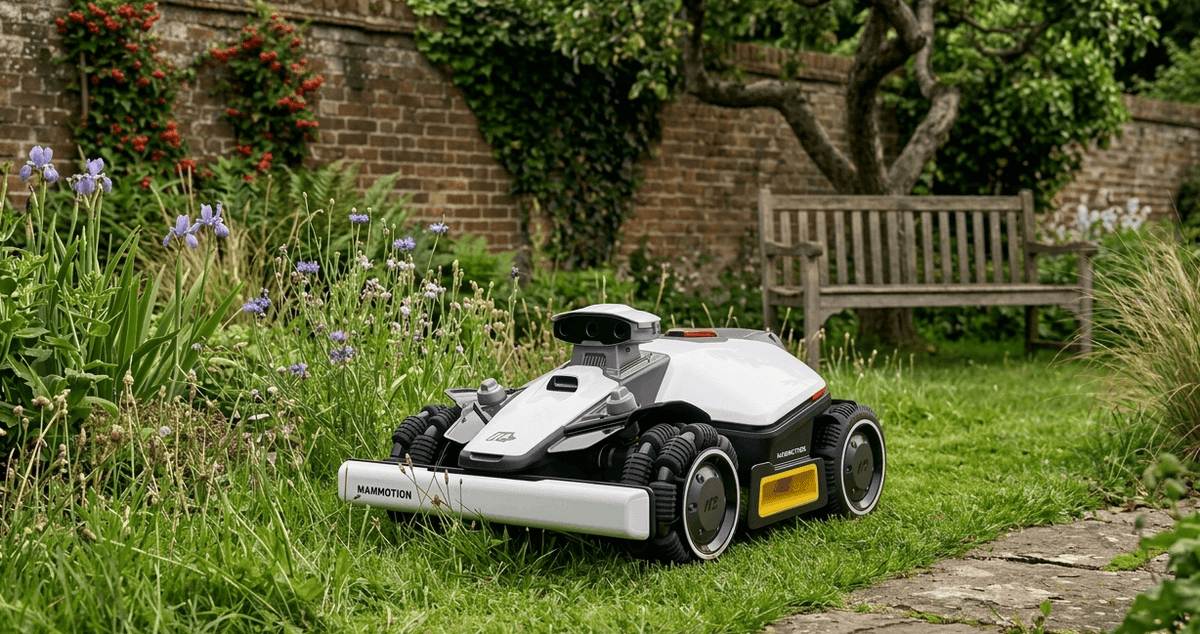
The best robot lawn mower can keep your grass trimmed with less hands-on work, but the right choice depends on more than a mower’s advertised coverage or maximum slope. Yard size, terrain, tree cover, narrow passages, edge-cutting performance, and setup requirements can all affect how well a model works on your property.
Our five picks serve different needs: an all-around option, a mower for steep yards, a model focused on edge trimming, a choice for larger lawns, and a compact option for small to medium yards. We compare their published specifications, navigation systems, pricing, and available independent reviews so you can narrow the field before buying.
No robot mower is completely maintenance-free. You may still need to trim borders, clear obstacles, clean the mower, replace blades, and adjust its schedule as grass growth and weather change. Use this guide to match a mower to your lawn’s actual conditions—not just the largest area or steepest slope listed on the box.
Best Robot Lawn Mower Picks for Different Yards
The best robot lawn mower for your property depends on how much grass you need to maintain, how steep or uneven the terrain is, and how the mower navigates around trees and boundaries. These five models offer different strengths, but their coverage and slope figures are manufacturer ratings rather than guarantees of performance on every lawn.
Compare the 5 Best Robot Lawn Mowers
|
Robot lawn mower |
Best for |
Rated coverage |
Rated slope |
Navigation |
Price basis |
|
Best overall |
0.75 acre |
80% (38.6°) |
LiDAR + NetRTK + AI vision |
$2,799 regular price |
|
|
Dreame A3 AWD Pro 2500 |
Steep yards |
0.62 acre |
80% (38.7°) |
3D LiDAR and AI vision |
$1,699.99 promotional price |
|
ECOVACS GOAT A2000 LiDAR PRO |
Edge trimming |
0.5 acre |
50% (27°) |
Dual LiDAR and AI vision |
$1,999.99 regular price |
|
Segway Navimow X430 |
Large yards |
1 acre |
84% (40°) |
RTK and AI vision |
$2,499 regular price |
|
Small to medium yards |
0.37 acre |
80% (38.6°) |
360° LiDAR and AI vision |
$1,799 regular price |
Prices are the editorial price basis used for this guide, not a guarantee of current checkout prices. Manufacturer coverage and slope ratings should also be verified for the exact model and configuration.
1. Mammotion LUBA 3 AWD 3000 — Best Overall
The LUBA 3 AWD 3000 robot lawn mower is the strongest all-around candidate for homeowners who need broad coverage, all-wheel drive, and multiple navigation systems. Its rated coverage is 0.75 acre, and Mammotion lists a maximum slope of 80% (38.6°). Its combination of 360° LiDAR, NetRTK, and dual-camera AI Vision offers multiple positioning inputs rather than relying on a single method.

Its trade-off is complexity: mapping, connectivity, and turning behavior can affect the experience. Independent testing has reported both strong terrain handling and issues that required software or app improvements. Choose it for a demanding mixed-terrain lawn, not because it is guaranteed to outperform every rival in every condition.
2. Dreame A3 AWD Pro 2500 — Best for Steep Yards
The Dreame A3 AWD Pro 2500 robot lawn mower is worth considering for steep or tree-covered lawns where satellite positioning may be unreliable. It uses OmniSense 3.0 3D vision and four-wheel drive, with a manufacturer-rated slope of 80% (38.7°) and rated coverage of 0.62 acre. Dreame also lists a 15.8-inch dual-blade cutting system.
A steep-slope rating does not guarantee reliable traction on wet grass, loose soil, or sharp transitions. Independent testing has reported occasional sticking and turf disturbance during turns, so inspect the ground conditions as carefully as the advertised incline. The $1,699.99 price in this guide is a promotional price, not a permanent price guarantee.
3. ECOVACS GOAT A2000 LiDAR PRO — Best for Edge Trimming
The GOAT A2000 LiDAR PRO robot lawn mower stands out because it combines a conventional cutting system with a dedicated TruEdge trimmer designed to reduce uncut grass along borders. Its navigation system combines rotating 360° LiDAR, 3D time-of-flight sensing, and an AI camera. ECOVACS lists a 0.5-acre coverage rating and a maximum slope of 50% (27°).
Edge performance still depends on the boundary shape. Tight corners, fence posts, uneven borders, and exposed soil can remain challenging, so do not assume the dedicated trimmer eliminates every manual touch-up. This model is best suited to buyers who value border finishing more than the highest slope rating.
4. Segway Navimow X430 — Best for Large Yards
The Navimow X430 robot lawn mower is the large-yard choice in this lineup, with a rated coverage of 1 acre, four-wheel drive, and a 17-inch dual-disc cutting system. Segway lists a maximum slope of 84% (40°) and combines RTK positioning with 360° AI Vision. Its wide cutting system and navigation package make it a candidate for larger, more complicated lawns.
The trade-offs are price, size, and weight. Network RTK can reduce the need to install a separate antenna where service is available, but buyers should confirm coverage at their property. PCWorld’s review also identifies its large-lawn capability alongside its high price and substantial size.
5. Mammotion LUBA mini 2 AWD 1500 — Best for Small to Medium Yards
The LUBA mini 2 AWD 1500 robot lawn mower is the compact option for homeowners who want wire-free mapping and all-wheel drive without buying a mower rated for a full acre. Its rated coverage is 0.37 acre, and Mammotion lists an 80% (38.6°) maximum slope. The model combines 360° LiDAR with dual-camera AI Vision and has a fixed edge-cutting disc.

Its compact positioning does not make setup or maintenance effortless. Mapping still takes time, and the mower may need help around awkward boundaries or obstacles. Check that the actual grass area—not the total property size—fits within its rated capacity.
For every model, treat rated coverage as a starting point. Trees, narrow passages, separate lawn sections, slopes, and obstacles can reduce how much usable area a mower can maintain efficiently.
Check out more of the best robot lawn mowers: Best Robot Lawn Mower 2026 (Tested & Reviewed for U.S. Lawns)
How to Choose the Best Robot Lawn Mower for Your Yard
The best robot lawn mower is the one that fits your usable grass area, terrain, layout, and budget without forcing you to pay for capacity you do not need. Before comparing advanced features, measure the grass you want maintained and identify the parts of the yard that could interrupt mowing.
|
Your lawn conditions |
What to prioritize |
Why it matters |
|
Small, relatively flat lawn |
Appropriate coverage and simple setup |
Extra off-road capability may add cost without much benefit |
|
Steep or uneven lawn |
AWD, traction design, and slope rating |
A high advertised rating alone does not guarantee grip |
|
Large lawn approaching 0.5–1 acre |
Coverage, cutting width, charging and scheduling |
A mower may need several sessions to maintain the full area |
|
Dense tree cover or buildings |
Navigation that can work when satellite signals are weak |
Positioning conditions can change across the yard |
|
Narrow paths or separate lawn sections |
Minimum passage width, mapping and zone support |
A mower must be able to reach each area reliably |
|
Many borders and garden beds |
Edge-cutting design and boundary control |
Some hand trimming may still be necessary |
Match the mower to usable lawn area
Measure the grass, not the entire lot. A half-acre property may contain a much smaller area of mowable lawn once the house, driveway, patio, planting beds, and other surfaces are excluded. If the grass is split into sections, check whether the mower can navigate the connecting passages or supports separately mapped zones.
Leave room for real-world constraints rather than buying solely to match the maximum advertised area. Slopes, obstacles, and complicated boundaries can make a lawn harder to maintain than an equally sized open rectangle.
Set a realistic budget
Compare the total purchase package, not just the mower’s headline price. Check whether the price includes the charging station, required antenna or accessories, spare blades, and any connectivity service that may eventually require renewal. A discounted model can be attractive, but confirm the sale’s end date and the manufacturer’s warranty and return terms.
Inspect the yard before ordering
Walk the mowing area and note steep sections, soft ground, roots, steps, narrow gates, exposed cables, and areas where the mower could become trapped. Measure the narrowest passage and check the manufacturer’s clearance requirements. If the lawn has several distinct zones or complicated boundaries, look for a mapping demonstration or independent review involving a similar layout.
The right robot lawn mower is the one that can manage your lawn’s hardest sections while covering its full mowable area—not necessarily the model with the highest price or the most features.
Robot Lawn Mower Navigation: RTK, LiDAR, and AI Vision
The best robot lawn mower navigation system depends on satellite visibility, tree cover, lawn boundaries, and the obstacles around your property. RTK helps a mower follow precise virtual boundaries, LiDAR maps nearby surroundings, and AI vision interprets visual details. Hybrid systems combine these approaches, but no single setup works equally well in every yard.
Boundary Wire vs. Wire-Free Navigation
Boundary-wire models use a physical cable to define the mowing area. Wire-free models create virtual boundaries through mapping and navigation technology, avoiding perimeter-wire installation but requiring a suitable setup process.
|
Navigation approach |
Best suited to |
Main limitation |
|
Boundary wire |
Simple lawns, buyers prioritizing established technology, and layouts that do not change often |
Installation takes time, and damaged wires or layout changes can require extra work |
|
RTK-based wire-free navigation |
Open lawns with a clear view of the sky |
Trees, buildings, and rooflines can weaken satellite reception |
|
LiDAR-based navigation |
Shaded or cluttered yards where local mapping is important |
Performance depends on sensor design, mapping quality, and how clearly the mower can identify lawn boundaries |
|
AI vision-based navigation |
Lawns with recognizable edges and obstacles that benefit from camera-based detection |
Lighting, visual contrast, weather, and camera visibility can affect recognition |
|
Hybrid navigation |
Complex yards where multiple sensors can compensate for one another |
Usually costs more, and additional sensors do not eliminate software or traction problems |
RTK vs. LiDAR vs. AI Vision: Which Should You Choose?
RTK (Real-Time Kinematic positioning) uses satellite positioning corrected by reference data to provide highly precise location estimates. It suits large, open lawns where the mower can maintain reliable positioning. A conventional RTK setup may require an antenna installed with a clear view of the sky. Network RTK can reduce or remove the need for an on-site reference antenna, but availability, connectivity, and service terms vary by product and region.
LiDAR (Light Detection and Ranging) measures distances using laser pulses to build a map of nearby surroundings. It can help a mower navigate under tree cover or near buildings where satellite reception is inconsistent. However, LiDAR does not automatically understand every object or distinguish every grass edge correctly; mapping and obstacle-recognition software still matter.
AI vision uses cameras and image-processing software to recognize boundaries, objects, and other visual cues. It can complement positioning systems by helping the mower interpret what is around it. Its performance may be affected by poor lighting, glare, low-contrast edges, tall vegetation, or adverse weather.
Is Hybrid Navigation Worth Paying For?
A hybrid system is worth considering if your yard combines open grass, shaded sections, trees, buildings, and irregular boundaries. For example, the Mammotion LUBA 3 AWD 3000 combines LiDAR, NetRTK, and AI vision, while the Dreame A3 AWD Pro 2500 uses LiDAR-based navigation with AI vision rather than relying on an RTK antenna.
Independent testing by The Verge found that newer navigation systems with fallback sensors improved performance in a tree-filled yard, while also documenting that software and turning behavior could still cause problems. Sensor combinations can improve resilience, but they cannot guarantee perfect boundary recognition, obstacle avoidance, or traction.
Before buying, check the navigation system’s actual requirements: whether it needs an external antenna, whether network correction services are available at your address, how mapping works, and whether the mower supports all your lawn zones. If possible, look for an independent review conducted in an environment similar to your own.
The practical rule is simple: choose RTK for reliable precision in open areas, consider LiDAR where satellite visibility is difficult, and treat AI vision as a useful layer of environmental recognition. For a complex lawn, prioritize a well-tested combination of sensors rather than the number of technologies listed on the box.
Robot Lawn Mower Performance: Slopes, Edges, and Narrow Passages
A robot lawn mower’s real-world performance depends on more than its maximum slope rating or cutting width. Traction, turning behavior, lawn-edge design, passage width, and zone layout all affect how much grass it can cut reliably. Before buying, compare manufacturer specifications with independent tests that include uneven ground, damp grass, obstacles, and connected lawn sections.
Slope Ratings: What Do the Numbers Really Mean?
Slope ratings are usually expressed as a percentage gradient, not degrees. An 80% gradient is approximately 38.7 degrees, while a 50% gradient is about 26.6 degrees. These figures describe steepness, but they do not guarantee that a mower can climb, turn, or stop safely on every surface at that angle.
|
Model |
Manufacturer-rated maximum slope |
What to consider |
|
Mammotion LUBA 3 AWD 3000 |
80% (38.6°) |
AWD supports traction on slopes, but turning behavior and ground conditions still matter |
|
Dreame A3 AWD Pro 2500 |
80% (38.7°) |
AWD is designed for steep terrain; verify performance on damp or loose ground |
|
ECOVACS GOAT A2000 LiDAR PRO |
50% (about 26.6°) |
Better suited to buyers whose slopes fall within its lower published limit |
|
Segway Navimow X430 |
84% (about 40°) |
Its higher rating is useful on steep lawns, but is not a guarantee across every surface |
|
Mammotion LUBA mini 2 AWD 1500 |
80% (38.6°) |
AWD suits challenging smaller yards, though narrow turns and soft ground remain relevant |
Figures are manufacturer specifications, not independent proof that every mower can safely handle the stated gradient in all conditions.
A slope’s shape matters as much as its steepness. A straight, firm incline can be easier to traverse than a shorter slope with an abrupt crest, a sidehill section, or limited turning room. Damp grass and loose soil can reduce traction, while repeated turns may scuff turf even when the mower can climb successfully.
Independent testing that includes sloped and damp grass is therefore more useful than a maximum-gradient claim alone. Consumer NZ, for example, evaluates robot mowers on sloped lawns and damp grass as separate performance conditions.
Edge Cutting: How Much Manual Trimming Will Remain?
No robot lawn mower should be assumed to eliminate all manual edging. The result depends on where the cutting disc sits relative to the mower’s body, whether the model has a dedicated edge-trimming mechanism, and whether the lawn borders a flush surface, a raised bed, a fence, or a wall.
The Dreame A3 AWD Pro 2500 uses EdgeMaster 2.0, which Dreame says can cut to within 1.2 inches of an edge. The ECOVACS GOAT A2000 LiDAR PRO has its own TruEdge trimming system. These features can reduce the amount of grass left along suitable borders, but they do not guarantee a clean finish around every corner, post, or raised edge.
Before buying, check the distance between the cutting mechanism and the mower’s outer body, the types of borders it can follow, and independent observations of missed patches. Expect to use a string trimmer occasionally around tight corners, vertical obstacles, or borders the mower cannot safely approach.
Narrow Passages and Multiple Lawn Zones
A mower must be able to reach every area you expect it to cut. A narrow gate, winding path, or passage between buildings can become a bottleneck even when the total lawn area is within the mower’s rated capacity.
Measure the narrowest part of each connecting route, not just the width of the main lawn. Compare that measurement with the manufacturer’s minimum passage specification, and allow for walls, uneven edges, and turns. A passage that is technically wide enough may still be difficult if the mower must make a sharp turn immediately before entering it.
For properties with separate grass areas, check whether the mower supports multiple mapped zones and how it travels between them. Some layouts may require a dedicated connecting route or manual relocation between zones. Confirm these details in the manual before purchase rather than assuming that a large coverage rating means every disconnected section can be reached automatically.
The most useful performance checklist is straightforward: verify the slope and surface conditions, inspect edge-cutting limitations, measure the narrowest passage, and confirm how the mower handles each lawn zone. These checks are more reliable than choosing a model from its maximum slope rating alone.
Robot Lawn Mower Costs, Maintenance, and Safety
The cost of owning a robot lawn mower goes beyond its purchase price. Replacement blades, routine cleaning, setup, battery care, occasional manual edging, and warranty coverage all affect long-term value. Maintenance needs vary by model and usage, so check the manufacturer’s manual before estimating annual costs or deciding how much work the mower will save.
What Ongoing Costs Should You Expect?
|
Cost or task |
What to check before buying |
|
Replacement blades |
Price, availability, replacement instructions, and recommended service interval |
|
Battery replacement |
Warranty coverage, replacement availability, and whether service requires a dealer |
|
Setup and installation |
Whether mapping, antenna placement, boundary-wire installation, or professional setup adds cost |
|
Cleaning and upkeep |
Access to the underside, wheel cleaning, sensor care, and charging-contact maintenance |
|
Manual edging |
Whether borders, corners, and obstacles will still need a string trimmer |
|
Repairs and warranty |
Warranty duration, exclusions, local service options, and replacement-part availability |
Avoid relying on a generic annual ownership-cost estimate unless it is based on the exact model and clearly stated assumptions. Blade life depends on mowing hours, grass conditions, and contact with debris. Battery life and replacement costs also vary, so confirm current parts pricing and warranty terms before purchase.
How Much Maintenance Does a Robot Lawn Mower Need?
Plan to inspect the mower regularly and remove grass buildup from the cutting area, wheels, and sensors as directed by its manual. Check the blades for wear or damage, keep charging contacts clean, and install firmware updates when recommended. Wet grass can stick to the underside and cutting components, increasing cleaning needs.
Always switch the mower off before cleaning or handling the blades, and wear suitable protective gloves. Do not assume every model can be rinsed with a hose or pressure washer; water-resistance ratings and permitted cleaning methods differ.
Are Robot Lawn Mowers Safe Around Children and Pets?
Robot lawn mowers have safety features, but their exposed or accessible cutting mechanisms can still cause injury. Schedule mowing when children and pets are away from the active lawn area, keep them from touching or climbing on the mower, and follow the manufacturer’s operating and supervision guidance.
Before each mowing session, remove toys, sticks, cables, and other objects that could interfere with cutting or movement. Do not assume AI vision will detect every small animal or object in every condition. If wildlife is active in your yard, avoid scheduling the mower when animals are most likely to be present.
Finally, confirm the warranty, local repair support, and availability of replacement blades and batteries before committing to a model. A mower that fits your yard but is difficult to service may be less convenient over time than one with readily available parts and clear maintenance instructions.
Best Robot Lawn Mower FAQs
1. Are Robot Lawn Mowers Worth It?
A robot lawn mower can save time if you want regular lawn maintenance without pushing a mower every week. However, setup, occasional troubleshooting, manual edging, and maintenance remain part of ownership. It is most useful when your lawn layout and grass conditions suit the model.
2. Can a Robot Lawn Mower Cut Wet Grass or Run in the Rain?
It depends on the model. Weather resistance does not automatically mean a mower is approved to cut wet grass. Many manufacturers recommend dry mowing conditions or use rain sensors to pause operation. Check the manual, and avoid mowing when wet conditions could reduce traction or damage your lawn.
3. Do Robot Lawn Mowers Collect Grass Clippings?
Most robot lawn mowers are designed to mulch grass rather than collect it in a bag. They cut small amounts frequently, leaving fine clippings on the lawn. This works best when the grass is maintained regularly; long or wet grass can produce clumps and may require a conventional mowing session first.
4. Does a Robot Lawn Mower Need Wi-Fi to Work?
Wi-Fi requirements vary by model. Some mowers rely on an app for setup, mapping, scheduling, or remote control, while positioning and connectivity features may use separate technologies or cellular services. Before buying, check whether the mower can follow saved schedules without an active internet connection and which features become unavailable offline.
5. How Often Should a Robot Lawn Mower Run?
There is no universal schedule. Run time and frequency depend on grass growth, season, desired lawn height, weather, and the mower’s capacity. Frequent, shorter mowing sessions usually help maintain a consistent lawn, but follow the manufacturer’s guidance and adjust the schedule when growth slows or conditions become unsuitable.

Did you like this article? Add us as a preferred source to find us more easily on Google.