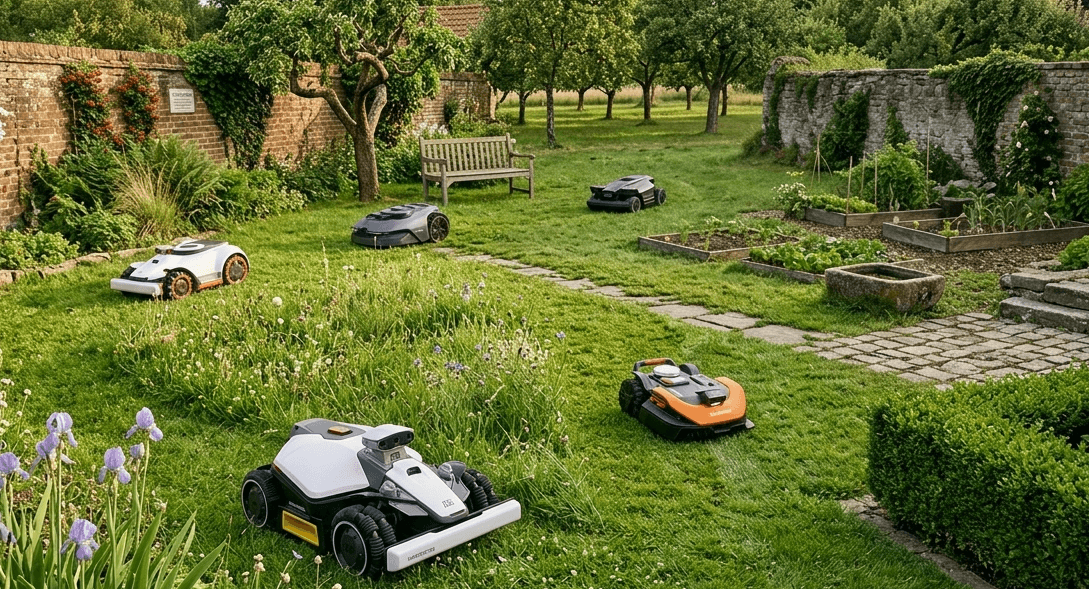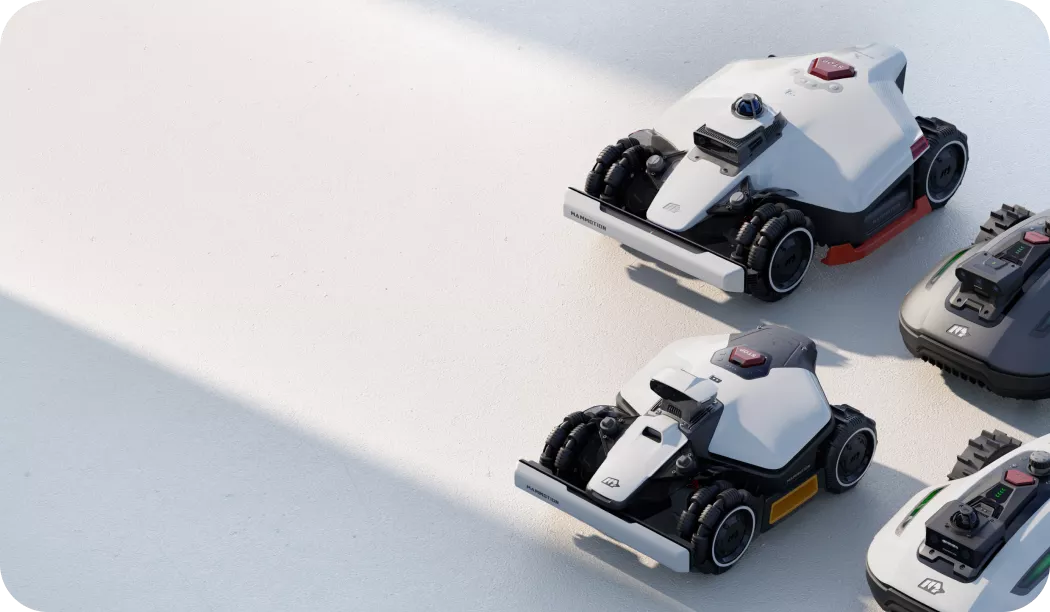


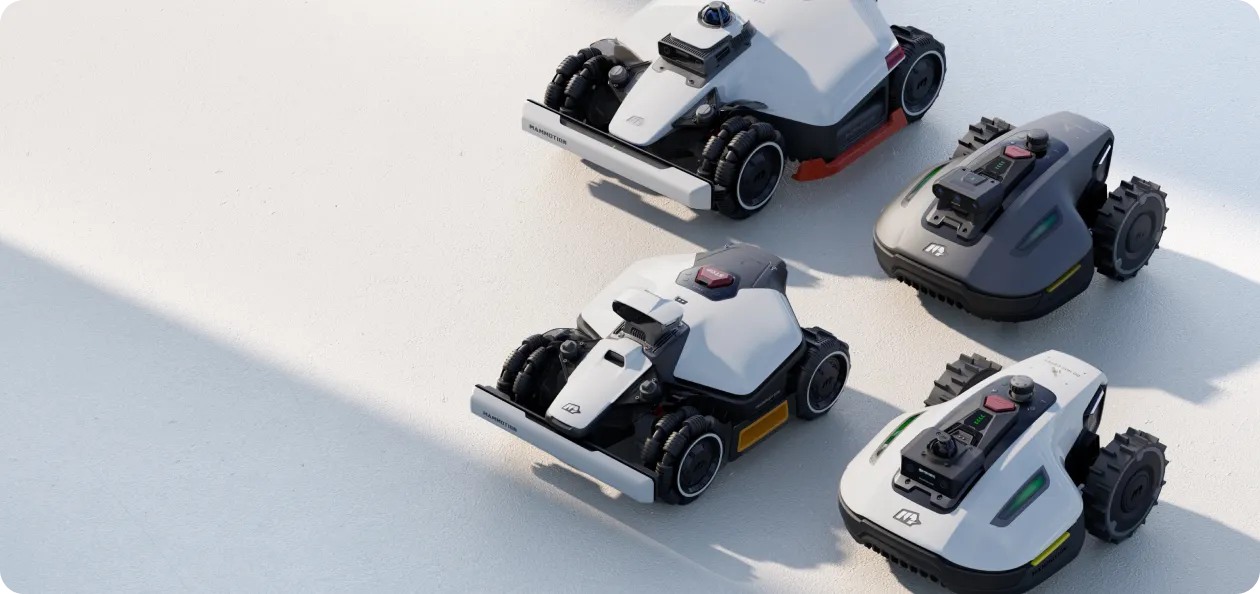

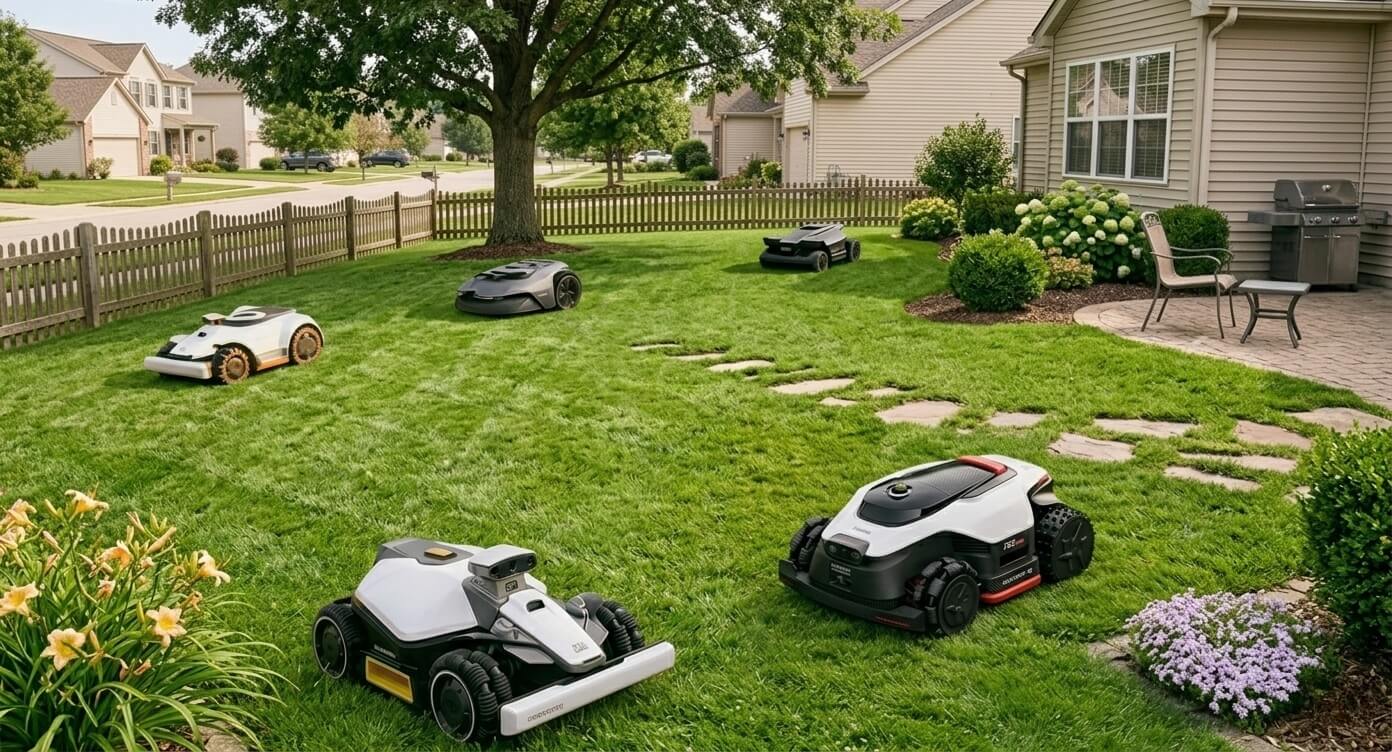
Finding the best robot lawn mower without perimeter wire has become much easier in 2026, thanks to rapid advancements in smart navigation technologies. Unlike traditional robot mowers that require you to install a physical boundary wire around your yard, the latest models use RTK GPS, LiDAR, and AI-powered vision systems to map and maintain your lawn with impressive precision.
For homeowners, this means no more time-consuming wire installation or digging. Instead, you can simply set up virtual boundaries through an app, customize mowing zones, and let the robot handle the rest. These wireless robot lawn mowers are not only easier to install, but also smarter—offering better obstacle avoidance, more efficient mowing patterns, and improved performance in complex yards with trees, slopes, or narrow passages.
In this 2026 test and review, we compare some of the most popular robot lawn mowers without perimeter wire currently available in the U.S. market. Our selection includes powerful models designed for large properties, as well as compact options ideal for smaller lawns.
We evaluated each mower based on key factors such as navigation technology, maximum coverage area, slope capability, smart features, and overall value—so you can easily find the right wireless lawn mower for your needs.
Best Robot Lawn Mowers Without Perimeter Wire 2026 (Top Picks)
Wireless robot lawn mowers are evolving rapidly, with new models combining RTK GPS, LiDAR, and AI vision to deliver precise, cable-free lawn care. Based on our 2026 test and comparison, here are the best robot lawn mowers without perimeter wire you can buy right now.
Best Overall: Mammotion LUBA 3 AWD 5000
The Mammotion LUBA 3 AWD 5000 stands out as one of the most powerful and advanced wireless robot lawn mowers on the market. It features a unique Tri-Fusion navigation system that combines RTK positioning, 360° LiDAR, and AI vision for highly accurate mapping and navigation—even in complex yards.
With its all-wheel-drive (AWD) system, it can handle slopes up to 80%, making it ideal for large, uneven, or challenging terrains. Its wide cutting deck and long battery life also make it a top choice for homeowners with expansive lawns.
- Best for: Large yards, complex landscapes, steep slopes
- Why we recommend it: Industry-leading navigation + unmatched terrain capability
- Not ideal for: Small lawns or budget buyers
Best for Large Yards: Dreame A3 AWD Pro 3500
The Dreame A3 AWD Pro 3500 is designed for homeowners who need a powerful mower for medium to large lawns. It uses the OmniSense™ 3.0 system, combining 360° 3D LiDAR with AI vision for reliable mapping and obstacle detection.
Thanks to its AWD hub motors, it can also tackle slopes up to 80%, making it a strong performer in more demanding environments. The wide cutting width helps improve efficiency across larger areas.
- Best for: Medium-to-large lawns, users needing strong performance
- Why we recommend it: Great balance of power, navigation, and coverage
- Not ideal for: Small yards or simple layouts
Best for Medium Lawns: MOVA LIDAX Ultra 2000
The MOVA LIDAX Ultra 2000 is a well-balanced option for homeowners with medium-sized lawns. It combines LiDAR-based navigation and AI vision to automatically map your yard and maintain efficient mowing patterns without the need for a boundary wire.
With coverage up to around 2000 m² (≈ 21,500 sq ft), it offers a solid mix of performance and ease of use. The app-based setup makes it especially appealing for users who want a simple, cable-free installation.
- Best for: Medium-sized lawns, easy setup
- Why we recommend it: Strong navigation with user-friendly setup
- Not ideal for: Very large or steep properties
Best LiDAR Navigation Option: Segway Navimow i215 LiDAR
The Navimow i215 LiDAR offers a powerful solution for small to medium lawns. It can identify over 200 types of obstacles, including toys, furniture, and pets, ensuring safe and efficient operation.
Its GeoSketch™ mapping system allows users to create detailed virtual maps and define mowing zones directly in the app. While it’s not designed for extreme slopes, it performs exceptionally well in flat to moderately uneven yards.
- Best for: Medium lawns, obstacle-rich environments
- Why we recommend it: Excellent object detection and mapping accuracy
- Not ideal for: Steep or highly uneven terrain
Best Compact with AWD: Mammotion LUBA mini 2 AWD 1500
The LUBA mini 2 AWD 1500 focuses on precision through advanced 360 LiDAR navigation combined with AI vision (dual-camera). Despite its size, it includes AWD capability, which is rare in this category, allowing it to handle uneven ground more effectively than many competitors.
It also supports advanced navigation and app-based zone management, making it a great choice for homeowners who want premium features in a smaller package.
- Best for: Small to medium yards, uneven terrain
- Why we recommend it: Compact size with strong terrain capability
- Not ideal for: Large properties
Comparison Table: Best Robot Lawn Mowers Without Perimeter Wire 2026
To quickly identify the key differences, the table below provides a direct comparison of the main technical specifications of the 5 models we selected for our 2026 review of boundary-free robotic lawn mowers.
|
Feature / Model |
Dreame A3 AWD Pro 3500 |
MOVA LIDAX Ultra 2000 |
Segway Navimow i215 LiDAR |
||
|
Max Lawn Area |
1.25 acres |
0.87 acre |
0.5 acre |
0.37 acre |
0.37 acre |
|
Navigation |
Tri-Fusion (RTK + 360° LiDAR + AI Vision) |
OmniSense™ 3.0 (360° LiDAR + AI Vision) |
360° LiDAR + AI Vision |
LiDAR + Dual Vision AI |
360 LiDAR + Vision (dual-camera) |
|
Boundary Wire Required? |
No |
No |
No |
No |
No |
|
Max Slope |
80% |
80% |
45% |
45% |
80% |
|
Cutting Width |
15.7 in |
15.7 in |
7.9 in |
8.7 in |
Main Disc: 7.8 in Edge Disc: 4.7 in |
|
Cutting Height |
S: 1-2.7 in H: 2.2-4 in |
1.18 - 3.94 in |
1.2 –3.9 in |
0.79 - 2.76 in |
S: 0.8-2.6 in H: 2.2-4.0 in |
|
Battery Capacity |
15 Ah |
7.5 Ah |
5 Ah |
7.65 Ah |
6.1 Ah |
|
Run Time per Charge |
215 min |
180 min |
70–90 min |
160 min |
150 min |
|
Obstacle Detection |
LiDAR + AI Vision |
360° LiDAR + AI Vision |
360° LiDAR + AI Vision |
VisionFence™ |
LiDAR + AI Vision + Sensors |
|
App Control |
Yes |
Yes |
Yes |
Yes |
Yes |
|
Waterproof Rating |
IPX6 |
IPX6 |
IPX6 |
IP66 |
IPX6 |
|
Anti-Theft Features |
GPS Tracking App Alerts AirTag Compatible |
Link Services Lift Alerts AirTag Compatibility |
Link Services (Optional) Lift Alerts AirTag Compatibility |
GPS Tracking Alarm Proximity Unlock PIN Code |
GPS Tracking App Alerts AirTag Compatible |
|
Key Features |
Tri-Fusion Navigation Triple Security Privacy-First Yard Monitoring Intelligent Battery Management Smart Home Integration |
EdgeMaster™ 2.0 OmniSense™ 3.0 Real-time Video Surveillance |
UltraView™ 2.0 TrueGuard™ Dual Mowing Schedules |
GeoSketch™ map VisionFence™️ Smart home integration |
Drop&Mow Mode Smart Cliff Shield Privacy-First Yard Monitoring Intelligent Battery Management |
The table already highlights the key differences between the models. In the next section, we’ll take a closer look at each of the cordless robotic mowers from our 2026 test and explain their strengths and unique features.
Best Cordless Robotic Lawn Mowers of 2026 in Detail
In the following section, we take a closer look at the individual models from our 2026 cordless robotic lawn mower test and highlight their key features, technologies, and recommended uses.
1. Best Overall Cordless Robot Mower: Mammotion LUBA 3 AWD 5000

The Mammotion LUBA 3 AWD 5000 stands out as one of the most powerful robot lawn mowers without perimeter wire for 2026. It’s designed for large and complex lawns, capable of handling up to 1.25 acres with precision.
Key Features:
- Tri-Fusion Navigation: Combines RTK GPS, 360° LiDAR, and AI Vision for ultra-precise mapping.
- All-Wheel Drive (AWD): Conquers slopes up to 80%, perfect for hilly or uneven lawns.
- Wide Cutting Width: At 40 cm (~16 in), it covers large areas efficiently.
- Smart Battery Management: Allows users to set charging limits and optimize energy usage.
- App-Controlled Zones: Easily set mowing zones, schedules, and virtual boundaries without a perimeter wire.
Pros |
Cons |
|
|
Bottom Line: If you’re looking for the best robot lawn mower without perimeter wire in 2026 for large, challenging yards, the Mammotion LUBA 3 AWD 5000 is a top-tier choice. Its multi-sensor navigation ensures precision even in complex garden layouts.
In addition, it is the only robotic lawn mower to have won the SEAL Sustainable Product Award 2026, so if you care about the environment, it’s an excellent choice.
2. Powerful All-Rounder: Dreame A3 AWD Pro 3500

The Dreame A3 AWD Pro 3500 is a powerful cordless robotic lawn mower designed for larger gardens. The model is designed for lawns up to 3,500 m² and uses the OmniSense™ 3.0 navigation system, which combines 360° 3D LiDAR and binocular AI vision. This allows the robot to automatically map the garden and reliably detect obstacles.
Key Features:
- OmniSense™ 3.0 Navigation: 360° LiDAR + AI Vision for automated lawn mapping
- AWD with Hub Motors: Handles slopes up to 80% with ease
- 40 cm Cutting Width: Covers larger areas efficiently
- Multi-Zone App Control: Schedule mowing zones and monitor the mower remotely
Pros |
Cons |
|
|
Bottom Line: The Dreame A3 AWD Pro 3500 is an excellent choice for those seeking a high-performance, no-perimeter-wire robot mower for medium to large lawns.
3. Best Option for Medium Lawns: MOVA LIDAX Ultra 2000
The MOVA LIDAX Ultra 2000 is ideal for medium-sized lawns up to 0.5 acre. This compact mower combines modern navigation with easy setup and digital lawn mapping.
Key Features:
- 360° LiDAR + AI Vision for precise mowing
- No Perimeter Wire Needed: Fully wireless setup via app
- App-Controlled Zones & Schedules
- Efficient for Medium Lawns: Smaller footprint for precise maneuvering
Pros |
Cons |
|
|
Bottom Line: For homeowners with medium lawns, the MOVA LIDAX Ultra 2000 is a convenient, wireless mower offering modern navigation and flexibility.
4. Next-Gen LiDAR: Segway Navimow i215 LiDAR

The Segway Navimow i215 LiDAR is perfect for small to medium lawns up to 0.37 acre. Its advanced LiDAR and dual-vision AI system map the lawn with precision, detecting over 200 types of obstacles.
Key Features:
- LiDAR + Dual Vision AI for accurate mapping
- GeoSketch™ Mapping: 3D digital lawn mapping in the app
- No Perimeter Wire Required
- Slope Handling: Up to 45%, suitable for mostly flat to slightly hilly lawns
Pros |
Cons |
|
|
Bottom Line: The Navimow i215 LiDAR is a solid option for medium lawns where precision and obstacle detection matter. Its wireless setup makes it a convenient choice for homeowners.
5. Compact Yet Capable: Mammotion LUBA mini 2 AWD 1500

The Mammotion LUBA mini 2 AWD 1500 is perfect for small to medium lawns up to 0.37 acre. Despite its compact size, it features AWD and AI navigation.
Key Features:
- 360 LiDAR + Vision (dual-camera) Navigation
- All-Wheel Drive handles slopes up to 80%
- App-Controlled Zones & Schedules
- Compact Design: Ideal for smaller or intricate gardens
- Fixed 4.7 in Edge Cutting Disc
Pros |
Cons |
|
|
Bottom Line: The LUBA mini 2 AWD 1500 is a great compact option for complex and small-to-medium lawns that still need advanced navigation and slope handling without a perimeter wire.
How a Robot Lawn Mower Without Perimeter Wire Works?
Traditional robot lawn mowers often require a perimeter wire installed around your lawn to define their working area. This wire acts as a physical boundary, preventing the mower from crossing into flower beds, pathways, or neighboring properties. While effective, installation can be time-consuming and inflexible.
Modern robot lawn mowers without perimeter wire operate completely differently, using advanced digital navigation systems to map and maintain your lawn with precision. These mowers rely on a combination of sensors, cameras, and satellite positioning rather than physical wires.
Key Technologies Behind Wireless Robot Mowers
1. RTK GPS Navigation
Premium models often use Real-Time Kinematic (RTK) GPS, which provides centimeter-level positioning. Some mowers come with a small RTK base station that transmits correction signals, allowing the robot to create an accurate digital map of your lawn. However, many manufacturers have now upgraded to NetRTK, which means RTK base stations are no longer required.
Benefits: Extremely precise navigation, ideal for large lawns, virtual boundaries without wiring.
Limitations: Signal accuracy may be affected by tall trees, buildings, or other obstructions.
2. LiDAR Navigation
LiDAR-equipped mowers scan the environment using laser pulses to generate a 3D map of your yard. This allows the robot to:
- Detect obstacles early, like toys, furniture, or pets
- Maintain accurate positioning even in low light
- Navigate efficiently through complex garden layouts
3. AI Vision Navigation
Some models use cameras with AI-powered vision to differentiate between grass, flower beds, pathways, and obstacles. This enables the mower to:
- Recognize and avoid toys, garden furniture, and pets
- Identify lawn edges for precise mowing
- Operate without physical boundaries in structured gardens
4. Multi-Sensor Fusion
Many modern best robot lawn mowers without perimeter wire 2026 combine multiple technologies, such as RTK GPS + AI Vision or LiDAR + AI Vision. By fusing sensor data, these mowers maintain accuracy even if one system is temporarily compromised. Mammotion, for example, offers Tri-Fusion Navigation, combining RTK, LiDAR, and AI Vision for ±1 cm precision — unmatched in the current market.
Why Wireless Robot Mowers Are a Game-Changer
- No Physical Wire Installation: Save hours of setup time. Boundaries are defined digitally via smartphone apps.
- Flexible Lawn Zones: Easily adjust mowing areas, no-go zones, or schedules without rewiring.
- Precise Navigation: Multi-sensor systems create consistent mowing patterns, even in complex gardens.
- Future-Proof Technology: Continuous software updates, improved obstacle detection, and smart home integration keep your mower cutting-edge.
Takeaway: The best robot lawn mower without perimeter wire 2026 combines advanced navigation technology and user-friendly app controls to deliver a fully wireless, precise, and efficient mowing experience. These systems are ideal for lawns with multiple zones, obstacles, or uneven terrain, offering convenience and superior lawn care compared to traditional perimeter-wire mowers.
Advantages & Disadvantages of Robot Lawn Mowers Without Perimeter Wire
Modern robot lawn mowers without perimeter wire offer significant advantages over traditional models, but there are some factors to consider before investing. Understanding these pros and cons will help you choose the best robot lawn mower without perimeter wire 2026 for your garden.
Advantages
1. Easy Installation
No need to lay cables around your lawn. Most wireless mowers use apps to digitally define mowing zones, saving hours of labor and allowing quick adjustments if your garden layout changes.
2. Flexible Zone Management
Create multiple mowing areas, designate no-go zones (like flower beds or pools), and schedule mowing times from your smartphone. Virtual zones can be modified instantly without rewiring.
3. Precise Navigation
Advanced sensors, LiDAR, AI Vision, and RTK GPS ensure consistent, efficient mowing. These mowers can handle complex layouts, avoid obstacles, and maintain perfect lines across large or irregular lawns.
4. Suitable for Complex Gardens
Wireless mowers excel in gardens with multiple levels, narrow passages, or many obstacles. All-wheel drive (AWD) models can handle slopes and uneven terrain better than most traditional mowers.
5. Future-Proof Technology
Manufacturers continuously release software updates, improving navigation, obstacle detection, and smart home integration. This keeps your mower up-to-date with minimal effort.
Disadvantages
1. Higher Upfront Cost
Wireless models with RTK, LiDAR, or AI Vision tend to cost more than perimeter-wire mowers. For small lawns, simpler wired models may offer better value.
2. Dependence on Sensors and Satellites
Accuracy relies on RTK signals or clear camera/LiDAR readings. Dense trees, buildings, or irregularly shaped lawns may temporarily reduce precision.
3. Limited Terrain Compatibility for Some Models
Not all wireless mowers can handle steep slopes or rough terrain. Smaller models with narrow cutting widths may take longer to mow larger lawns.
4. Battery & Charging Considerations
Mowers are fully battery-powered. Large lawns require models with high-capacity batteries or efficient charging routines. For example, the Mammotion LUBA 3 AWD 5000 can run up to 215 minutes on a single charge, making it suitable for very large properties.
5. Maintenance and Updates
Advanced systems require occasional firmware updates and sensor checks. Regular app monitoring ensures optimal navigation and obstacle detection.
Takeaway: While robot lawn mowers without perimeter wire come at a higher cost, they offer unmatched convenience, flexibility, and precision, especially for medium to large lawns or complex garden layouts. By weighing the advantages and disadvantages, you can select the best robot lawn mower without perimeter wire 2026 that meets your specific garden needs.
Conclusion: Which Wireless Robot Lawn Mower Is Best in 2026?
Robot lawn mowers without perimeter wire have quickly evolved into one of the most convenient and advanced solutions for modern lawn care. Thanks to technologies like RTK GPS, LiDAR, and AI vision, these machines can map your yard, avoid obstacles, and mow with precision—without the need for time-consuming wire installation.
So, which is the best robot lawn mower without perimeter wire 2026?
The answer ultimately depends on your lawn size, terrain, and specific needs:
- For large and complex yards: High-performance models like the Mammotion LUBA 3 AWD 5000 offer powerful navigation and excellent slope handling.
- For medium to large lawns: The Dreame A3 AWD Pro 3500 provides a strong balance of performance and coverage.
- For medium-sized lawns: The MOVA LIDAX Ultra 2000 delivers easy setup and reliable wireless navigation.
- For precision and obstacle detection: The Segway Navimow i215 LiDAR is a solid choice for structured environments.
- For medium and uneven lawns: Compact options like the LUBA mini 2 AWD 1500 still offer advanced features in a smaller footprint.
Overall, today’s wireless robot mowers are no longer just a niche innovation—they’re becoming the new standard in lawn care, offering flexibility, efficiency, and a significantly better user experience compared to traditional wired models.
Final Verdict: If you want maximum convenience, minimal installation, and smarter lawn maintenance, investing in a robot lawn mower without a perimeter wire is absolutely worth it in 2026.