


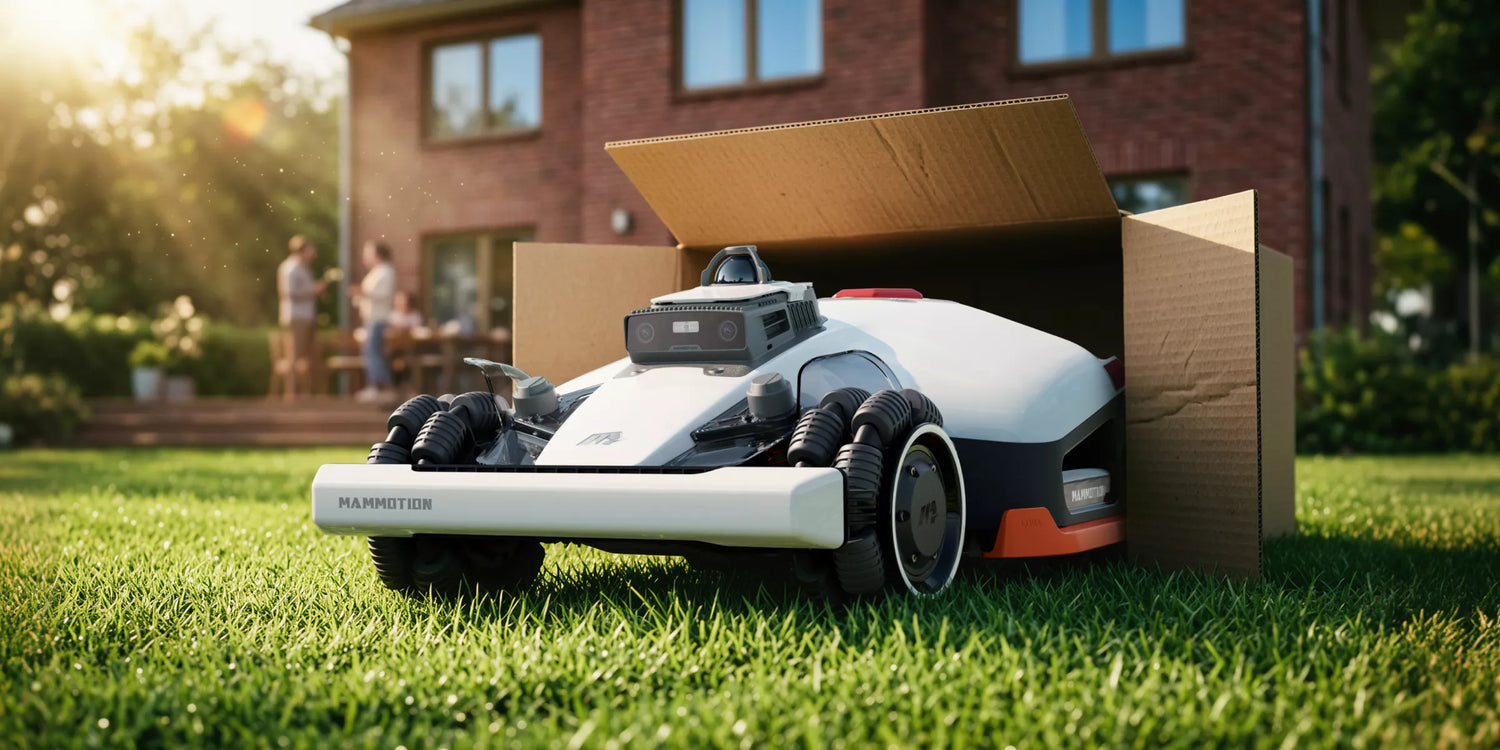
Robot lawn mowers in 2026 are no longer defined solely by wire-free mowing.
Today’s leading systems combine RTK positioning, AI vision, LiDAR, and multi-sensor fusion to improve navigation reliability across different lawn environments.
The biggest difference between modern robot mowers is no longer automation itself — it’s how consistently they perform on real-world properties with slopes, trees, narrow passages, and complex layouts.
To identify the best robot lawn mowers of 2026, we compared navigation reliability, obstacle handling, slope capability, ownership experience, and long-term usability across different lawn types.
Best Robot Lawn Mowers at a Glance
Before diving into detailed comparisons, here’s a quick overview of the robot lawn mowers that stood out most across different lawn types, navigation systems, and ownership needs in 2026.
|
Category |
Product |
Navigation System |
Best For |
|
Best Overall for Complex Lawns |
NetRTK + AI Vision + LiDAR |
Large, steep, and multi-zone properties |
|
|
Advanced LiDAR Navigation |
MOVA LiDAX Ultra 1000 |
LiDAR + AI Vision |
Shaded lawns and RTK-free navigation |
|
Best Vision-Only Robot Mower |
Eufy E18 |
AI Vision |
Small lawns with simple layouts |
|
Best RTK + Vision Balance |
Navimow X430 |
RTK + 360° AI Vision |
Medium suburban lawns |
|
Best AWD Alternative |
Dreame A3 AWD 1000 |
LiDAR + AI Vision |
Sloped lawns and edge cutting |
How We Evaluated These Robot Lawn Mowers
Robot lawn mowers in 2026 are no longer competing solely on mowing performance. Navigation consistency, terrain adaptability, software reliability, and long-term ownership experience now play a much larger role in real-world usability.
To compare these robotic mowers fairly, we focused on the factors that matter most across actual U.S. lawn conditions rather than relying only on manufacturer specifications.
1. Navigation Reliability
Modern robot mowers now use very different localization technologies, ranging from vision-only systems to RTK, LiDAR, and hybrid sensor fusion platforms.
We evaluated:
- positioning consistency
- signal recovery behavior
- narrow passage navigation
- obstacle rerouting
- performance near trees and fences
- navigation stability during temporary signal degradation
2. Real-World Lawn Performance
A mower that works well on a flat open yard may perform very differently on more demanding properties.
We considered how each mower handled:
- steep slopes
- uneven terrain
- multi-zone layouts
- side-yard transitions
- irregular lawn edges
- shaded areas and partial canopy coverage
3. Obstacle Avoidance & Safety
AI-assisted obstacle detection has improved significantly in recent years, but real-world performance still varies widely between systems.
We evaluated how effectively each mower recognized and navigated around:
- garden tools
- toys
- tree roots
- outdoor furniture
- pets and unexpected obstacles
4. Ownership Experience
In 2026, software quality is just as important as hardware capability.
We looked at:
- app usability
- mapping workflow
- OTA update experience
- docking consistency
- setup complexity
- zone management
- long-term maintenance expectations
5. Terrain Capability
Not all robot mowers are designed for aggressive terrain.
To better understand real-world traction performance, we compared:
- wheel grip on slopes
- hill transition stability
- AWD effectiveness
- wet grass traction
- recovery from wheel slip and uneven surfaces
This broader evaluation approach matters because the best robot lawn mower for a small flat suburban yard may be completely different from the best option for a steep, tree-covered multi-zone property.
Best Robot Lawn Mowers of 2026
1. Mammotion LUBA 3 AWD 3000 - Best Overall for Complex Lawns
The LUBA 3 AWD 3000 is one of the most advanced autonomous lawn systems currently available, combining NetRTK, AI vision, and LiDAR into a tri-fusion navigation platform designed for demanding residential properties.
While many robot mowers in 2026 still rely heavily on a single positioning method, the LUBA 3 focuses on navigation redundancy and terrain adaptability. That makes it particularly well-suited for large multi-zone lawns, steep terrain, and environments where signal conditions may vary throughout the property.
Key Specs
|
Feature |
Details |
|
Navigation System |
Tri-Fusion (NetRTK + AI Vision + LiDAR) |
|
Drive System |
AWD |
|
Max Lawn Coverage |
3000㎡ |
|
Slope Capability |
Up to 80% |
|
Multi-Zone Support |
Yes |
|
Boundary Wire Required |
No |
Why It Stands Out in 2026
The biggest shift in premium robot lawn mowers this year is the move toward multi-sensor fusion systems, and the LUBA 3 AWD is currently one of the clearest examples of that transition.
Instead of depending entirely on satellite positioning, the mower combines:
- NetRTK for global positioning
- AI vision for semantic obstacle recognition
- LiDAR for environmental perception and positioning resilience
This hybrid approach helps improve route continuity when satellite visibility becomes temporarily inconsistent near trees, fences, or narrow side-yard transitions.
The AWD platform also gives the LUBA 3 a meaningful advantage on steep or uneven terrain where many dual-wheel mowers begin struggling with traction and route consistency.
LUBA 3 AWD has also won the SEAL Sustainable Product Award 2026, making it an excellent choice for eco-conscious consumers.
|
Best For |
Not Ideal For |
|
|
Real-World Performance
On complex lawns with elevation transitions, irregular edges, and narrow side-yard passages, the LUBA 3 AWD maintains more stable route continuity than most RTK-only systems.
The combination of LiDAR and AI-assisted navigation helps reduce some of the temporary positioning instability that can affect satellite-dependent mowers under partial canopy coverage. While no RTK-based platform is completely immune to signal challenges, the tri-fusion system improves recovery consistency during degraded positioning scenarios.
The AWD system is especially noticeable during hill transitions and wet-grass traction conditions, where wheel slip can significantly affect mowing efficiency on lower-traction competitors.

2. MOVA LiDAX Ultra 1000 - Advanced LiDAR + Vision Navigation
LiDAR + AI vision robot mower designed for wire-free setup, shaded lawns, and multi-zone mapping up to ~0.25 acre.
The MOVA LiDAX Ultra 1000 represents a different direction in the 2026 robot mower landscape — one that prioritizes LiDAR-based spatial mapping combined with AI vision, instead of relying on satellite-based RTK positioning.
This approach is especially relevant for homeowners with heavily shaded lawns, tree coverage, or environments where GPS-based systems can occasionally lose consistency. According to product specifications, the system builds a real-time 3D map of the lawn using LiDAR and vision sensors, allowing it to operate without boundary wires or an RTK base station.
Why It Stands Out in 2026
The key difference with the LiDAX Ultra series is its RTK-free navigation philosophy.
Instead of depending on external positioning infrastructure, it uses:
- 360° 3D LiDAR for spatial mapping
- AI vision for object recognition and semantic understanding
- Real-time environmental reconstruction for navigation
This makes it particularly strong in environments where traditional RTK systems may face challenges such as signal obstruction under dense trees or complex backyard layouts.
It also supports multi-zone mapping and can manage separate lawn areas within a single system, which is increasingly important for suburban properties with front/back yard separation.
|
Best For |
Not Ideal For |
|
|
Real-World Performance
In real-world usage scenarios, LiDAR + vision systems tend to excel in consistent short-range navigation and obstacle detection, particularly in environments with visual structure such as fences, garden beds, and trees.
However, compared to RTK-based or fusion systems, performance can vary more in:
- large open lawns requiring long-range positioning stability
- highly complex terrain with steep elevation changes
- extended runtime routing across wide properties
On the positive side, LiDAR-based mapping provides strong local spatial awareness, which helps the mower maintain accurate positioning even when GPS signals are unreliable or unavailable.
3. Eufy E18 - Best Vision-Only Robot Mower for Small Lawns
Vision-only AI robot mower designed for small lawns with no RTK or boundary wire setup required.
The Eufy E18 represents one of the most mature versions of the vision-only robot mower category, a segment that has grown quickly in 2026 as manufacturers aim to reduce installation complexity for smaller suburban lawns.
Unlike RTK or LiDAR-based systems, the E18 relies entirely on AI camera-based navigation and visual mapping, meaning it does not require satellite positioning, external antennas, or boundary wire installation. This makes it one of the simplest robot mower setups currently available, especially for first-time users.
Why It Stands Out in 2026
The key value of the Eufy E18 is not maximum performance — it is minimal friction ownership.
It is designed around a very different philosophy from high-end fusion systems like LUBA 3 AWD:
- no RTK setup
- no LiDAR calibration
- no external infrastructure
- fully vision-driven mapping
This allows the mower to go from unboxing to first mow in a very short time, with automatic yard scanning handled entirely through its camera-based system.
Recent real-world usage also shows strong improvement in mapping stability and obstacle detection over time, as the system refines its understanding of the lawn with repeated runs.
|
Best For |
Not Ideal For |
|
Large properties or multi-acre lawns Steep slopes or uneven terrain Heavily shaded yards with inconsistent lighting conditions Complex multi-zone properties with narrow passages |
Real-World Performance
In practical use, vision-only systems like the E18 perform best in clean, structured environments where visual features are clear and consistent.
However, limitations become more noticeable in more complex environments:
- performance can vary under strong sunlight or shadow transitions
- edge consistency is less precise compared to RTK-based systems
- long-term navigation drift can appear in more complex yard geometries
This aligns with broader user feedback that vision-only mowers are strongest when used as frequent maintenance tools for simple lawns, rather than heavy-duty autonomous systems.
4. Navimow X430 - Best RTK + Vision Balance for Reliable Everyday Use
RTK + Vision Fusion robot mower designed for stable navigation, clean mapping, and low-maintenance suburban lawn automation up to ~1 acre.
The Navimow X430 represents the most “balanced” approach in the 2026 robot mower market — sitting between fully experimental sensor-fusion systems and simpler vision-only models.
It builds on Segway’s RTK-based navigation foundation and adds AI-assisted vision for obstacle handling and edge awareness, aiming to improve reliability in real suburban environments without overcomplicating the system architecture.
Why It Stands Out in 2026
In a market increasingly split between high-end fusion systems (RTK + LiDAR + Vision) and entry-level vision-only mowers, the X430 takes a middle path focused on predictability and consistency.
- Its navigation stack combines:
- RTK positioning for global lawn mapping
- AI vision for obstacle recognition and refinement
- Software-based route optimization for consistent cutting patterns
This makes it particularly appealing for homeowners who want wire-free automation without the complexity or cost of multi-sensor flagship systems.
Compared to newer tri-fusion systems, the X430 does not aim to maximize terrain adaptability — instead, it prioritizes stable performance in typical suburban environments with fewer edge-case failures.
|
Best For |
Not Ideal For |
|
|
Real-World Performance
In practical use, RTK + Vision systems like the Navimow X430 tend to deliver very consistent mowing patterns in open and semi-structured lawns, especially where satellite visibility is strong and uninterrupted.
Compared to vision-only systems, RTK improves:
- route accuracy over long distances
- consistency in lawn coverage
- repeatability of mowing patterns
Compared to LiDAR-heavy systems, however, it can be more sensitive to:
- tree canopy interference
- temporary signal loss near structures
- edge-case navigation in highly irregular yards
That said, in typical suburban environments, this category is often seen as the “lowest-friction reliable zone” — meaning fewer surprises during day-to-day operation.
5. Dreame A3 AWD 1000 - AWD Challenger for Slopes and Edge Control
The Dreame A3 AWD 1000 represents one of the most technically advanced navigation stacks in the 2026 robot mower category, combining 360° 3D LiDAR, binocular AI vision, and AWD traction control into a fully wire-free autonomous system.
Unlike earlier-generation RTK-based mowers that rely heavily on satellite positioning, the A3 AWD uses OmniSense 3.0 spatial mapping, where LiDAR provides real-time 3D environmental reconstruction while binocular cameras handle object recognition and semantic understanding of the lawn.
This dual-layer perception system allows the mower to operate without boundary wires, RTK antennas, or fixed beacons, instead building a continuously updated digital model of the yard during operation.
Why It Stands Out in 2026
The key innovation of the A3 AWD 1000 is not just “having LiDAR and vision,” but how these systems are fused into a single navigation stack.
In real-world testing scenarios, this architecture is especially useful in environments where:
- tree coverage breaks satellite visibility
- lawn geometry is irregular or multi-zone
- terrain includes slopes, edges, and transitions
- obstacle density is high (gardens, furniture, pets)
Unlike RTK-dependent systems, LiDAR-based mapping also reduces reliance on external signal infrastructure, shifting the system toward fully onboard perception-driven autonomy.
|
Best For |
Not Ideal For |
|
|
Real-World Performance
In practical use, the A3 AWD’s LiDAR-first navigation approach provides strong advantages in spatial consistency, particularly in structured environments with defined boundaries such as fences, hedges, and garden edges.
The binocular vision layer improves object classification, allowing the mower to better distinguish between static and dynamic obstacles compared to earlier single-sensor systems.
However, compared to RTK-based systems:
- large open-area global positioning is less dependent on satellite constancy but more reliant on internal mapping continuity
- mapping complexity increases slightly in highly repetitive or featureless environments
- system performance depends more on environmental structure than external correction signals
RTK vs LiDAR vs Vision vs Hybrid Navigation Systems
Robot lawn mowers in 2026 are primarily differentiated by their navigation architecture rather than raw cutting performance. The table below summarizes the key differences between the four dominant systems.
Navigation System Comparison (2026)
|
Navigation Type |
How It Works |
Strengths |
Limitations |
Best For |
|
Vision-Only |
AI cameras interpret lawn visually without external positioning systems |
Fast setup, no RTK or wires, low cost |
Sensitive to lighting, weaker in complex or shaded environments |
Small, flat, simple suburban lawns |
|
RTK + Vision |
Satellite-based RTK positioning enhanced with AI vision for obstacle refinement |
High positional accuracy, stable mapping, mature ecosystem |
Requires good satellite visibility, can struggle under dense tree coverage |
Medium suburban lawns with moderate complexity |
|
LiDAR + Vision |
3D spatial mapping using LiDAR combined with AI visual recognition |
Strong performance under trees, no satellite dependency, accurate local mapping |
Less efficient in large open areas, more complex system behavior |
Shaded or visually complex lawns |
|
Hybrid (RTK + LiDAR + Vision) |
Multi-sensor fusion system dynamically switching between positioning methods |
Highest reliability, strong redundancy, best performance in complex terrain |
Higher cost, more system complexity |
Large, steep, and highly complex properties |
Why This Matters for Buyers
This architectural shift explains why modern robot mowers can behave very differently even at similar price points.
- Vision-only systems prioritize simplicity
- RTK systems prioritize precision
- LiDAR systems prioritize environmental awareness
- Hybrid systems prioritize reliability across all conditions
Understanding these differences is critical before selecting a robot lawn mower in 2026, because performance differences are now primarily determined by navigation design rather than raw hardware specifications alone.
Note: Mammotion is currently the only manufacturer on the market offering a Tri-Fusion (NetRTK + LiDAR + AI Vision) navigation system.
How to Choose the Right Robot Lawn Mower in 2026
Choosing a robot lawn mower in 2026 is less about brand preference and more about matching navigation architecture and system capability to your specific lawn type.
With the market now split between vision-only systems, RTK-based platforms, LiDAR navigation, and full sensor fusion robots, the “best” option is no longer universal — it is contextual.
Below is a practical breakdown to help you select the right category based on real-world lawn conditions.
1. Small, Simple Lawns (Flat, Open, Low Complexity)
Recommended: Vision-Only Systems
If your lawn is relatively flat, open, and under ~0.2–0.3 acres, a vision-only robot mower is often the most efficient choice.
These systems prioritize simplicity and fast deployment over advanced navigation redundancy, and the price will be cost-effective.
Best fit examples: Eufy E18
2. Medium Suburban Lawns (Typical Residential Properties)
Recommended: RTK + Vision Systems
Most suburban homes fall into this category. These lawns typically include moderate complexity, such as garden beds, fences, and light elevation changes.
RTK + vision systems offer a strong balance between accuracy and usability. Besides, most manufacturers already achieve NetRTK, which means these robot mowers don't need a physical RTK base station.
Best fit examples: Navimow X430
3. Shaded or Tree-Dense Lawns
Recommended: LiDAR + Vision Systems
If your property includes significant tree coverage or frequent satellite obstruction, LiDAR-based navigation provides a more reliable alternative to RTK.
These systems rely on real-time 3D spatial mapping rather than GPS signals.
Best fit examples: MOVA LiDAX Ultra 1000
4. Large, Complex, or Steep Properties
Recommended: Hybrid / Tri-Fusion Systems
For larger properties with slopes, multi-zone layouts, or irregular geometry, hybrid systems offer the highest level of navigation redundancy.
These platforms combine RTK, LiDAR, and AI vision to dynamically adapt to changing environmental conditions.
Best fit examples: Mammotion LUBA 3 AWD 3000
5. Sloped or Terrain-Challenging Lawns
Recommended: AWD-Focused Systems (often Hybrid or Vision-assisted)
If slope performance is your primary concern, drivetrain capability becomes just as important as navigation.
AWD systems significantly improve traction stability on uneven or wet grass conditions.
Best fit examples: Dreame A3 AWD 1000 / Mammotion LUBA 3 AWD 3000
Common Mistakes Robot Mower Buyers Make in 2026
Even in 2026, most dissatisfaction with robot lawn mowers doesn’t come from poor hardware—it comes from mismatched expectations and incorrect system selection.
As navigation technology has diversified into RTK, LiDAR, vision, and hybrid architectures, choosing the wrong category for your lawn type is now the most common cause of poor user experience.
Below are the most frequent mistakes buyers make when selecting a robot lawn mower in 2026.
1. Choosing Based on Price Instead of Lawn Complexity
One of the most common mistakes is treating robot mowers as a “budget vs premium” decision.
In reality, the correct decision is based on lawn complexity, not price.
A cheaper vision-only mower may outperform a premium system in a simple flat yard, while a high-end fusion system may be unnecessary for the same environment.
2. Underestimating Tree Coverage and Signal Interference
Many buyers assume RTK-based systems will perform identically across all environments.
However, in real-world usage, dense trees, structures, and partial sky obstruction can affect satellite stability, which impacts navigation consistency in RTK-dependent systems.
For shaded properties, LiDAR-based or hybrid systems often provide more stable performance.
3. Overestimating Vision-Only Systems
Vision-only robot mowers have improved significantly, but they are still best suited for simple, structured lawns.
Common expectation gap:
- Buyers expect full autonomy across complex terrain
- But vision systems perform best in controlled lighting and simpler layouts
These systems are not designed for large estates or highly irregular environments.
4. Ignoring Slope and Traction Requirements
Navigation is only part of the equation—terrain handling is equally important.
Many users underestimate how much slope and surface conditions affect real-world mowing performance.
AWD systems provide significantly better traction on:
- steep hills
- wet grass
- uneven ground
Without AWD, even advanced navigation systems can struggle in physically demanding terrain.
5. Expecting Fully “Set-and-Forget” Behavior in Complex Lawns
While modern robot mowers are highly autonomous, complex properties still require:
- initial mapping optimization
- occasional zone adjustments
- boundary refinement in edge cases
The most advanced systems reduce manual input, but do not eliminate it entirely in complex environments.
Final Verdict: Which Robot Lawn Mower Is Best in 2026?
The best robot lawn mower in 2026 is no longer defined by raw specifications, but by how well its navigation architecture matches your lawn type and environmental conditions.
Each system category now serves a clearly defined role:
- Vision-only systems are ideal for small, simple lawns with minimal setup requirements
- RTK + vision systems offer the best balance of accuracy and usability for typical suburban properties
- LiDAR-based systems excel in shaded or GPS-challenged environments
- Hybrid systems deliver the highest reliability for large, complex, or steep terrains
Among them, advanced multi-sensor fusion platforms such as
represent the most capable category for demanding properties, where navigation redundancy and terrain adaptability are critical.
However, the most important takeaway in 2026 is simple:
There is no single “best” robot lawn mower—only the best system for your specific lawn.
Selecting based on lawn complexity, not marketing claims or maximum specifications, is the key to long-term satisfaction with autonomous mowing systems.