
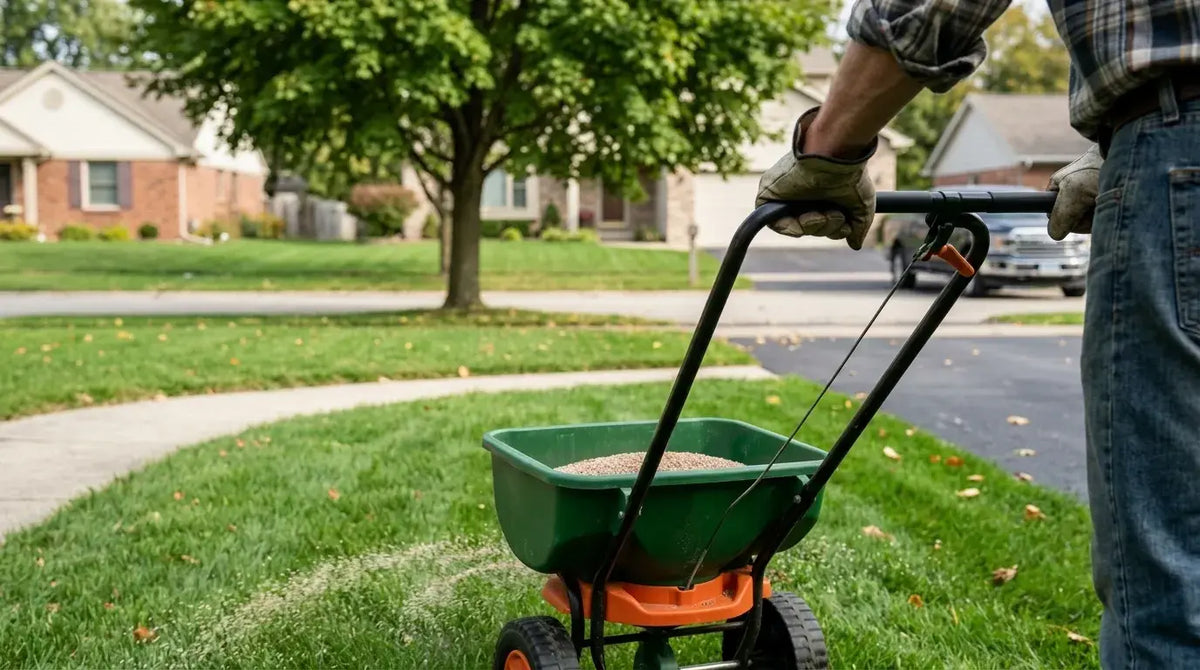
How often you should fertilize your lawn depends on your grass type, soil conditions, local climate, and maintenance goals. Some established lawns can stay healthy with one or two applications per year, while lawns maintained for dense growth and deep green color may need more frequent feeding.
The goal is to provide enough nutrients for healthy growth without overfertilizing. Here’s how to decide how many times a year to fertilize your lawn and adjust your schedule to suit your grass.
How Often Should You Fertilize Your Lawn?
Many established lawns can use 1-3 fertilizer applications per year as a starting point, while higher-maintenance lawns may need more. However, there is no universal schedule: recommendations vary by grass species, region, and desired lawn quality.
|
Lawn maintenance goal |
General starting point |
Best suited for |
|
Low maintenance |
1–2 applications per year |
Healthy lawns where moderate color and growth are acceptable |
|
Moderate maintenance |
2–3 applications per year |
Homeowners who want a reasonably dense, green lawn |
|
High maintenance |
3–4 or more applications per year |
Lawns where consistent color, dense growth, and heavy use are priorities |
These ranges are planning guidelines, not universal prescriptions. For example, Iowa State University Extension recommends one late-fall application for low-maintenance Kentucky bluegrass lawns in Iowa, two fall applications for moderate maintenance, and three applications for homeowners seeking higher-quality turf. Purdue University Extension describes programs with two to six applications for established cool-season lawns, depending on maintenance intensity and growing conditions.
More applications do not automatically produce a healthier lawn. Frequent feeding can increase mowing requirements, while excessive fertilizer can contribute to nutrient runoff. Consider both application frequency and your lawn’s total annual nitrogen needs when choosing a program.
For seasonal guidance, see our article on when to fertilize your lawn.
How Many Times a Year Should You Fertilize Your Lawn by Grass Type?
Grass type is one of the most important factors in choosing a fertilizer schedule. Cool-season and warm-season grasses grow most actively at different times, and individual species vary in their nitrogen requirements.

Cool-Season Grasses
Kentucky bluegrass, tall fescue, fine fescue, and perennial ryegrass are common cool-season grasses. They grow most actively in cooler conditions, particularly in spring and fall. Many established cool-season lawns benefit from a program that emphasizes late-summer and fall fertilization.
2-3 applications per year can be a practical starting point for moderate-maintenance lawns, but the appropriate frequency depends on the species, region, and desired appearance. Fine fescue generally needs less nitrogen than intensively managed Kentucky bluegrass. Shaded lawns may also need less fertilizer because grass growth is slower.
Avoid applying fertilizer to dormant or severely drought-stressed turf. Follow local Cooperative Extension recommendations to determine the appropriate annual nitrogen rate and application schedule.
Warm-Season Grasses
Bermudagrass, Zoysiagrass, St. Augustinegrass, and buffalograss grow most actively in warm weather. Fertilization generally takes place during active growth, with the schedule adjusted for local climate and species.
For many established warm-season lawns, 1-3 applications per year may be sufficient, depending on the grass species, local climate, and maintenance goals. More intensively managed Bermudagrass lawns may need additional applications, while established Zoysiagrass and buffalograss lawns can often perform well with less nitrogen.
General Fertilization Frequency Table
|
Grass type |
General frequency guidance |
Key consideration |
|
Kentucky bluegrass |
Often 1–3 applications |
Many regional programs emphasize fall feeding |
|
Tall fescue |
Often 2–3 applications |
Adjust for maintenance goals and local conditions |
|
Fine fescue |
Often 1–2 applications |
Usually suited to lower-input programs |
|
Bermudagrass |
Often 2–4 applications |
Higher-maintenance lawns may need more frequent feeding |
|
Zoysiagrass |
Often 1–3 applications |
Established lawns often need less nitrogen than Bermudagrass |
|
St. Augustinegrass |
Varies by region and maintenance level |
Follow local growing-season recommendations |
|
Buffalograss |
Often 0–2 applications |
A low-input grass that generally needs little nitrogen |
These ranges are illustrative, not fixed prescriptions. Kansas State University Extension, for example, lists annual nitrogen requirements of approximately 4–8 pounds per 1,000 square feet for improved Bermudagrass, 2–4 pounds for Zoysiagrass, and 0–2 pounds for buffalograss under its regional recommendations.
This illustrates an important distinction: the number of applications is not the same as the total amount of nitrogen your lawn needs each year. Check recommendations for your grass and region, then divide the recommended amount into suitable applications according to the fertilizer label.
What Affects How Often You Need to Fertilize?
Grass type is only one factor in your fertilizer schedule. Product formulation, lawn condition, soil nutrients, and grass-clipping management can also influence how often you need to fertilize.
Fertilizer Type and Release Rate
Quick-release fertilizers make nutrients available relatively quickly, while slow-release products supply nitrogen over a longer period and may reduce the need for frequent applications.
Always follow the product label for application rates and intervals. Slow-release fertilizer does not mean you can ignore recommended timing or apply extra product before the next scheduled treatment.
Lawn Age and Maintenance Goals
Newly established lawns may need a different fertilizer program from mature lawns. Follow local Extension guidance for seeding or sod establishment, then adjust the schedule once the grass is established.
Your maintenance goals matter, too. A dense, deep-green lawn may require more fertilizer than a low-maintenance lawn. More fertilizer can encourage faster growth and additional mowing, so choose a schedule that matches your lawn’s needs and the amount of care you want to provide.
Soil Conditions and Grass Clippings
A soil test can help identify pH problems and determine whether phosphorus or potassium is needed. Because routine soil tests may not reliably measure a lawn’s nitrogen needs, use your state Cooperative Extension service’s recommendations to guide nitrogen applications.
Grass clippings can also reduce fertilizer needs. When finely chopped clippings remain on the lawn, they decompose and return nutrients to the soil. University of Maryland Extension notes that recycling grass clippings and leaf litter over time can supply about 25% of a lawn’s annual nutrient needs, potentially eliminating one fertilizer application. The actual benefit depends on the lawn and its maintenance practices.
If your lawn contains a mixture of cool-season and warm-season grasses, avoid applying a schedule intended for just one species. For example, University of Maryland Extension recommends a compromise schedule for intermingled tall fescue and Zoysiagrass, with applications aligned to the appropriate regional windows for each grass.
Can You Fertilize Your Lawn Too Often?
Yes. Excess nitrogen can encourage excessive growth, increase mowing requirements, and worsen certain turfgrass disease problems. Applying too much fertilizer at once can also burn grass, while excess nutrients may contribute to water pollution.
To reduce these risks:
- Follow the product label. Use the recommended application rate and interval rather than adding extra fertilizer for faster greening.
- Track annual nitrogen. Consider all applications throughout the year, not just how many times you fertilize.
- Consider lawn conditions. Avoid fertilizing dormant or severely drought-stressed grass, and follow local recommendations.
- Check local regulations. Some states and municipalities restrict fertilizer use, particularly phosphorus applications or fertilizer use near waterways.
You can skip an application when your lawn does not need additional nutrients or your planned annual fertilizer program has already been completed. A healthy lawn does not necessarily benefit from another feeding simply because several weeks have passed.
Frequently Asked Questions
1. How Many Weeks Apart Should You Fertilize Your Lawn?
The interval depends on the fertilizer’s release rate, grass type, and product directions. Quick-release products generally act over a shorter period than slow-release formulations. Follow the label’s recommended interval rather than applying every product on the same schedule.
2. Can You Skip a Lawn Fertilizer Application?
Yes. If your lawn is healthy, its nutrient needs are being met, or your annual fertilizer plan is complete, you may be able to skip an application. Base the decision on your grass type, local recommendations, and total annual nitrogen needs.
3. Does Slow-Release Fertilizer Mean Fewer Applications?
Not necessarily, but it may reduce application frequency by supplying nitrogen over a longer period. The result depends on the formulation, application rate, grass species, and growing conditions. Always check the label.
4. Do Grass Clippings Reduce the Need for Fertilizer?
Yes, potentially. Grass clippings decompose and return nutrients to the soil, which can reduce the amount of additional fertilizer needed. However, clipping recycling does not always provide all the nitrogen your lawn requires, so continue to follow regional recommendations.
Did you like this article? Add us as a preferred source to find us more easily on Google.