

The right lawn mowing height depends on the grass species, season, and growing conditions, but most established lawns should not be cut extremely short; cool-season grasses commonly perform well around 2.5–4 inches, while warm-season grasses generally tolerate shorter heights, often about 1–2.5 inches.
Cutting height affects how much leaf tissue remains for photosynthesis, root development, drought tolerance, and weed competition. We generally recommend using the 1/3 Rule when mowing the lawn.
Lawn Mowing Height by Grass Type
Choose the mowing height according to the grass species rather than using one universal mower setting, because cool-season and warm-season turf have different growth patterns and tolerance for close cutting. Keeping cool-season turf around 2.5–4 inches generally provides more leaf area and supports deeper, more drought-tolerant roots, while many warm-season grasses are maintained at lower heights.
Cool-Season Grass Mowing Height
Cool-season grasses such as tall fescue, Kentucky bluegrass, and fine fescue generally benefit from a higher mowing height, particularly when heat or drought increases stress. The University of Maryland Extension lists 3–4 inches for tall fescue and fine fescue and 2.5–3.5 inches for Kentucky bluegrass.
| Cool-Season Grass | Recommended Mowing Height |
|---|---|
| Tall fescue | 3–4 in |
| Fine fescue | 3–4 in |
| Kentucky bluegrass | 2.5–3.5 in |
During hot, dry periods, raising the mower height by about 0.5–1 inch can help reduce stress on cool-season turf. Mowing dormant or severely heat-stressed turf simply to maintain a green appearance.
Warm-Season Grass Mowing Height
Warm-season grasses generally grow most actively during warmer weather and can be maintained at shorter heights than many cool-season grasses, but the correct setting still depends on species and local growing conditions. University of Maryland Extension lists zoysiagrass at 1.5–2.5 inches and Bermudagrass at 1–1.5 inches, illustrating why a single mowing height should not be applied to every lawn.
| Warm-Season Grass | Recommended Mowing Height |
|---|---|
| Zoysiagrass | 1.5–2.5 in |
| Bermudagrass | 1–1.5 in |
Mowing too high can also be inappropriate for some warm-season turf, so the goal is not simply to set the mower as high as possible. Instead, match the cutting height to the grass species, local growing conditions, and mower type.
The important distinction is that “shorter” does not automatically mean “healthier.” Cutting below the appropriate range can remove too much leaf tissue, weaken the turf, and increase stress.
How to Choose the Right Mowing Height
The best lawn mowing height is the highest practical height that remains appropriate for the grass species and lawn conditions. Start with the recommended range for your turf, then adjust upward when the lawn is exposed to heat, drought, or other stress. The objective is to maintain enough leaf area for healthy growth while avoiding excessive height between mowing sessions.
A simple decision process is:
- Identify the dominant grass species.
- Start near the middle or upper part of its recommended range.
- Raise the mower height during hot or dry conditions when appropriate.
- Avoid removing more than one-third of the leaf tissue at one mowing.
- Reassess the height if the lawn shows repeated browning, scalping, or drought stress.
A higher mowing height can also help shade the soil surface and reduce conditions favorable to some weeds. University of Maryland Extension notes that proper mowing height can reduce weed and disease pressure in tall fescue lawns.
For a deeper explanation of species-specific cutting heights, see our guide to optimal grass cutting height.
Lawn Mowing Frequency and the 1/3 Rule
Lawn mowing frequency should be based on how quickly the grass grows rather than a fixed weekly schedule. The central rule is to remove no more than one-third of the leaf blade at each mowing. Because growth rate changes with season, weather, moisture, fertility, and grass species, a lawn may need mowing every few days during rapid growth and much less often when growth slows or stops.
How the 1/3 Rule Determines Mowing Frequency
The 1/3 rule connects your mowing height directly to your mowing schedule. If your target cutting height is 3 inches, you should generally mow when the grass reaches about 4.5 inches, because removing the top 1.5 inches equals one-third of the current blade height.
| Target Mowing Height | Mow When Grass Reaches | Approx. Growth Rate Example* |
|---|---|---|
| 2 in | 3 in | ~5 days |
| 2.5 in | 3.75 in | ~6.3 days |
| 3 in | 4.5 in | ~7.5 days |
| 3.5 in | 5.25 in | ~8.8 days |
| 4 in | 6 in | ~10 days |
*Based on an assumed growth rate of 0.2 inches/day, so actual frequency will vary with grass species, temperature, rainfall, irrigation, fertility, and season.
This demonstrates why mowing a lawn extremely short does not necessarily reduce mowing frequency. At a 1-inch target height, only 0.5 inch of growth can accumulate before another cut under the one-third rule. At a 3-inch target, approximately 1.5 inches of growth can accumulate before mowing.
Why Lawn Mowing Frequency Changes With Growth Rate
Lawn mowing frequency changes because grass does not grow at a constant rate throughout the year. Spring growth, warm temperatures, moisture, fertility, grass species, and other environmental conditions can make the lawn grow rapidly, while drought, extreme heat, cold, or dormancy can slow or stop growth. Weekly mowing may therefore be insufficient during periods of rapid growth.
Instead of asking, “Do I need to mow every week?” check the actual grass height.
A practical approach is:
- Rapid growth: check the lawn every 2–4 days.
- Moderate growth: check approximately every 5–8 days.
- Slow growth: mowing may be needed less frequently.
- Dormant grass: do not mow simply because the calendar says it is mowing day.
If your lawn regularly becomes much taller than the target height between cuts, increasing mowing frequency is usually better than repeatedly cutting off a large percentage of the leaf tissue.
For more practical scheduling guidance, see our guide to how often you should mow your lawn.
Best Time to Mow a Lawn
The best time to mow a lawn is generally when the grass is dry, actively growing, and not under severe heat or drought stress; for most lawns, this means mowing after morning dew has dried and before the strongest afternoon heat, rather than mowing at a fixed clock time. University of Maryland Extension advises against mowing wet lawns and recommends avoiding mowing when grass has stopped growing because of drought or temperatures above 90°F (32°C).
Best Time of Day for Lawn Mowing
Late morning is often a practical mowing window because overnight dew has usually evaporated while the most intense afternoon heat has not yet arrived. Late afternoon can also work when temperatures are moderate and the grass is dry. Avoid mowing when the lawn is wet with dew, immediately after irrigation, or during periods of extreme heat when the turf is already under significant stress.
| Condition | Mowing Guidance |
|---|---|
| Morning dew still present | Wait until the grass dries |
| Late morning | Generally suitable if turf is dry |
| Midday with extreme heat | Avoid when possible |
| Late afternoon | Suitable if temperatures remain moderate |
| Evening with wet/dewy turf | Avoid if grass will remain wet |
The goal is not to follow a universal “perfect hour.” Instead, look for a dry lawn, reasonable temperature, firm soil, and active growth.
Lawn Mowing in Hot and Dry Weather
Hot and dry weather changes the mowing decision because turf that is already stressed has less capacity to recover from aggressive cutting. During hot or dry periods, raising the mowing height by about 0.5–1 inch can help preserve more leaf area. If the grass has entered dormancy because of drought or extreme heat, mowing should generally be postponed until active growth resumes.
A useful decision rule is:
- Grass actively growing: mow according to the normal height and one-third rule.
- Hot and dry but still growing: consider raising the mowing height.
- Severely drought-stressed: avoid unnecessary mowing.
- Dormant: do not mow simply to maintain appearance.
- Growing again after stress: gradually return to the normal mowing schedule.
This approach prevents the common mistake of treating mowing as a fixed calendar task even when the lawn is no longer growing normally.
Lawn Mowing After Rain or Irrigation
After rain or irrigation, wait until the grass is dry and the upper soil surface is firm enough to support the mower without creating ruts. Wet grass is more likely to clog the mower, form uneven clumps, and reduce traction, while saturated soil can be damaged by mower wheels. Specifically recommends delaying mowing until wet grass dries.
There is no universal rule such as “wait exactly 24 hours after rain.” Drying time depends on rainfall amount, sunlight, humidity, soil type, drainage, and weather conditions.
Before mowing, check:
- Are the grass blades dry?
- Is the soil firm underfoot?
- Are mower wheels leaving tracks?
- Is the mower deck likely to clog?
- Is the lawn still actively growing?
If the answer to any of these questions indicates poor conditions, waiting is usually better than forcing the mowing schedule.
For a dedicated timing guide, see best time to mow a lawn.
How to Mow a Lawn: Practical Guide
Proper lawn mowing combines the correct cutting height, a sharp Cutting Blade, a suitable Cutting Deck setting, dry turf, controlled mowing speed, and consistent overlap between passes. The goal is not simply to remove grass but to make a clean cut while limiting plant stress. Removing no more than one-third of the leaf tissue and changing mowing direction regularly can also help maintain more uniform turf growth.

Lawn Mowing Technique for Clean and Healthy Cuts
A clean lawn mowing technique starts with preparing the area, setting the mower correctly, and avoiding aggressive passes. Clear rocks, sticks, wires, and other debris before mowing. Then use a sharp blade, maintain a consistent speed, slightly overlap adjacent passes, and avoid repeatedly following exactly the same mowing pattern. Alternating directions can reduce continuous scalping and help grass grow more upright.
A practical mowing sequence is:
- Remove rocks, sticks, wires, and other debris.
- Set the Cutting Deck to the correct height.
- Confirm the Cutting Blade is sharp and undamaged.
- Mow only when the grass is reasonably dry.
- Maintain a steady mowing speed.
- Slightly overlap each pass to reduce uncut strips.
- Change mowing direction regularly.
- Check for clumps and uneven areas after finishing.
For walk-behind mowers on slopes, Recommends mowing across the slope rather than directly up and down when appropriate for the mower and conditions. Steep slopes can be difficult and dangerous to mow, so the mower manufacturer's instructions and the actual terrain should always determine whether the area is suitable for mowing.
For a more detailed step-by-step guide, see how to mow a lawn.
Lawn Mowing Blade and Cutting Deck Setup
A sharp Cutting Blade is one of the simplest ways to improve mowing quality. If grass develops a white or ragged appearance immediately after mowing, a dull blade or excessively low Cutting Deck setting may be responsible.
| Mowing Check | Practical Target |
|---|---|
| Grass removed per mowing | No more than 1/3 |
| Blade condition | Sharp, clean cutting edge |
| Turf condition | Preferably dry |
| Mowing direction | Change periodically |
| Cutting Deck height | Match grass species and target height |
| Passes | Slightly overlap each row |
If the grass tips look torn, frayed, or ragged after mowing, inspect the blade before changing other settings. Dull blades can tear the grass instead of producing a clean cut, increasing water loss from damaged leaf tissue and potentially increasing disease susceptibility.
Lawn Mowing Pattern and Grass Clippings
A good mowing pattern produces consistent coverage without repeatedly stressing the same wheel tracks or cutting direction. Alternate directions from one mowing session to the next and use slight overlap between passes. Properly cut, short grass clippings can generally remain on the lawn because they decompose and return nutrients; heavy piles or long, wet clumps should instead be redistributed, mulched further, or removed.
Grass clippings are not normally a cause of thatch when mowing is performed correctly. The main problem occurs when the lawn is overgrown or wet and the mower leaves large piles that block the turf surface.
Leave clippings when:
- They are short and evenly distributed.
- No more than one-third of the leaf tissue was removed.
- The grass is dry.
- There are no heavy piles or windrows.
Redistribute or remove clippings when:
- The lawn was significantly overgrown.
- Large clumps cover the grass underneath.
- Wet grass has produced heavy, sticky piles.
- Multiple passes have created concentrated rows of clippings.
For homeowners who want a more consistent mowing pattern with less manual work, a robotic lawn mower can also be a practical option. Robotic mowers are designed for frequent, smaller cutting cycles, which can help avoid the large clumps associated with removing too much grass at once.

If you want to estimate the time required for different lawn sizes and mowing approaches, see how long it takes to mow a lawn.
Lawn Mowing on Wet Grass, Slopes, and Overgrown Turf
Wet grass, sloped terrain, and overgrown lawns require different mowing decisions because the main risk is no longer just cutting height. Wet turf can reduce traction and cause clumping, slopes can increase stability risks, and overgrown grass can force the mower to remove too much leaf tissue in one pass. In all three situations, the correct response is to adjust the mowing conditions or technique rather than simply mowing faster.
Lawn Mowing on Wet Grass
Mowing wet grass is generally best avoided until the grass dries and the soil becomes firm enough to support the mower. Wet blades can stick together, clog the mower deck, produce uneven clumps, and reduce traction. If the soil is saturated, mower wheels can also create ruts and compact or disturb the surface. Waiting for suitable conditions usually produces a cleaner cut and reduces turf damage.
If mowing cannot be postponed, first consider whether the lawn is actually firm enough to support the mower safely. If wheels sink into the soil or leave visible tracks, conditions are too wet for routine mowing.
For a deeper look at the risks, drying conditions, and situations when mowing may be unavoidable, see our guide on can you mow wet grass.
Lawn Mowing on Slopes
Mowing a slope requires more than checking the mower's maximum advertised grade. Real-world passability depends on slope angle, surface condition, soil moisture, traction, cross-slope travel, turning behavior, and the mower manufacturer's operating limits. Steep slopes can be difficult or dangerous to mow, and walk-behind mower guidance commonly recommends traveling across a slope rather than directly up and down.
For robotic lawn mowers, an AWD drive system may provide greater traction on sloped lawns than a two-wheel-drive design, but AWD alone does not guarantee that every slope is suitable. Evaluate the actual terrain, surface condition, turning areas, and the manufacturer's specified operating limits.

Lawn Mowing When Grass Is Too Tall
When grass is significantly overgrown, do not immediately lower the mower to the final target height and remove the entire excess in one pass. Cutting too much leaf tissue at once can stress the turf, so the safer approach is to raise the deck, remove a limited amount, allow the lawn to recover, and then gradually return to the desired mowing height.
A practical recovery sequence is:
- Raise the Cutting Deck above the normal setting.
- Remove no more than approximately one-third of the leaf tissue.
- Leave the lawn to recover and resume active growth.
- Mow again when it reaches the appropriate threshold.
- Gradually return to the normal mowing height.
- Resume a more frequent schedule so the lawn does not become severely overgrown again.
This is especially important after vacations, extended rainy periods, or rapid spring growth.
Lawn Mowing Problems and Corrective Actions
Common lawn mowing problems can usually be traced to incorrect cutting height, a dull Cutting Blade, unsuitable mowing conditions, or inconsistent mowing technique. Use the table below to identify the likely cause and apply the corresponding correction rather than repeatedly mowing the lawn without changing the underlying condition.
| Lawn Mowing Problem | Likely Cause | Corrective Action |
|---|---|---|
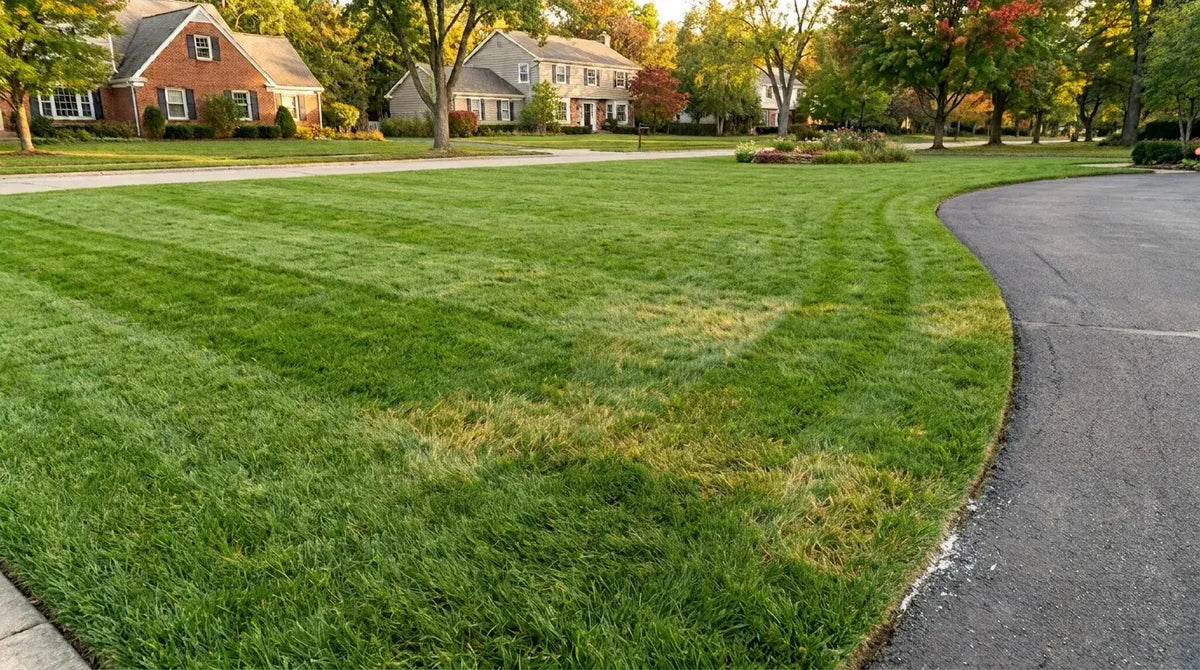
| Grass turns yellow or brown after mowing | Cutting too short, removing more than 1/3 of the blade, or mowing drought-stressed turf | Raise the Cutting Deck, follow the 1/3 rule, and avoid mowing severely stressed or dormant grass |
| Grass looks ragged or torn | Dull or damaged Cutting Blade | Sharpen or replace the blade; Cornell recommends checking blade sharpness and sharpening after approximately 10 hours of mowing |
| Lawn has uneven height | Uneven Cutting Deck setting, inconsistent speed, or uneven ground | Check deck height on all sides and maintain a consistent mowing speed |
| Strips of grass remain after mowing | Insufficient overlap between passes or uneven mowing pattern | Overlap each pass slightly and change mowing direction periodically |
| Large piles of grass clippings | Grass was too tall or wet, or more than 1/3 was removed | Mow when dry, reduce excessive height gradually, and redistribute heavy clumps |
| Mower frequently clogs | Wet grass or excessive clipping volume | Wait for the grass to dry and avoid removing too much grass in one pass |
| Visible wheel tracks or ruts | Soil is too wet or saturated | Wait until the soil firms up before mowing |
| Lawn looks stressed after repeated mowing | Incorrect mowing height or mowing during heat/drought stress | Adjust the Cutting Deck to the grass-specific height and reduce mowing during severe stress |
| Grass leans or develops a visible grain | Repeatedly mowing in the same direction | Alternate mowing patterns and directions |
| Overgrown lawn becomes severely damaged after mowing | Attempting to reach the final height in one pass | Reduce the height gradually over multiple mowing sessions |
The most important corrective principle is simple: check the mowing height, Cutting Blade, grass moisture, and mowing frequency before changing equipment or mowing more aggressively. In most cases, correcting these four factors addresses the underlying cause rather than only improving the lawn's appearance temporarily.
Lawn Mowing FAQs
Mow when the grass reaches roughly 1.5 times your target mowing height, which keeps the amount removed within the 1/3 rule. A lawn growing at 0.2 inches per day could require mowing about every 7.5 days when maintained at 3 inches, but actual frequency varies with grass species, weather, irrigation, and season.
The best mowing height depends on grass type. Common extension recommendations include 3–4 inches for tall fescue, 2.5–3.5 inches for Kentucky bluegrass, 1.5–2.5 inches for zoysiagrass, and 1–1.5 inches for Bermudagrass. Avoid using one mower height for every type of turf.
No. Cutting grass shorter does not necessarily reduce mowing frequency because a shorter target height means the grass reaches the 1/3 mowing threshold sooner. Maintaining an appropriate height for the grass species is generally better than repeatedly cutting the lawn as short as possible.
It is best to avoid removing more than one-third of the grass blade in a single mowing. If the lawn is significantly overgrown, raise the Cutting Deck and reduce the height gradually over multiple mowing sessions rather than trying to reach the final height immediately.
Generally, wait until the grass is dry and the soil has firmed up. Wet mowing can cause clumping, clog the Cutting Deck, reduce traction, and leave wheel tracks in soft soil. Heavy dew alone may only require waiting until the grass surface dries.
Late morning after the morning dew has dried is generally a practical mowing period, while mowing during extreme midday heat should be avoided when the lawn is heat- or drought-stressed. The condition of the turf matters more than choosing one exact clock time.
There is no universal number of hours because drying time depends on rainfall, temperature, humidity, sunlight, drainage, and soil conditions. The lawn should be sufficiently dry and the soil firm enough that mower wheels do not create visible ruts or excessive compaction.
Do not automatically cut grass shorter before summer. For cool-season turf, maintaining a higher mowing height during heat and drought can reduce stress; for example, tall fescue is commonly maintained around 3–4 inches. Adjust the height according to the grass species and local growing conditions rather than using a pre-summer “short cut.”
Final Takeaway
Effective lawn mowing is a process of adjusting to the lawn rather than following a fixed calendar. Choose a mowing height appropriate for the grass species, keep the Cutting Blade sharp, remove no more than one-third of the leaf tissue, mow when the grass is dry and the soil is firm, and increase or decrease mowing frequency according to actual growth.
Core Framework: Right height → Right growth threshold → No more than 1/3 removed → Dry conditions → Consistent technique
When those five factors are managed together, mowing becomes less about cutting grass as often as possible and more about maintaining a stable, healthy turf canopy throughout the growing season.
Did you like this article? Add us as a preferred source to find us more easily on Google.