





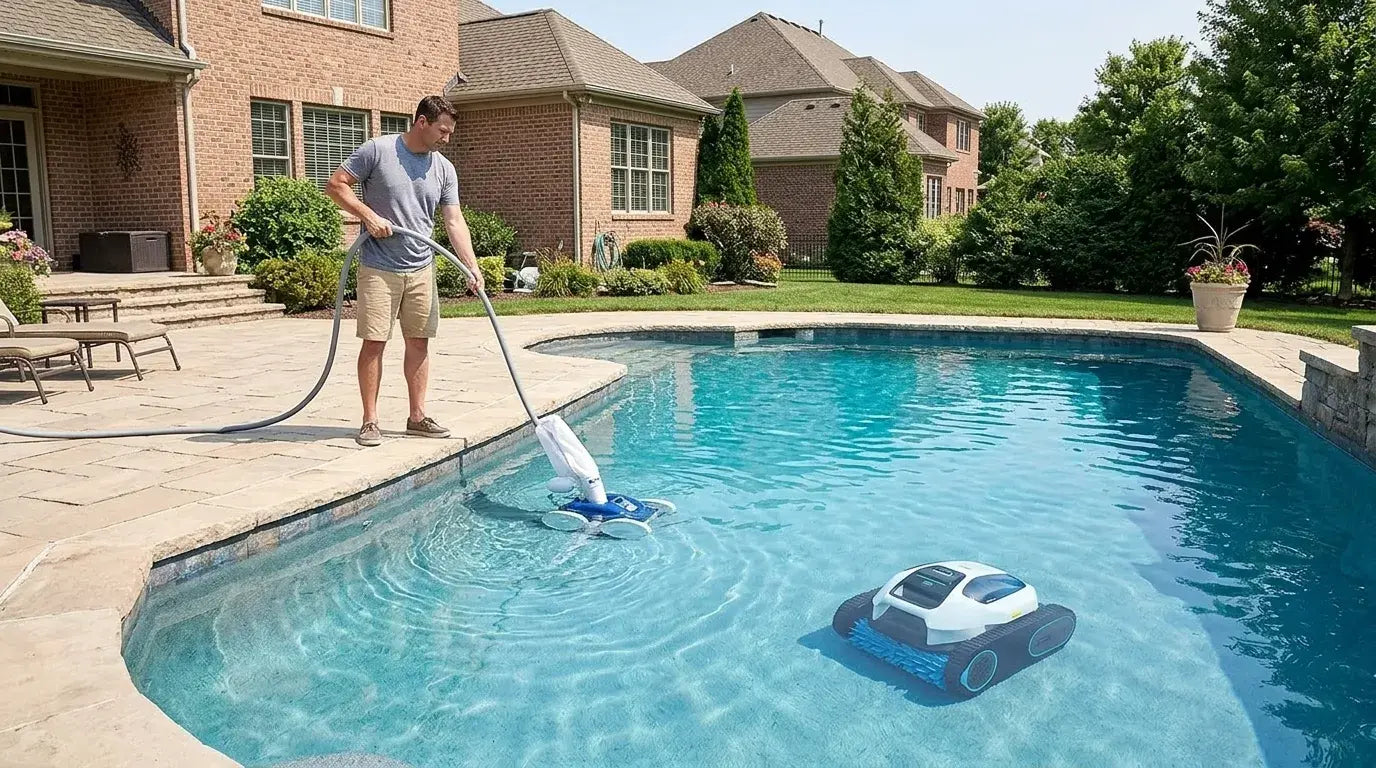
A robotic pool cleaner is usually the better choice for low-effort, independent cleaning, while a pressure-side pool cleaner can make more sense for pools with existing pressure infrastructure and heavy leaf debris. The key difference is where the cleaning work happens: a robotic cleaner uses its own motor and filter, while a pressure-side cleaner uses return-line pressure and may require a booster pump.
Neither option is automatically better. Your choice should depend on your pool’s existing equipment, typical debris, required cleaning coverage, upfront cost and ongoing maintenance.
Robotic vs Pressure-Side Pool Cleaner at a Glance
A robotic pool cleaner uses its own motor, pump and onboard filter, while a pressure-side pool cleaner uses return-line water pressure and may require a booster pump. Robotic cleaners generally offer greater equipment independence and lower active labor, while pressure-side cleaners can be practical for pools with existing pressure infrastructure and heavy debris.
| Factor | Robotic Pool Cleaner | Pressure-Side Pool Cleaner |
|---|---|---|
| Power source | Internal motor and pump | Return-line water pressure |
| Pool pump required for cleaning | No | Yes |
| Booster pump | Not required | Model/system dependent |
| Debris collection | Onboard filter | Separate debris bag |
| Pool filter loading | Lower for robot-collected debris | Generally lower than suction-side cleaning |
| Active cleaning labor | Low | Low |
| Installation | Usually minimal | May require plumbing or booster pump |
| Typical equipment cost | ~$150–$1,500+ | ~$400–$1,000+ |
| Typical robotic cycle | ~1–3.5 hours | Depends on pump schedule and model |
| Wall/waterline cleaning | Available on some models | More limited/model dependent |
| Main maintenance | Filter, brushes, drive components | Debris bag, hose and cleaner components |
| Best starting point | Independent routine cleaning | Existing pressure infrastructure and heavy debris |
Quick Decision: Which Pool Cleaner Fits Your Pool?
Choose a robotic pool cleaner if you:
- Want cleaning to operate independently of the pool pump.
- Prefer less hands-on cleaning.
- Want debris collected in a dedicated onboard filter.
- Need floor, wall or waterline coverage that the selected model supports.
- Do not have a convenient pressure-side connection.
Choose a pressure-side pool cleaner if you:
- Already have suitable return-line pressure.
- Regularly deal with leaves and larger debris.
- Prefer a separate debris bag.
- Are comfortable with the possibility of a booster pump.
- Want to make use of existing pressure-side infrastructure.
Key Insight: The key comparison is not simply robotic vs pressure-side. It is whether you want the cleaner to provide its own power and filtration, or whether you want to use the pool’s existing return system to perform the cleaning work.
For a more detailed explanation of the differences between suction-type, pressure-type, and robotic systems, please refer to Types of Automatic Pool Cleaners: Which One Is Right for Your Pool?.
How Robotic and Pressure-Side Pool Cleaners Work
A robotic pool cleaner provides its own motor, pump and filtration, while a pressure-side pool cleaner uses pressurized water from the pool’s return system. The main difference is whether cleaning power and debris filtration are handled inside the cleaner or through existing pool equipment.
How a Pressure-Side Pool Cleaner Uses Return-Line Pressure
A pressure-side pool cleaner typically follows this path:
Water returning from the pool system enters the cleaner and provides the pressure needed for movement and cleaning. Many pressure-side cleaners also use this water flow to create additional circulation around the pool and move debris toward the cleaner.
Depending on the model, the cleaner may operate from existing return-line pressure or require a dedicated booster pump.
How a Robotic Pool Cleaner Creates an Independent Cleaning System
A robotic pool cleaner typically follows this path:
The robot supplies its own cleaning power through an internal motor and pump. Brushes loosen debris, the intake draws it into the cleaner and the onboard filter captures it.
Because the robot does not rely on the pool pump to create cleaning suction or return-line pressure, its cleaning cycle can operate independently of the pool's normal circulation schedule.
Follow the Power, Debris and Maintenance
| Question | Robotic Pool Cleaner | Pressure-Side Pool Cleaner |
|---|---|---|
| Where does cleaning power come from? | Internal motor and pump | Return-line water pressure |
| Does the pool pump power the cleaner? | No | Yes |
| Is a booster pump required? | No | Model dependent |
| Where does debris go? | Onboard filter | Separate debris bag |
| Where does filter maintenance occur? | Robot | Pool system + debris bag |
| Main equipment dependency | Lower | Medium to high |
The practical difference is where the cleaning workload sits. A robotic cleaner moves most of that work into the robot itself, while a pressure-side cleaner makes the pool's return system part of the cleaning process.
Robotic vs Pressure-Side Pool Cleaner for Debris Removal and Filtration
A robotic pool cleaner and a pressure-side pool cleaner handle debris differently: robotic models combine mechanical pickup with an onboard filter whose particle rating and suction performance can be specified directly, while pressure-side cleaners typically use return-line pressure to move debris into a separate bag, making intake size, water flow and bag capacity more important than a simple “better for leaves” label.
What Actually Determines How Well a Pool Cleaner Picks Up Debris?
The ability to remove debris depends on flow/suction + intake + filtration + debris capacity + coverage, not the pool cleaner category.
- Suction or water-flow performance: Determines how effectively debris is drawn toward the intake.
- Filter particle rating: Determines the approximate size of particles the filter is designed to capture.
- Intake opening: Affects how easily larger leaves and debris can enter the cleaner.
- Filter or debris-bag capacity: Determines how much material can be collected before maintenance is required.
- Brush system: Helps loosen debris that is attached to the pool surface.
- Cleaning coverage and navigation: Determines whether the cleaner actually reaches the debris in the first place.
This is why saying that a pressure-side cleaner is “better for leaves” or a robotic cleaner is “better for fine debris” is too broad to be useful. The actual specifications of the cleaner matter.
Robotic vs Pressure-Side Pool Cleaner: Which Debris Profile Fits Better?
| Pool Cleaning Requirement | Robotic Pool Cleaner | Pressure-Side Pool Cleaner |
|---|---|---|
| Fine dust / small particles | Filter rating is critical | Depends on cleaner and pool filtration |
| Sand / fine sediment | Check filter particle rating | Depends on bag and overall filtration |
| Leaves | Check intake + filter capacity | Often a strong use case |
| Acorns / larger debris | Check intake opening and filter capacity | Often well suited |
| Heavy mixed debris | Compare suction, intake and filter capacity | Compare intake, water flow and bag capacity |
| Debris kept out of main pool filter | Yes, in onboard filter | Yes, in debris bag |
| Wall / waterline debris | Available on selected models | Model dependent |
| Fine-particle performance | More directly specified by filter rating | More dependent on overall system |
Robotic Pool Cleaner Filtration Depends on Suction Power and Filter Rating
A robotic pool cleaner has two separate jobs: move debris into the intake and retain that debris inside the filter.
For example, the Mammotion SPINO E1 combines a maximum 5,800 GPH suction power with a 180 μm filter basket. It also uses a roller brush and supports floor, wall and waterline cleaning.
That gives you a much more meaningful way to evaluate robotic cleaning performance:
However, 180 μm should not be interpreted as “captures every particle larger than 180 μm.” Real-world pickup also depends on water flow, debris shape, how firmly the material is attached to the surface and whether the debris actually reaches the intake.
This distinction is important when comparing robotic cleaners. A higher advertised suction number alone does not guarantee better fine-particle cleaning, just as a finer filter alone does not guarantee stronger debris pickup.
How Pressure-Side Pool Cleaners Handle Leaves and Larger Debris
Pressure-side pool cleaners approach debris removal differently. Return-line water pressure powers the cleaner, while a venturi-style intake helps move debris into an attached debris bag. Many models are designed around relatively large debris such as leaves and acorns, and some require a dedicated booster pump to provide the necessary pressure and flow.
The important specifications are therefore different:
- Required water flow
- Operating pressure
- Intake size
- Debris-bag capacity
- Booster-pump requirement
- Cleaner coverage
The separate bag is a meaningful advantage for pools with frequent large debris because collected leaves and other material remain in the cleaner's bag rather than being routed through the main pool filter.
But this does not mean a pressure-side cleaner automatically handles every type of debris better. Fine particles that are stirred up but not captured can still return to the pool's normal filtration path, depending on the cleaner's design and operating conditions.
The Better Question Is Not “Which Cleaner Picks Up More?”
The better comparison is the debris your pool produces and the specifications that determine whether each cleaner can collect it efficiently.
For a robotic cleaner, start with:
For a pressure-side cleaner, start with:
Robotic vs Pressure-Side Pool Cleaner for Pool Shape and Cleaning Coverage
A robotic pool cleaner can be the better choice when your pool requires systematic coverage of floors, walls or the waterline, while a pressure-side pool cleaner can be sufficient when the main cleaning requirement is floor debris and the pool already has suitable pressure-side infrastructure. Actual coverage depends on the specific cleaner and pool geometry.
Robotic vs Pressure-Side Pool Cleaner for Floors, Walls and Waterline
| Cleaning Area | Robotic Pool Cleaner | Pressure-Side Pool Cleaner |
|---|---|---|
| Pool floor | Generally a core cleaning area | Generally a core cleaning area |
| Walls | Available on many models | Model and pool geometry dependent |
| Waterline | Available on selected models | More limited and model dependent |
| Steps and benches | Navigation and geometry dependent | Often requires separate manual cleaning |
| Corners and ledges | Navigation dependent | Hose movement and cleaner path dependent |
This is not simply a “robotic cleans more” comparison. The important question is whether the areas your pool actually needs cleaned are included in the model's rated coverage.
Why Pool Geometry Matters More Than Pool Volume
Pool geometry affects where a cleaner can travel and what areas it can reach, so shape can matter more than water volume when comparing cleaning coverage.
Check:
- Steps and benches
- Tanning ledges
- Ledges and shallow shelves
- Tight corners
- Steep transitions between depths
- Sloped floors
- Irregular or freeform walls
- Obstacles and fittings
For example, a 10,000-gallon pool with a simple floor may be easier for an automatic cleaner to cover than a 30,000-gallon pool with benches, multiple levels and irregular geometry.
Pool size still matters, but pool shape determines where the cleaner can physically travel.
Besides, a pressure-side cleaner is influenced by its hose configuration, water flow, and how the pool's shape affects its movement. It can work effectively on a pool floor, but complex geometry may create areas that the cleaner reaches inconsistently.
Pressure-Side Pool Cleaner Booster Pump and Installation Requirements
A pressure-side pool cleaner may require additional plumbing, return-line pressure or a dedicated booster pump, while a robotic pool cleaner typically operates as a self-contained unit with no connection to the pool’s hydraulic cleaning system. The exact installation requirement depends on the pressure-side cleaner model and the equipment already installed around the pool.
Robotic vs Pressure-Side Pool Cleaner for Installation
A robotic pool cleaner normally does not require a dedicated suction line, pressure line or booster pump. It contains its own drive system, internal pump and filtration system, so the installation process is generally limited to preparing the unit and providing appropriate power or charging access.
A pressure-side cleaner may involve multiple additional components:
| Installation Requirement | Pressure-Side Pool Cleaner | Robotic Pool Cleaner |
|---|---|---|
| Pool plumbing connection | Required | Not required for cleaning |
| Dedicated cleaner line | Model/system dependent | Not required |
| Booster pump | Model dependent | Not required |
| Electrical work | May be required for booster pump | Power or charging access |
| Equipment-pad space | May increase | Not required |
| Connection to pool circulation | Required | Not required |
| Installation complexity | Can range from moderate to high | Usually minimal |
The key advantage of robotic installation is therefore infrastructure independence. The cleaner does not need the pool to already have the correct hydraulic setup.
Does a Pressure-Side Pool Cleaner Always Need a Booster Pump?
No. Some pressure-side pool cleaners are designed to operate without a booster pump, while others require dedicated pressure from a booster pump.
A non-booster pressure-side cleaner may operate using the pool's existing return-line pressure when the available flow and pressure meet the cleaner manufacturer's requirements. A booster-pump-driven cleaner requires additional equipment to supply the specified water pressure and flow. Pentair, for example, currently lists both pressure-side systems that operate without a booster pump and cleaner systems designed to work with dedicated booster pumps.
Pressure-Side Pool Cleaner Installation Checklist
Before buying a pressure-side pool cleaner, check the following:
- Dedicated pressure-side line: Does the pool already have a compatible cleaner return line?
- Available water pressure and flow: Can the existing circulation system meet the cleaner's requirements?
- Booster-pump requirement: Is the selected model designed to operate with or without a dedicated booster pump?
- Plumbing modifications: Is a new pressure line or additional piping required?
- Electrical supply: If a booster pump is needed, is suitable electrical capacity available?
- Equipment-pad space: Is there enough room for an additional pump and related plumbing?
- Timer or automation: Can the cleaner and booster pump be scheduled correctly with the main circulation system?
These requirements can change the purchase decision significantly. A pressure-side cleaner can be relatively straightforward when the required infrastructure already exists, but retrofitting a pool with a booster pump, plumbing and electrical equipment can increase installation complexity.
Robotic vs Pressure-Side Pool Cleaner Cost, Energy Use and Maintenance
A robotic pool cleaner can have a higher upfront price but lower installation requirements, while a pressure-side pool cleaner may have a lower equipment cost in some cases but can add plumbing, booster-pump, energy and maintenance costs. The better long-term value depends on the cleaner model and how much compatible pool equipment you already have.
Upfront Cost: Compare the Cleaner and the Infrastructure
The purchase price alone does not show the full cost difference. A pressure-side cleaner can be cost-effective when the pool already has a compatible pressure line and required equipment, while installation costs can rise when a booster pump, plumbing modifications or electrical work are needed. A robotic cleaner generally has minimal installation requirements, but higher-end models can cost more upfront.
| Cost Factor | Robotic Pool Cleaner | Pressure-Side Pool Cleaner |
|---|---|---|
| Typical equipment range | ~$150–$1,500+ | ~$400–$1,000+ |
| Additional installation | Usually minimal | Can range from minimal to significant |
| Booster pump | Not required | Model dependent |
| Dedicated plumbing | Not normally required | Model/system dependent |
| Main replacement items | Filter, brushes, tracks/drive parts | Debris bag, hose, wheels and cleaner parts |
| Existing equipment dependency | Lower | Medium–high |
These are planning ranges rather than fixed market prices. A robotic cleaner can start at the lower end of the market, while premium models can exceed $1,000. Pressure-side costs also vary by whether the pool already has the required plumbing and pressure equipment.
Energy Use Depends on Pump and Booster-Pump Runtime
A robotic pool cleaner uses its own electric motor and pump, so its cleaning energy use can usually be estimated directly from the model's rated power and cycle length. A pressure-side cleaner uses water pressure from the pool circulation system and may also require a dedicated booster pump.
For a robotic cleaner:
For example, a robotic cleaner rated at 100–200 W running for 2 hours uses approximately 0.2–0.4 kWh per cycle. At an electricity rate of $0.30/kWh, that equals approximately $0.06–$0.12 per cleaning cycle.
For a pressure-side cleaner, energy use depends on:
- Main pool-pump power
- Whether the cleaner requires additional pump runtime
- Booster-pump power, if required
- Cleaning frequency
- Electricity rate
The most important distinction is whether the pressure-side cleaner adds runtime that would not otherwise be required for normal circulation. If the main pump is already operating, not all of that electricity should automatically be assigned to the cleaner. A booster-pump system, however, adds a separate electrical load during cleaning.
Robotic vs Pressure-Side Pool Cleaner Maintenance Costs
Robotic cleaners concentrate maintenance inside the unit, while pressure-side cleaners add recurring wear items and may also involve the pool's pressure and pump equipment.
| Maintenance Item | Robotic Pool Cleaner | Pressure-Side Pool Cleaner |
|---|---|---|
| Debris collection | Onboard filter | Separate debris bag |
| Filter/bag cleaning | Clean robot filter after use or as needed | Empty debris bag as needed |
| Common wear parts | Filter, brushes, tracks/wheels | Bag, hose, tires/wheels, cleaner parts |
| Typical replacement cost | ~$20–$150+ per part | ~$20–$150+ per part |
| Additional equipment | None for cleaning operation | Booster pump may apply |
| Main maintenance location | Cleaner itself | Cleaner + pool pressure system |
The $20–$150+ per part figures are planning ranges, not annual maintenance costs. Actual spending depends heavily on the specific model and which components wear out.
Robotic vs Pressure-Side Pool Cleaner Decision Matrix
The better choice depends less on the cleaner category itself than on four measurable factors: existing pool infrastructure, debris type, required cleaning coverage, and owner maintenance preference. A pressure-side cleaner is strongest when the pool is already equipped for it and produces heavy debris, while a robotic pool cleaner is often the more independent option when you want separate filtration and broader model-specific coverage.
Which Pool Cleaner Fits Your Pool Setup?
| Your Pool Situation | Better Starting Point | Why |
|---|---|---|
| Existing pressure-side line and compatible booster pump | Pressure-Side | You can use infrastructure already installed |
| No pressure-side plumbing | Robotic | No dedicated pressure line or booster pump is required |
| Heavy leaves, acorns or large debris | Pressure-Side or Robotic | Compare debris capacity and how often the collection system must be emptied |
| Fine dust, sand or small particles | Robotic | Check the robot's actual filter rating and filtration design |
| Want floor + wall + waterline cleaning | Suitable Robotic Model | Coverage is available on some models |
| Want to reduce dependence on the pool pump | Robotic | Cleaning power and filtration are self-contained |
| Already have a working pressure-side system | Pressure-Side | Replacing functioning infrastructure may add unnecessary cost |
| Need to avoid adding a booster pump | Robotic | No hydraulic booster system is required |
| Pool has complex geometry | Compare Specific Models | Navigation and coverage vary by model |
| Lowest purchase price is the priority | Compare Total Setup Cost | A cheaper cleaner can require additional equipment |
The Simplest Buying Rule
If you already own the pressure-side infrastructure, start by evaluating whether a pressure-side cleaner still meets your debris and coverage requirements.
If you do not own that infrastructure, compare the cost of adding it against a robotic cleaner that already contains its own cleaning motor, pump and filtration.
Decision Checklist:
• Existing pressure infrastructure → Evaluate pressure-side first.
• No pressure infrastructure → Evaluate robotic first.
• Heavy debris → Compare collection capacity.
• Fine debris or broader coverage → Compare filtration and model-specific cleaning capability.
This is a more useful decision rule than simply saying that robotic cleaners are “better” or pressure-side cleaners are “cheaper.” Current comparison guides similarly emphasize that the existing equipment pad, debris load and service burden can change the answer from one pool to another.
FAQ
No. A pressure-side pool cleaner may operate from existing return-line pressure, while other models require a dedicated booster pump to provide the specified flow and pressure. The manufacturer's requirements and your pool's existing plumbing determine whether additional equipment is necessary.
A pressure-side pool cleaner can be advantageous for heavy leaves, acorns and other large debris because its separate debris bag can hold larger material without sending it directly into the pool's main filter. A robotic cleaner can also handle leaves, but its filter capacity and intake design determine how frequently the basket needs to be emptied.
Often, yes, but the specific filter matters more than the cleaner category. Pressure-side debris bags are generally designed around larger debris, whereas a robotic cleaner can use finer filtration. Check the robot's stated filter rating and the manufacturer's intended debris range before assuming it will capture a particular particle size.
Most pressure-side pool cleaners are primarily designed for floor cleaning, although some models can provide limited wall coverage. Waterline cleaning is generally not a standard pressure-side capability, so you should verify the exact model's coverage rather than treating all pressure-side cleaners as equivalent.
Yes, a suitable robotic pool cleaner can replace much of the routine cleaning performed by a pressure-side cleaner, particularly when it provides the required debris capacity and floor, wall or waterline coverage. However, a pressure-side system may remain practical when a pool already has a dedicated pressure line and booster pump, especially for pools with unusually heavy large-debris loads.
Not automatically, but a robotic cleaner can reduce energy use because it does not require the pool's circulation pump or a pressure-side booster pump to provide cleaning power. The actual cost depends on the robot's rated power, cleaning cycle, pool-pump runtime, booster-pump requirement and local electricity rate.
Usually, the first step is to compare the cost of adding the required pressure-side infrastructure with the cost of a robotic cleaner that does not require a dedicated pressure line. If installing a pressure line, booster pump and related electrical or plumbing equipment adds substantial cost, the robotic option can become more attractive from an installation-complexity standpoint.
Check the robotic cleaner's maximum pool size, cleaning areas, filter rating, debris capacity, runtime, pool-surface compatibility and wall/waterline capability. Also consider whether the existing pressure-side system is already fully installed and functioning, because replacing a working system purely for a different cleaner architecture may not provide enough value to justify the change.
Did you like this article? Add us as a preferred source to find us more easily on Google.