



Seasonal lawn care means adjusting mowing, watering, fertilizing, weed control, aeration, and other lawn tasks to your grass type, season, and growing conditions. A healthy lawn does not follow one fixed schedule all year. Cool-season and warm-season grasses have different growth cycles, while heat, drought, rainfall, soil moisture, and temperature can change the right time for a specific task.
A practical four-season lawn care plan should therefore answer two questions: What does the lawn need this season, and is the lawn ready for that task? Spring focuses on restarting growth and managing weeds, summer on heat and water stress, fall on recovery and turf establishment, and winter on protecting dormant grass.
Use the seasonal lawn care calendar below as a framework rather than a rigid set of dates. The most reliable approach is to start with grass type, check whether the turf is actively growing, consider recent weather and soil conditions, and then choose the appropriate task.
Quick Seasonal Lawn Care Overview
| Season | Main lawn care tasks | Primary goal |
|---|---|---|
| Spring | Resume mowing, manage weeds, assess soil and fertilizer needs, repair suitable areas | Support healthy spring growth |
| Summer | Water as needed, mow during active growth, manage heat and drought stress, monitor pests and disease | Reduce stress and protect turf |
| Fall | Continue mowing, aerate compacted soil, overseed suitable lawns, fertilize according to need, manage leaves | Recover and strengthen turf |
| Winter | Limit traffic on dormant or frozen turf, avoid unnecessary inputs, maintain equipment | Minimize winter damage |
Use this table as a quick reference, not as a fixed national calendar. The right timing still depends on grass type, active growth, soil moisture, temperature, rainfall, and local climate. University Extension guidance consistently emphasizes matching lawn maintenance to the turfgrass life cycle rather than applying the same schedule everywhere.
Grass Type Determines the Seasonal Lawn Care Schedule
Your grass type determines when the lawn grows fastest, when it becomes heat- or cold-stressed, and when mowing, fertilizing, aerating, and overseeding are most appropriate.
In U.S. lawns, the first major distinction is between cool-season grass and warm-season grass. Cool-season grasses generally grow most actively during cooler periods of the year, while warm-season grasses perform their main growth during warmer weather. For cool-season turf, the University of Minnesota identifies roughly 55–75°F air temperatures as optimal for shoot growth and about 50–65°F soil temperatures as optimal for root growth.
Cool-Season Grass vs. Warm-Season Grass
| Factor | Cool-Season Grass | Warm-Season Grass |
|---|---|---|
| Common examples | Tall fescue, Kentucky bluegrass, perennial ryegrass, fine fescue | Bermudagrass, zoysiagrass, St. Augustinegrass |
| Main growth periods | Primarily spring and fall | Primarily late spring through summer |
| Summer response | Growth may slow during heat and drought; some lawns can become dormant | Usually the main active-growth period |
| Winter response | Growth slows or stops depending on climate | Often enters winter dormancy |
| Major seasonal focus | Spring/fall growth and summer stress management | Warm-season growth and winter dormancy |
| Mowing window | Mow whenever the turf is actively growing | Mow during active warm-season growth |
Cool-season grasses such as tall fescue, Kentucky bluegrass, perennial ryegrass, and fine fescues generally perform their strongest growth during cooler periods. Warm-season grasses such as bermudagrass and zoysiagrass are adapted to warmer growing conditions and usually become much less active as temperatures fall.
The difference matters because the same calendar date can represent completely different growth stages for different turf types. A lawn should therefore be managed according to its dominant grass rather than simply following a nationwide month-by-month schedule.
How Grass Type Changes the Annual Cycle
| Season | Cool-Season Lawn | Warm-Season Lawn |
|---|---|---|
| Spring | Growth resumes; mowing and weed management increase | Growth begins as temperatures rise; avoid treating dormant turf as fully active |
| Summer | Heat and drought can slow growth or trigger dormancy | Often the main period of active growth |
| Fall | Strong recovery and establishment period | Growth gradually slows as temperatures decline |
| Winter | Reduced growth or dormancy depending on climate | Typically dormant in regions with winter cold |
For mixed lawns, base the seasonal program on the dominant turfgrass rather than assuming that every grass species will respond identically. University of Maryland Extension specifically recommends this approach for mixed-species lawns.
Before applying herbicides or other treatments, identify the grass species first. Some pesticides that are safe for one turfgrass species can injure another, and many pre-emergence herbicides can also interfere with newly seeded turf. Always check the product label and the requirements for the specific grass being treated.
The practical rule is simple: use the calendar to plan, but use grass type and growth stage to decide. A date can tell you that spring or fall has arrived; it cannot by itself tell you whether the turf is ready for mowing, fertilizing, aeration, or overseeding.
Spring Lawn Care: Mowing, Weeding, Fertilizing, and Lawn Repair
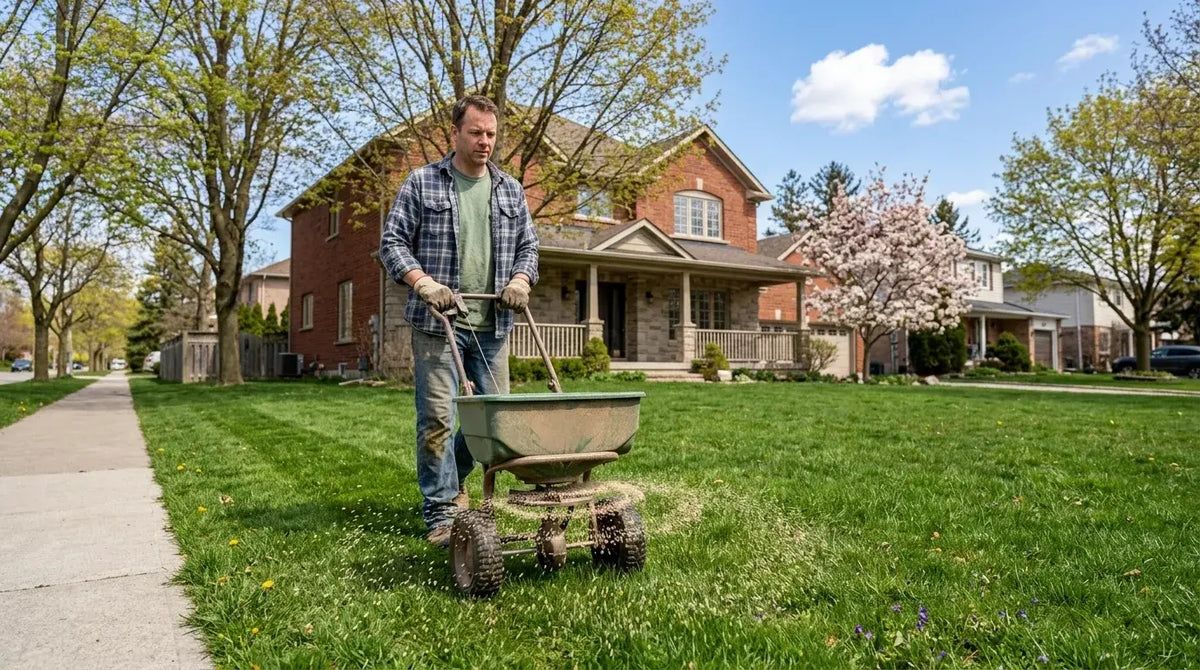
Spring lawn care should focus on supporting healthy growth without forcing the turf to grow before conditions are suitable. The main priorities are resuming mowing as growth requires, managing weeds, reviewing soil and fertilizer needs, and repairing thin or bare areas only when the grass can establish successfully.
Spring Lawn Care Checklist
| Spring Lawn Care Task | What to Do | Important Timing Consideration |
|---|---|---|
| Mowing | When grass resumes active growth | Base frequency on growth rate |
| Weed control | Identify weeds and choose an appropriate control method | Avoid treatments that can damage actively growing turf |
| Soil testing | Test when fertilizer or lime decisions are uncertain | Use results to guide phosphorus, potassium, and lime decisions |
| Fertilizing | Apply only when the grass and soil conditions support it | Avoid unnecessary early-spring fertilization |
| Lawn repair | Repair thin or bare areas when establishment conditions are favorable | Fall is often a stronger establishment window for cool-season turf |
The most important spring task is usually mowing according to growth rate. Penn State Extension notes that peak spring growth can require mowing more than once per week, while University of Maryland Extension gives the same principle: mowing frequency changes with grass type, soil moisture, temperature, and fertility.

Spring Lawn Mowing and Weed Control
Spring mowing should follow the rate at which the grass is growing rather than a fixed weekly schedule. A useful rule is to avoid removing more than one-third of the grass blade in a single mowing, which means a lawn maintained at a 3-inch height should generally be cut before it reaches roughly 4.5 inches. Penn State Extension likewise recommends basing mowing frequency on growth rate and notes that peak spring growth can require mowing more than once per week.
For crabgrass, timing is more useful than simply choosing a calendar date. Penn State Extension recommends applying a pre-emergence treatment approximately 10–14 days before the expected germination period. With adequate moisture, crabgrass begins germinating when temperatures in the upper inch of soil reach approximately 55–58°F at daybreak for four to five days. Local conditions can shift that window, so soil temperature and regional guidance are more useful than a universal date.
Pre-emergence herbicides also create a common task conflict: they may interfere with newly seeded grass. If spring overseeding is planned, check the product label for seeding restrictions before applying a pre-emergent treatment.
Spring Fertilizing, Soil Testing, and Lawn Repair
Spring fertilization should be based on grass type, soil conditions, and the lawn's actual needs rather than the assumption that every lawn needs an early-season fertilizer application. Caution against fertilizing too early in spring because it can encourage growth when the turf should still be relatively slow or dormant.
A practical spring decision sequence is:
- Identify the dominant grass type.
- Confirm that the grass is actively growing.
- Review whether fertilizer was already applied during the previous fall.
- Use a soil test when nutrient or lime needs are uncertain.
- Check whether any planned weed-control product conflicts with seeding.
- Repair thin or bare areas only when temperature, moisture, and establishment conditions are suitable.
Penn State Extension notes that soil testing can determine phosphorus and potassium needs, while nitrogen requirements are managed differently and cannot be determined directly from a standard soil test.
For cool-season lawns, late summer and early fall are often a better establishment window than spring because new turf has more favorable cool growing conditions before the next major period of summer heat. For more info about spring lawn care, see our guide "Spring Lawn Care Complete Guide".
Spring lawn care rule: Let active growth determine mowing, let soil and turf conditions determine inputs, and do not assume that every spring task belongs in the same week.
Summer Lawn Care: Watering, Mowing, and Heat Stress Management
Summer lawn care is primarily about managing heat, drought, and reduced growth rather than forcing every lawn to remain continuously green. Water when the lawn actually needs it, mow only while the turf is actively growing, avoid unnecessary fertilizer during severe heat or drought stress, and recognize when cool-season grass is entering natural summer dormancy.
Summer Lawn Care Checklist
| Summer Lawn Care Task | What to Do | What to Watch For |
|---|---|---|
| Watering | Irrigate when the lawn shows signs of stress or establishment requires it | Blue-gray color, wilting, persistent footprints, dry soil |
| Mowing | Continue while grass is actively growing | Reduce or stop mowing when growth pauses |
| Fertilizing | Avoid automatic applications during severe summer stress | Heat, drought, and dormant turf |
| Monitor pests and disease | Inspect stressed or changing turf | Insects, disease symptoms, thinning, or abnormal discoloration |
The main summer goal is not to keep every lawn continuously green. The goal is to maintain healthy turf while conditions support growth and reduce additional stress when heat or drought limits recovery.
Summer Watering and Drought Stress
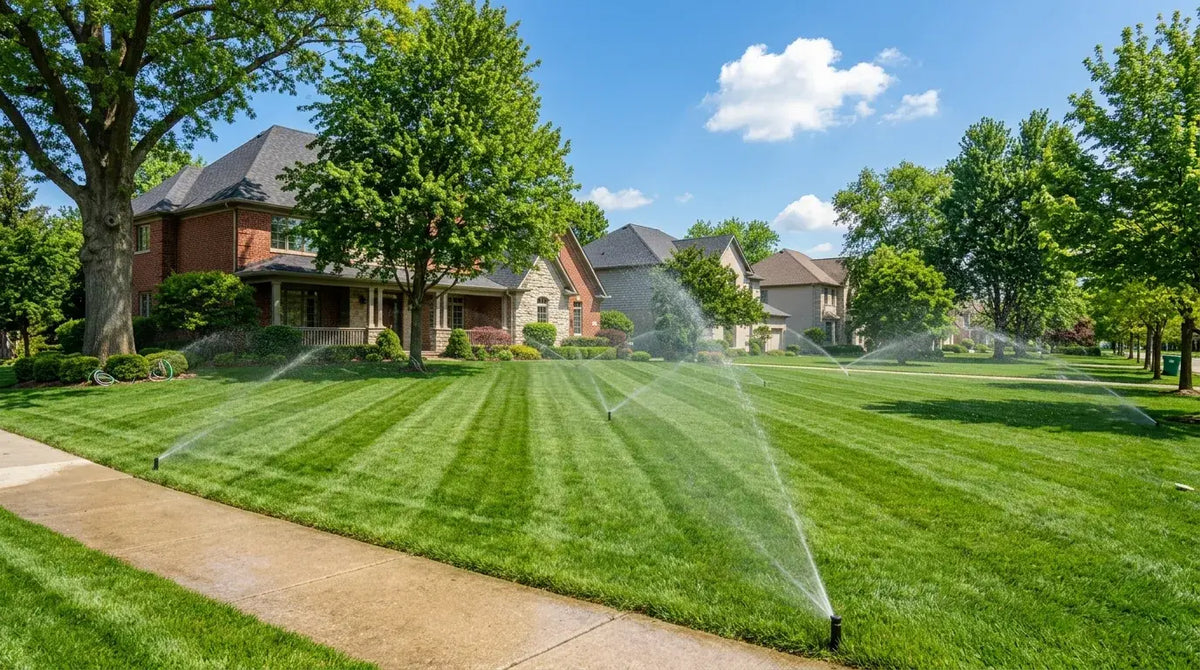
Water established turf based on soil moisture and plant stress, not an automatic daily schedule. Established lawns generally should be watered based on need rather than an automatic calendar schedule. University of Maryland Extension recommends watching for signs such as a blue-gray color or footprints that remain after walking across the grass. When irrigation is necessary, water slowly enough to encourage deeper penetration rather than frequent shallow watering.
For established turf that needs irrigation, wetting the soil to roughly 4–6 inches deep is one practical benchmark. A screwdriver or similar probe can help check how deeply moisture has penetrated.
Cool-season grasses deserve particular attention during summer. Tall fescue and Kentucky bluegrass can slow down or enter dormancy during heat and drought. Dormancy is a survival response, not necessarily a sign that the lawn needs more fertilizer or daily irrigation. In many situations, the grass can recover when cooler, wetter conditions return.
The key distinction is between dormant turf and dead turf. Persistent drought can eventually cause permanent damage, so homeowners should monitor unusually prolonged or severe drought rather than assuming every brown lawn will automatically recover.
Summer Mowing, Fertilizing, and Stress Management
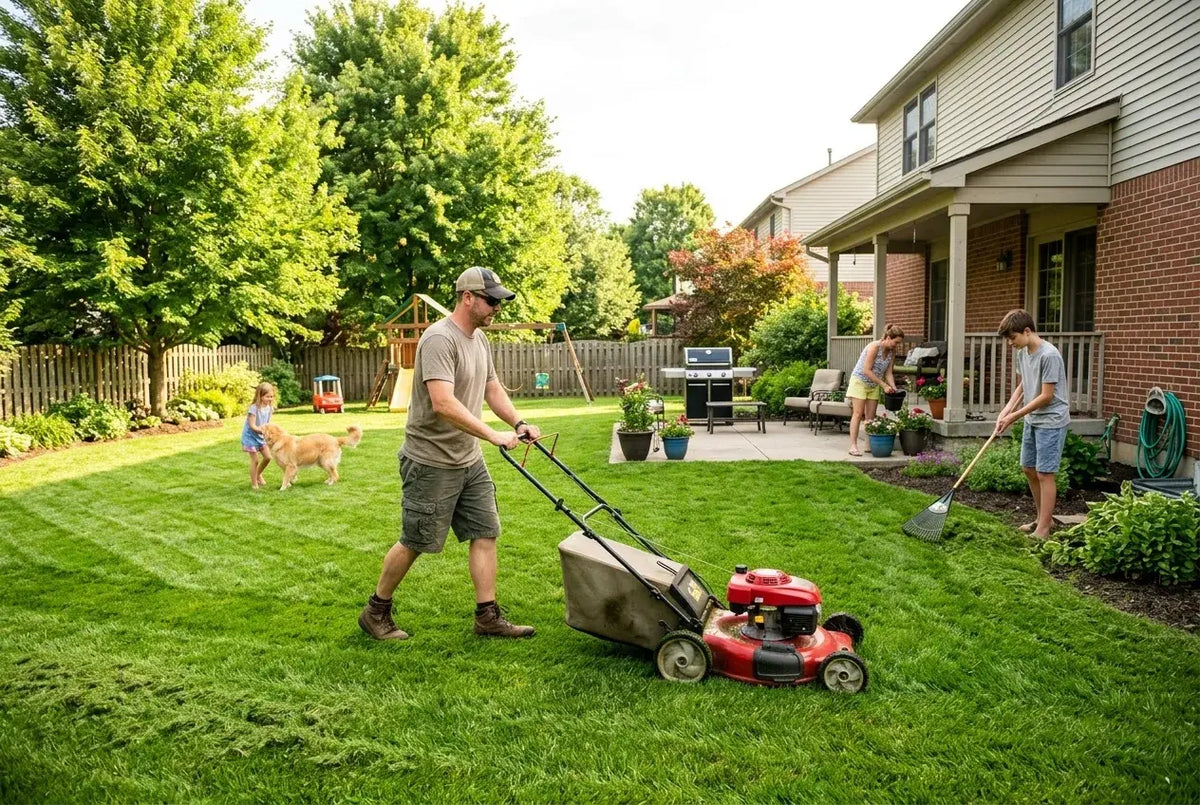
Summer mowing should continue when the grass is actively growing, but mowing frequency should decrease when heat or drought causes growth to slow or stop. Specifically notes that drought-stressed lawns may not require mowing until active growth resumes after rainfall.
For many cool-season lawns, raising the mowing height during hot, dry conditions can help reduce stress. University of Maryland Extension, for example, recommends 3–4 inches for summer mowing of cool-season turf such as tall fescue and fine fescue. The exact target should still match the grass species and local recommendations.
A useful summer decision sequence is:
- Identify the grass type.
- Check whether it is actively growing.
- Adjust mowing frequency and height accordingly.
- Check soil moisture before irrigating.
- Reduce unnecessary foot traffic during severe stress.
- Avoid automatic fertilization of severely heat- or drought-stressed turf.
- Monitor for insects and diseases when symptoms appear.
Do not use an arbitrary temperature such as 90°F as a universal mowing cutoff. The more defensible trigger is whether the turf is actively growing or has stopped growth because of heat or drought. For more info about summer lawn care, see our guide "Summer Lawn Care Complete Guide".
Summer lawn care rule: Protect the lawn from stress instead of forcing green growth at any cost.
Fall Lawn Care: Aeration, Overseeding, Fertilizing, and Recovery
Fall lawn care focuses on recovering from summer stress, rebuilding thin turf, and preparing suitable lawns for winter through aeration, overseeding, fertilizing, and continued basic maintenance. For many cool-season lawns, fall combines strong natural growth with favorable establishment conditions, while warm-season lawns gradually move toward reduced growth and dormancy. For more info about fall lawn care, see our guide "Fall Lawn Care Complete Guide".
Fall Lawn Care Checklist
| Fall Lawn Care Task | What to Do | Main Consideration |
|---|---|---|
| Mowing | Continue while grass is actively growing | Frequency decreases as growth slows |
| Watering | Water established turf when needed | Newly seeded turf needs closer moisture monitoring |
| Core aeration | Core-aerate compacted areas | Perform while grass can recover |
| Overseeding | Seed thin or damaged cool-season areas when appropriate | Good seed-to-soil contact is essential |
| Fertilizing | Fertilize according to grass type and soil needs | Fall timing differs by turf type |
| Weed control | Address persistent weeds appropriately | Avoid harming desirable turf |
| Leaf management | Remove thick leaf layers or mulch suitable amounts | Avoid prolonged heavy leaf cover |
The exact timing varies by grass type and climate. University of Maryland Extension's 2026 lawn calendar, for example, recommends late summer through mid-autumn for core aeration, overseeding, and soil-test-based fertilization on appropriate cool-season lawns, while also recommending irrigation and mowing as needed during continued growth.
Fall Aeration and Overseeding
Core aeration is most useful when soil compaction limits the movement of air, water, or nutrients through the soil. Penn State Extension recommends aerating during cool weather, particularly in early to mid-spring or late summer to early fall, so the turf can recover under favorable growing conditions.
Aeration can also improve the establishment of new seed by creating better contact between seed and soil. Penn State emphasizes that seed-to-soil contact is especially important during overseeding.
For cool-season lawns, late summer into early fall is commonly a strong renovation and overseeding window. University of Maryland Extension identifies late summer to mid-autumn as an important period for core aeration and overseeding of suitable tall fescue lawns.
The basic sequence is:
- Identify the grass type.
- Assess summer damage and turf density.
- Check whether compaction is actually a problem.
- Aerate compacted soil while the grass is actively growing.
- Overseed appropriate thin or bare areas.
- Maintain adequate moisture during establishment.
- Fertilize according to grass type and soil needs.
- Continue mowing while the lawn remains actively growing.
Do not automatically aerate every lawn every year. Aeration is primarily a response to compaction or a specific establishment need, not a universal seasonal ritual.
Fall Fertilizing and Leaf Management
Fall fertilization should support active recovery rather than follow a blanket “fall fertilizer” rule. Many turfgrasses can benefit from nitrogen applications in mid- to late spring and/or late summer to early fall, while phosphorus and potassium requirements should be guided by soil testing.
University of Maryland Extension provides a more grass-specific schedule: late summer into early autumn is a prime period for fertilizing established tall fescue, while warm-season grasses such as zoysia and bermudagrass follow a different seasonal cycle.
For leaves, the main concern is prolonged heavy coverage that blocks light and air from the turf. Leaves can often be shredded with a mower and left to decompose when the amount is manageable, while thick layers should be removed or redistributed. University of Maryland Extension recommends removing thick leaf cover or shredding suitable amounts in place. Wondering when to winterize your lawn? See our "Winterize Lawn Guide" for more info.
Fall lawn care rule: Use the strong cool-season growth period to recover and establish turf, but only apply aeration, seed, fertilizer, and other inputs when the grass type and soil conditions support them.
Winter Lawn Care: Dormancy, Cold Protection, and Lawn Maintenance
Winter lawn care is mainly about protecting dormant or slow-growing turf rather than trying to stimulate growth. The most important steps are limiting traffic on frozen or snow-covered grass, avoiding unnecessary fertilizer or mowing, monitoring unusual winter dryness, and using the dormant season to maintain equipment and prepare for spring. See our "Winter Lawn Care Guide" for more info.
Winter Lawn Care Checklist
| Winter Lawn Care Task | What to Do | Why It Matters |
|---|---|---|
| Foot traffic | Minimize unnecessary traffic on frozen or snow-covered turf | Reduces physical injury |
| Fertilizing | Avoid using fertilizer simply to stimulate dormant grass | Dormant turf cannot use nutrients normally |
| Mowing | Do not mow dormant or non-growing turf | There is little benefit and greater risk of injury |
| Watering | Monitor unusual dry conditions rather than following a routine schedule | Winter moisture needs vary by climate |
| Equipment | Sharpen and maintain mower blades and equipment | Prepare for spring growth |
Winter Dormancy and Turf Protection
Cool-season and warm-season grasses respond differently to winter, but both can experience periods when active growth is greatly reduced or stopped. During those periods, the priority is protecting the turf crown and root system rather than encouraging new leaf growth.
It is advisable to avoid unnecessary walking on frozen or snow-covered turf because traffic can injure the crowns of the plants.
Winter damage can also result from unusual combinations of cold, ice, excess moisture, or dry winter conditions. Because winter conditions vary widely across the United States, watering should not be treated as a universal weekly task. Instead, monitor local conditions and the actual moisture status of the lawn.
Winter Fertilizing and Spring Preparation
Dormant turf should not be fertilized simply because the calendar says winter lawn care has begun. Fertilizer should be timed to the grass's growth cycle and regional recommendations. University Extension guidance consistently emphasizes matching fertilizer timing to turfgrass activity rather than applying nutrients when grass is dormant.
Winter is often more useful as a preparation period. Homeowners can:
- Sharpen or replace mower blades.
- Inspect irrigation equipment.
- Review the previous season's problem areas.
- Plan spring weed management.
- Review soil-test results.
- Identify thin or damaged areas that may need repair.
- Confirm the dominant grass species before selecting treatments.
Winter lawn care rule: Protect dormant turf from physical damage and unnecessary inputs, then use the slower season to prepare for the next active-growth period.
Seasonal Lawn Care Tasks That Should Follow Growth, Not the Calendar
Four seasons lawn care works best when the calendar is used as a guide rather than a fixed schedule. Grass type, active growth, soil moisture, temperature, rainfall, and recent weather can shift the right time for mowing, watering, fertilizing, aerating, and seeding by weeks.
Use Growth Conditions to Time Lawn Care
The most useful approach is to move through four decision points before starting a seasonal lawn care task:
| Check | What to Determine | Why It Matters |
|---|---|---|
| Grass type | Cool-season or warm-season | Determines the main growing periods |
| Growth status | Actively growing, slowing, or dormant | Determines whether mowing, fertilizing, or aeration is appropriate |
| Weather and soil | Temperature, rainfall, and soil moisture | Changes watering and establishment timing |
| Recent lawn conditions | Drought, compaction, summer damage, previous fertilizer | Helps determine which tasks are actually needed |
For example, cool-season grasses generally grow most actively during the milder conditions of spring and fall, while warm-season grasses concentrate growth in warmer weather. A task that is appropriate for one grass type may be poorly timed for another.
When to Adjust the Seasonal Lawn Care Schedule
The normal schedule should be adjusted whenever the biological condition of the lawn conflicts with the calendar. Mowing should follow active growth, watering should follow soil and turf moisture, and fertilizing, aeration, and seeding should be performed when the grass and soil can respond successfully.
Use this sequence:
Calendar → Grass Type → Growth Status → Soil and Weather → Task
This simple decision process prevents several common mistakes:
- Mowing dormant turf because it is normally mowing season.
- Fertilizing during severe heat or drought stress.
- Watering automatically when the soil is already adequately moist.
- Overseeding immediately after applying a product that restricts seed germination.
- Aerating soil that is too wet or choosing a period when the grass cannot recover.
- Applying a treatment without first confirming that the product is safe for the grass species.
The goal is not to abandon a seasonal lawn care calendar. It is to make the calendar responsive to actual turf conditions.
Seasonal Lawn Care Calendar for Cool-Season and Warm-Season Grass
A 4 seasons lawn care calendar is most useful when it separates cool-season and warm-season grasses rather than assigning the same tasks to every lawn. Cool-season grasses generally concentrate growth in spring and fall, while warm-season grasses grow mainly from late spring through summer, so mowing, fertilizing, aeration, and overseeding should follow the grass's active growth cycle.
Seasonal Lawn Care Calendar
| Season | Cool-Season Grass | Warm-Season Grass |
|---|---|---|
| Spring | Resume mowing as growth starts; control spring weeds; assess fertilizer and soil needs; repair thin areas when necessary | Wait for the lawn to green up; begin regular mowing as active growth starts; address weeds and soil needs |
| Summer | Water during prolonged heat or drought; raise mowing height when appropriate; allow suitable turf to go dormant rather than forcing growth | Regular mowing and irrigation as needed; fertilize according to grass type and soil needs; monitor heat, drought, pests, and disease |
| Fall | Continue mowing while actively growing; aerate compacted areas; overseed thin areas; fertilize according to soil needs; manage leaves | Reduce inputs as growth slows; avoid late-season nitrogen applications; manage leaves and prepare for dormancy |
| Winter | Protect dormant or slow-growing turf; avoid unnecessary traffic on frozen or snow-covered grass; maintain equipment | Protect dormant turf; minimize traffic; maintain equipment and prepare for spring |
This table is a seasonal framework rather than a fixed national calendar. For example, University of Maryland Extension identifies late summer to early autumn as the prime period for aerating, overseeding, and fertilizing tall fescue, while zoysia follows a substantially different schedule and may be dormant from mid-autumn into spring.
How to Use the All Season Lawn Care Calendar
Start with the grass type, then check whether the turf is actively growing and whether soil and weather conditions support the planned task. If unusual heat, drought, rainfall, or cold has disrupted the normal growth cycle, delay or modify the task instead of following the calendar blindly.
Use these six questions:
- What grass species dominates the lawn?
- Is the turf actively growing?
- Is the soil too dry, too wet, frozen, or otherwise unsuitable?
- Has the lawn recently experienced significant heat, drought, or cold stress?
- Does the planned treatment conflict with another task, such as seeding?
- Does the product label or local Extension guidance specify a different timing?
That approach turns a generic all-season lawn care calendar into a practical decision system that can work across different U.S. regions.
Seasonal Lawn Care FAQ
All seasons lawn care depends on grass type, climate, growth stage, and weather conditions, so there is no single schedule that works for every lawn. The questions below cover the most common timing and task decisions for year-round lawn maintenance.
Spring: Resume mowing as grass begins active growth, manage weeds, assess soil and fertilizer needs, and repair thin areas when conditions support establishment. Summer: Focus on moisture and heat stress, adjusting mowing and irrigation to actual growth conditions. Fall: Prioritize recovery, aeration, overseeding, and appropriate fertilization for cool-season lawns. Winter: Protect dormant turf and avoid unnecessary traffic or inputs.
Fertilizer timing depends on grass type, soil conditions, previous applications, and local recommendations rather than the season alone. Note that many turfgrasses benefit from nitrogen in mid- to late spring and/or late summer to early fall, while phosphorus and potassium requirements should be determined through soil testing.
Water based on soil moisture and turf stress rather than a fixed weekly schedule. About 1 inch of water per week is a general reference for actively growing turf, but rainfall, soil type, temperature, evaporation, and grass type can substantially change actual requirements. Established cool-season turf may also enter summer dormancy during prolonged heat and drought.
Yes, mowing should follow active growth and heat or drought conditions. Avoid mowing dormant turf, and do not remove more than one-third of the blade at a time. When cool-season grass is under severe summer stress, maintaining an appropriate mowing height and reducing unnecessary traffic can help limit additional damage.
For many cool-season lawns, late summer to early fall is the preferred window for aeration and overseeding. Aeration is particularly useful where soil is compacted, while overseeding can improve thin or bare areas when seed has adequate contact with the soil and enough time to establish before severe cold.
Not as part of a routine schedule, but unusually dry winter conditions can require attention in some climates. Dormant turf generally does not need regular irrigation, while prolonged dry, cold, windy conditions can increase the risk of winter desiccation. Local climate and soil conditions should determine whether supplemental water is necessary.
A seasonal schedule is a better starting point, but actual lawn conditions should determine the final timing. Note that drought, unusual heat, cold, and other weather conditions can require normal seasonal practices to be delayed. Use the calendar to anticipate tasks, then confirm grass growth, soil moisture, and weather before acting.
No. Cool-season and warm-season grasses have different active-growth periods and therefore different mowing, fertilizing, aeration, and overseeding windows. For mixed lawns, recommends basing care on the dominant grass type rather than applying one universal schedule.
Final Seasonal Lawn Care Rule
The most reliable four-season lawn care strategy is not a list of dates. It is a decision process: identify the grass, determine whether it is actively growing, check soil and weather conditions, and then choose the task that fits those conditions.
Spring, summer, fall, and winter provide the framework, but the grass itself determines the timing. That distinction helps prevent the most common seasonal lawn-care mistakes: mowing dormant turf, fertilizing stressed grass, watering by habit, overseeding at the wrong time, or applying a treatment without considering the turf species.
Did you like this article? Add us as a preferred source to find us more easily on Google.