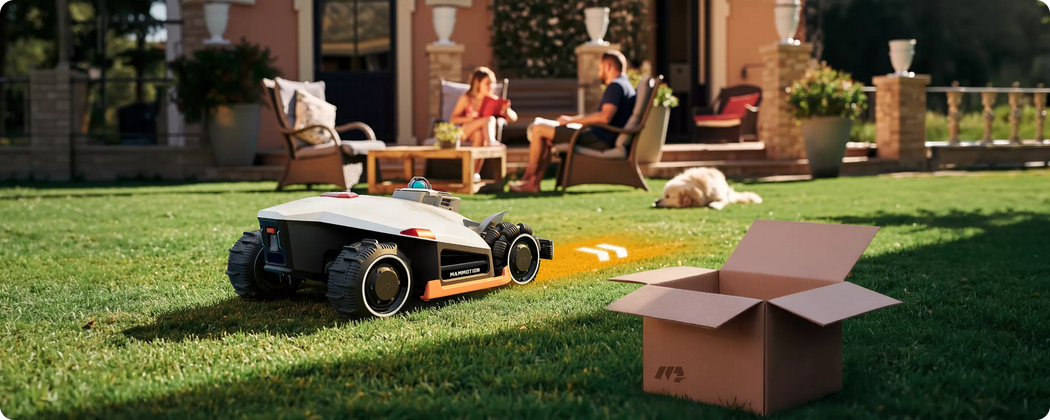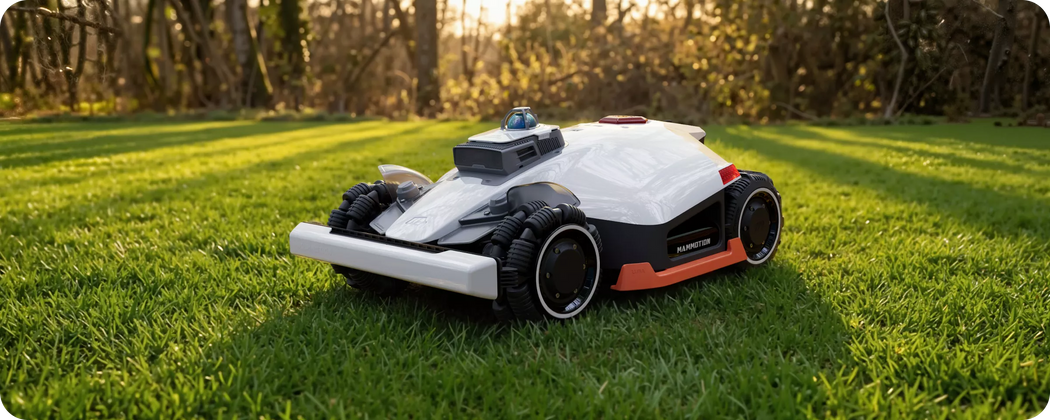







For decades, robotic lawn mowers relied on perimeter wires to define the boundaries of a yard. While effective, these wires came with a cost: hours of installation, difficulty navigating complex garden layouts, and limited flexibility when the landscape changed. Today, a new generation of wireless, AI-powered robotic mowers is transforming how we care for our lawns.
Wire-free mowers aren’t just about convenience. They represent a significant technological leap in precision, safety, and intelligence, bringing the principles of autonomous robotics into everyday life. For homeowners, this means less manual effort, fewer maintenance headaches, and a consistently healthier, more visually appealing lawn.
In this article, we’ll explore how these AI navigation systems work, the technologies powering them — and what they mean for the future of lawn care.
Traditional Robotic Lawn Mower Navigation
Before AI-powered, wire-free systems became a reality, most robotic lawn mowers relied on perimeter wires to define the mowing area. These buried wires serve as invisible fences, guiding the mower along predetermined boundaries and ensuring it stays within the intended area. While this method is effective and has powered robotic mowing for years, it comes with both advantages and notable limitations.
How Perimeter Wire Systems Work
A perimeter wire is typically laid around the edge of a lawn and around obstacles like flowerbeds or trees. The mower senses the wire’s electrical signal and changes direction whenever it reaches the boundary. Some systems also use guide wires to help the mower navigate back to the charging station efficiently.
The system is simple in concept, but it requires manual installation — measuring your lawn, laying the wire, and sometimes fixing it in place with pegs. For complex lawns with curves, slopes, or garden features, installation can be time-consuming and may require adjustments over time.
Pros of Robot Lawn Mowers with Perimeter Wire
- Reliable boundary control: The mower will almost never leave the designated area.
- Consistent mowing patterns: The mower follows the wire, ensuring no lawn sections are missed.
- Proven technology: Perimeter wire mowers have been around for decades and are widely available at affordable prices.
Cons of Robot Lawn Mowers with Perimeter Wire
- Labor-intensive setup: Installing the wire, especially on irregular lawns, can take hours.
- Inflexibility: Any changes to the lawn layout — adding flowerbeds or garden ornaments — require re-laying or adjusting the wire.
- Obstacle navigation is limited: Mowers are constrained by the wire and may struggle to maneuver around temporary objects like toys, furniture, or fallen branches.
- Aesthetics and maintenance: Wires may be visible above ground in some cases, and accidental breaks can interrupt mowing until repaired.
While perimeter wire systems offer reliability, these limitations highlight the need for smarter, more adaptable, wire-free solutions. Modern AI navigation technologies solve these challenges by allowing robotic mowers to understand their environment dynamically, learn the lawn layout, and operate autonomously without the constraints of physical wires.
AI Navigation Technologies in Wire-Free Robot Lawn Mowers
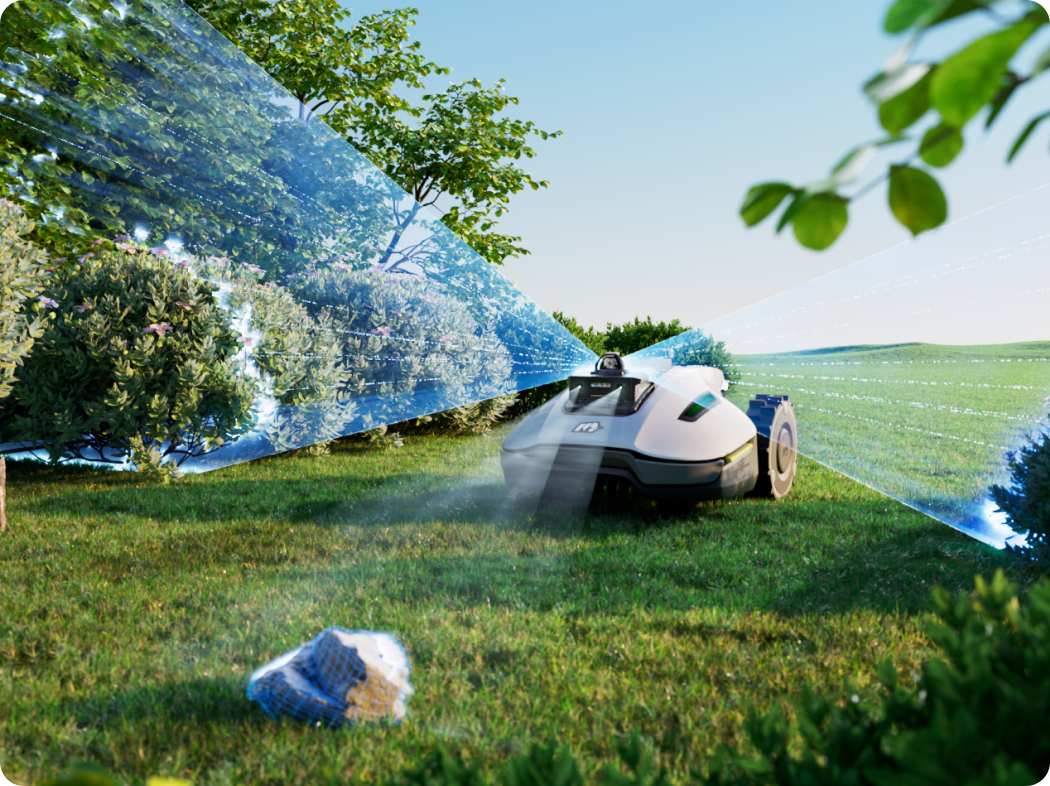
The biggest breakthrough in modern robotic lawn care is wire-free navigation powered by AI. By integrating sensors, computer vision, and high-precision positioning, these mowers can map your lawn, avoid obstacles, and optimize mowing patterns — all without buried perimeter wires. Today, several navigation technologies are leading this revolution, from Vision + RTK and LiDAR + Vision to Mammotion’s Tri-Fusion system.

1. RTK + AI Vision Navigation
Vision + RTK combines AI-powered cameras with Real-Time Kinematic (RTK) GPS to achieve high-precision, wire-free navigation.
- RTK GPS provides centimeter-level accuracy by correcting standard GPS signals with a reference station. This allows the mower to know its exact position on the lawn at all times.
- AI Vision uses cameras and machine learning to detect obstacles, recognize garden features, and map the terrain.
Together, these systems allow the mower to navigate efficiently in moderately open areas while safely avoiding obstacles like trees, garden furniture, or pets. Many premium robotic mowers use this combination as a reliable, proven method for wire-free operation.

2. LiDAR + AI Vision Navigation
For more complex lawns, LiDAR + Vision offers a robust alternative.
- LiDAR (Light Detection and Ranging) emits laser pulses to measure distances to objects, building a dense 3D map of the environment in real time. This helps the mower understand lawn geometry and detect obstacles with high accuracy.
- AI Vision complements LiDAR by identifying objects, distinguishing between static and dynamic obstacles, and enhancing obstacle avoidance.
This combination is particularly effective in shaded areas, under tree canopies, or in lawns with irregular shapes and multiple garden features. By combining geometric precision (LiDAR) with semantic understanding (vision), these mowers can operate safely and efficiently without perimeter wires.
3. Mammotion’s Tri-Fusion Navigation
Leading-edge technology now integrates three complementary systems: LiDAR, RTK GPS, and AI Vision. Mammotion’s Tri-Fusion Positioning System exemplifies this approach.
How Mammotion Tri-Fusion Works:
- Dynamic Sensor Fusion: The mower continuously evaluates which sensor input is most reliable.
-
- RTK handles wide-open areas for precise global positioning.
- LiDAR provides detailed 3D mapping for complex or cluttered spaces.
- Vision interprets subtle visual cues, enhancing obstacle detection.
- Adaptive Mapping: Tri-Fusion enables the mower to maintain ±1 cm accuracy across diverse lawns.
- Wire-Free Operation: No perimeter wires, base stations, or manual setup are required, drastically simplifying installation.

This combination delivers the highest level of autonomy, allowing mowers to learn the lawn over time, dynamically adjust mowing paths, and handle a wide range of obstacles and terrains. It represents the current state-of-the-art in autonomous, wire-free lawn care. Here you can learn more about AI Vision vs. RTK vs. LiDAR, and figure out which one is right for you.
Navigation Technology Comparison in Wire-Free Robot Lawn Mowers
|
Navigation Type |
Core Technologies Used |
Key Strengths |
Limitations |
Best Use Case |
Example Products |
|
AI cameras + onboard processors |
Simple setup, no GPS dependency, strong object recognition |
Lower positional accuracy, affected by lighting/weather |
Small to medium lawns with clear visual boundaries |
||
|
RTK + Vision |
AI cameras + RTK GPS |
Centimeter-level positioning, good obstacle detection |
Requires good satellite signal, may struggle under dense canopy |
Open to moderately complex lawns |
|
|
LiDAR + Vision |
LiDAR sensors + AI cameras |
High-precision 3D mapping, strong performance in shaded areas |
Higher hardware cost, increased power consumption |
Dense, irregular, or tree-covered lawns |
|
|
Tri-Fusion (Mammotion) |
RTK GPS + LiDAR + AI Vision |
Dynamic sensor switching, ±1 cm accuracy, highest autonomy |
Premium pricing, advanced system complexity |
Complex, multi-zone lawns requiring maximum reliability |
By leveraging these AI navigation technologies, modern robotic lawn mowers overcome the limitations of perimeter wires, offering flexible, intelligent, and highly efficient lawn care.
Benefits of Wire-Free AI Robotic Lawn Mowers
The shift from perimeter wires to AI-driven navigation isn’t just a technical upgrade — it fundamentally changes the ownership experience. For homeowners, wire-free robotic lawn mowers deliver practical, day-to-day benefits that traditional systems simply can’t match.
1. No Perimeter Wires, No Installation Hassle
One of the biggest pain points with older robotic mowers is installation. Laying perimeter wires can take several hours and often requires rework if the lawn layout changes. Wire-free AI mowers eliminate this step entirely.
Using digital mapping, satellite positioning, and onboard sensors, these mowers can be set up through a mobile app in minutes. Adjusting boundaries, adding no-go zones, or creating multiple mowing areas becomes a software task rather than a physical one.
2. Smarter Navigation and Adaptive Mowing
AI-powered navigation allows robotic mowers to understand and adapt to the lawn rather than blindly following a wire.
- Optimized mowing paths reduce overlap and missed spots
- Adaptive routing improves efficiency on irregular lawns
- Multi-zone mowing is handled digitally without guide wires
Over time, many AI mowers learn the layout of the yard and improve their coverage patterns, resulting in a more consistent cut and reduced mowing time.
3. Superior Obstacle Detection and Safety
Advanced vision systems, LiDAR, and sensor fusion dramatically improve obstacle awareness.
Wire-free AI mowers can:
- Detect and avoid pets, children, toys, and garden furniture
- Slow down or reroute around dynamic obstacles
- Reduce collision damage to landscaping and mower hardware
This level of safety is particularly important for households with pets or frequently changing yard conditions.
4. Greater Flexibility for Complex and Changing Lawns
Traditional perimeter wire systems are rigid. Any landscaping change — adding a flowerbed, moving a patio, installing new edging — requires physical wire adjustments.
AI navigation systems allow instant updates through software:
- Seasonal lawn changes are easily accommodated
- Temporary obstacles don’t disrupt mowing schedules
- Complex shapes, slopes, and narrow passages are handled more effectively
This flexibility makes wire-free mowers especially appealing for modern landscaping designs.

5. Improved Efficiency and Energy Use
By understanding where they’ve been and where they need to go, AI mowers waste less time and energy.
- Fewer redundant passes
- More predictable battery usage
- Faster return-to-base routing
The result is longer battery life, shorter mowing cycles, and lower overall energy consumption — a win for both convenience and sustainability.
Limitations and Considerations of Wire-Free AI Robotic Lawn Mowers
While wire-free robotic lawn mowers represent a major leap forward in lawn care technology, they are not without trade-offs. Understanding these limitations is essential for homeowners evaluating whether AI-powered navigation is the right fit for their yard.
1. Higher Upfront Cost
Advanced navigation systems come with advanced hardware. Cameras, LiDAR sensors, RTK modules, and onboard processors significantly increase manufacturing costs.
As a result, wire-free AI robotic mowers typically sit at the premium end of the market. For smaller or very simple lawns, traditional perimeter-wire models may still offer better cost efficiency.
2. Dependence on Environmental Conditions
Despite major advances, AI navigation still depends on external factors:
- Vision-based systems can be affected by poor lighting, heavy shadows, fog, or nighttime operation without adequate illumination.
- RTK-based systems require a strong satellite signal and may experience reduced accuracy near tall buildings, dense tree canopies, or steep terrain.
- LiDAR systems perform well in many conditions but can struggle in heavy rain or with reflective surfaces.
- Hybrid systems like Tri-Fusion significantly reduce these risks, but no system is entirely immune.
3. Learning Curve and Software Reliance
Wire-free mowers shift complexity from hardware to software.
- Initial digital mapping may take time for first-time users
- App updates and firmware upgrades are essential for optimal performance
- Occasional recalibration may be required after major yard changes
For tech-averse users, this can feel more complex than a simple wired setup.
4. Battery and Processing Demands
AI navigation requires continuous sensor processing, which increases power consumption.
- LiDAR and real-time vision analysis draw more energy
- Larger lawns may require higher-capacity batteries or multiple charging cycles
- Battery degradation over time remains a long-term consideration
Manufacturers continue to improve efficiency, but energy management is still a critical factor.
5. Not One-Size-Fits-All
Wire-free robotic mowers excel in many scenarios, but they’re not ideal for every lawn.
Choosing the right navigation system depends heavily on lawn size, layout, and user expectations.
Conclusion: Why AI Navigation Is Redefining Robotic Lawn Mowers
The move from perimeter wires to AI-driven navigation marks one of the most significant advancements in robotic lawn care. What was once a rigid, setup-heavy system has evolved into a flexible, intelligent solution capable of understanding and adapting to real-world environments.
By leveraging technologies such as pure vision navigation, Vision + RTK, LiDAR + Vision, and advanced systems like Mammotion’s Tri-Fusion navigation, modern robotic lawn mowers achieve a level of precision, safety, and autonomy that traditional wired models simply cannot match. These systems eliminate installation headaches, improve mowing efficiency, and offer the flexibility required for today’s complex and ever-changing lawns.
For homeowners considering the future of lawn maintenance, one conclusion is clear: AI navigation without perimeter wires isn’t just an upgrade — it’s the new direction of robotic mowing.
Did you like this article? Add us as a preferred source to find us more easily on Google.