


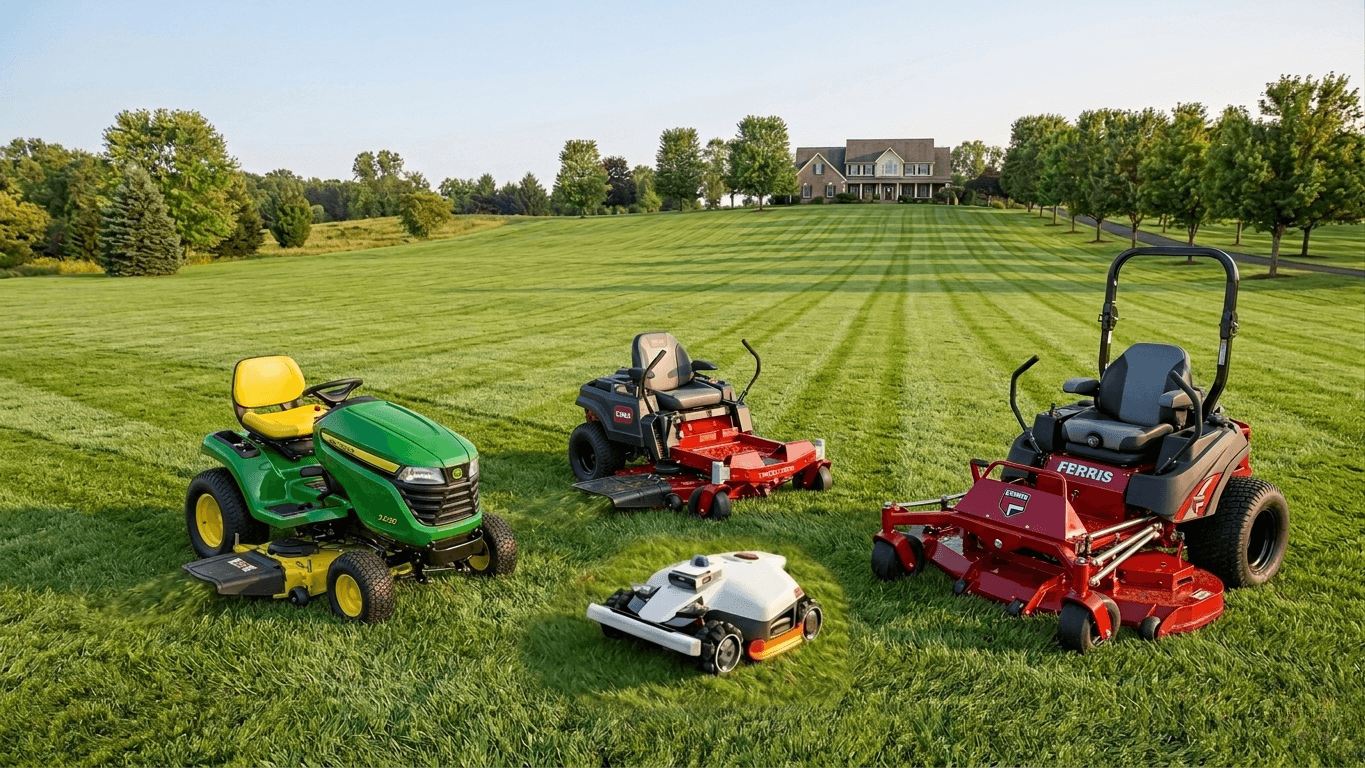
For large yards, there is no single best lawn mower that fits every property.
Choosing the best lawn mower for large yards depends on more than just brand or price. Yard size, terrain, mowing efficiency, and how much time you want to spend mowing all play a critical role in selecting the right machine.
This guide covers the main types of lawn mowers for large yards, compares their real-world performance, and highlights which option works best for different property conditions. It also includes the best mower recommendations for 2026.
If you want a quick recommendation based on large yard conditions, the best lawn mower type depends on how your property is used:
- Best for Fast Mowing on Flat or Open Yards (1–4 Acres): Zero Turn Mower
- Best for Budget & Multi-Purpose (0.5–2 Acres Flat): Lawn Tractor
- Best for Hilly, Sloped, or Complex Obstacle Yards (1–5+ Acres): Stand-On Mower
- Best for Low-Maintenance Automated Lawn Care: Robot Lawn Mower
Each category serves a different purpose, and the “best” choice depends on your terrain, mowing frequency, and how much effort you want to spend maintaining your lawn.
How to Choose the Best Lawn Mower for a Large Yard
Before choosing a mower, it’s important to match the machine to your yard conditions rather than focusing only on brand or engine size. The best lawn mower for a large yard is usually determined by four key factors.
1. Yard Size
For properties under 1 acre, a riding mower or robotic mower is often enough. As lawn size increases beyond 1–2 acres, deck size, mowing speed, and fuel or battery efficiency become much more important.
Larger properties also benefit more from commercial-grade components and wider cutting decks because they significantly reduce mowing time.
2. Terrain and Slope
Flat lawns are ideal for zero-turn mowers and lawn tractors because they maximize speed and affordability on open ground. However, uneven terrain, hills, and rough ground require better traction and stability.
Stand-On mowers are generally more stable on slopes, while some modern robot lawn mowers with AWD systems are designed specifically for complex terrain and steep inclines.
3. Obstacles and Lawn Layout
Yards with trees, fences, flower beds, and narrow passages require more maneuverability than open lawns.
Zero-turn and Stand-On mowers perform exceptionally well around obstacles because of their zero-degree turning radius, while robot lawn mowers are often effective for multi-zone lawns that require frequent navigation around landscaping features.
Open properties with minimal obstacles usually benefit more from larger deck sizes and faster mowing speeds.
4. Maintenance and Time Commitment
Traditional gas-powered mowers require regular maintenance, including oil changes, belts, filters, and blade servicing.
Homeowners who prioritize lower maintenance and automation may prefer robot lawn mowers, while users focused on maximum cutting speed and weekly mowing efficiency often choose zero turn or stand-on mowers instead.
Types of Lawn Mowers for Large Yards Compared
Different mower types are designed for different property conditions. Understanding the strengths and limitations of each category makes it much easier to choose the best lawn mower for a large yard.
|
Mower Type |
Lawn area |
Best For |
Main Advantage |
Main Limitation |
|
Zero Turn Mowers |
1 - 10+ Acres |
Flat to moderately uneven large lawns |
Fastest mowing speed and maneuverability |
Less stable on steep hills, Loud noise |
|
Lawn Tractors |
0.5 - 3 Acres |
Flat and utility-focused properties |
Better stability and towing capability |
Slower mowing speed and high noise |
|
Stand-On Mowers |
1 - 8+ Acres |
Commercial and large-scale mowing |
High productivity and visibility |
Higher cost and less comfort |
|
0.1 - 5+ Acres |
Automated, low-maintenance lawn care |
Minimal manual mowing required |
Higher upfront cost, and the navigation selection is important |
Zero Turn Mowers - Best for Flat to Moderately Uneven Large Lawns
Zero-turn mowers are designed primarily for speed and maneuverability. They are one of the most popular choices for homeowners with large, open lawns because they significantly reduce mowing time compared to traditional riding mowers.
Their dual-hydrostatic transmission system allows extremely tight turning, which helps when mowing around trees, flower beds, and landscaping features.
Lawn Tractors - Best for Flat Terrain and Gentle Slopes Lawns
Lawn tractors are designed for versatility and stability rather than maximum mowing speed. They are often a better choice for properties with little hills, flat terrain, or homeowners who want to tow attachments such as carts, spreaders, or aerators.
Compared to zero-turn mowers, lawn tractors usually offer a more familiar driving experience and improved traction on slopes.
Stand-On Mowers - Best for Slopes or Hills Large Lawns
Stand-on mowers are commonly used in commercial and semi-commercial environments where productivity and maneuverability are both important.
They combine many of the speed advantages of zero-turn mowers with improved visibility and easier on/off access for operators working around complex properties.
Robot Lawn Mowers - Best for Require Low-Maintenance Lawn Care
Robot lawn mowers are designed for automated lawn maintenance with minimal manual mowing effort. Modern systems now support larger properties, multi-zone navigation, RTK positioning, and AWD traction systems for complex terrain.
Unlike traditional mowers that cut large amounts of grass at once, robot lawn mowers maintain lawns through frequent light trimming, helping keep grass height consistently controlled.
Best Lawn Mower for Large Yards 2026
This section highlights the best-performing models in each mower category for large yards in 2026. Each option is selected based on real-world efficiency, durability, and suitability for different property types.
Best Zero Turn Mower for Large Yard: Toro TimeCutter® Zero Turn Mower 42 in

The Toro TimeCutter 42-inch is a residential zero turn mower built around speed, maneuverability, and durability for medium-to-large suburban properties. It uses a 22 HP Briggs & Stratton engine paired with a dual hydrostatic transmission, allowing a top mowing speed of up to 7 mph, which is one of the key reasons it is widely used for 1–3 acre lawns.
The owner features a 42-inch fabricated steel deck (10-gauge IronForged® construction), which improves durability compared to stamped decks commonly found in entry-level residential models. This makes it more suitable for frequent mowing and slightly rougher lawn conditions.
Key Performance Breakdown
- Cutting speed: High (up to 7 mph ground speed)
- Cut quality: Consistent on flat lawns, strong stripe definition with proper blade setup
- Maneuverability: Excellent in tight turns and obstacle-heavy lawns
- Build quality: Above-average residential (commercial-inspired deck design)
- Comfort: Padded seat, step-through design improves usability during long sessions
Best Use Case
- 1–3 acre open or semi-open lawns
- Properties with trees, garden beds, or landscaping obstacles
- Users prioritizing mowing time reduction over versatility
Limitations (Important)
- Not ideal for steep slopes due to zero turn rear-wheel behavior
- Performance decreases on very rough or uneven terrain
- No utility/towing focus compared to lawn tractors
Best Lawn Tractor for Large Yard: John Deere X330 Lawn Tractor with 48-inch Deck

The John Deere X330 is a mid-range lawn tractor in the X300 series, designed for homeowners who need reliable performance on 1–3+ acre properties with mixed terrain. It is powered by a 22 HP cyclonic V-twin engine, paired with a 48-inch Accel Deep™ mower deck, which is engineered for strong airflow and consistent cut quality even in thicker grass conditions.
Unlike zero turn mowers that prioritize speed, the X330 focuses on traction, stability, and long-term durability, making it more suitable for sloped or uneven yards. Its hydrostatic transmission with Twin Touch™ foot pedals allows smooth forward and reverse control, which is especially useful when mowing larger properties that require frequent direction changes.
Key Performance Breakdown
- Cutting performance: Consistent and stable, especially in medium-to-tall grass conditions
- Terrain handling: Strong stability on slopes and uneven ground (better than most zero turn mowers in this segment)
- Maneuverability: Moderate — not designed for tight obstacle navigation
- Build quality: Heavy-duty residential frame with long service life focus
- Versatility: Strong towing capability for carts, spreaders, aerators, and other yard attachments
Best Use Case
- 1–3+ acre lawns with hills or mixed terrain
- Homeowners who need all-purpose yard maintenance capability
- Users who value stability and utility over mowing speed
- Properties where towing and attachments are frequently used
Limitations
- Slower mowing speed compared to zero turn mowers
- Larger turning radius reduces efficiency in obstacle-heavy lawns
- Less suitable for users whose main goal is fast weekly mowing completion
Why It Fits Large Yards
The X330 is not designed to be the fastest mower in its class. Instead, it is positioned as a durable, stable, multi-purpose machine that can handle long-term use across varied terrain conditions. For many homeowners with large yards, this balance of stability and versatility is more important than raw mowing speed.
Best Stand-On Mower for Large Yard: Ferris SRS™ Z3X Soft Ride Stand-On Mower

The Ferris SRS Z3X is a commercial-grade stand-on mower designed for professional landscaping productivity, especially on large properties with varied terrain. It is positioned above residential zero-turn mowers in terms of durability and workload capacity, and is commonly used in commercial mowing operations.
A key engineering feature is its suspension platform system, which reduces operator fatigue by absorbing vertical impacts during long mowing sessions. This is especially important in stand-on mowers, where weight distribution and vibration control directly affect productivity over time.
The mower also uses a pivoting front axle design, which allows all four wheels to maintain ground contact more consistently on uneven terrain. This improves traction and stability on slopes compared to traditional zero-turn mowers, which can lose grip in similar conditions.
Key Performance Breakdown
- Cutting speed: Very high (commercial productivity level, up to ~12 mph travel speed depending on configuration)
- Cut quality: Professional-grade, consistent across large open areas
- Terrain handling: Strong on slopes due to pivoting axle + low center of gravity design
- Productivity: High efficiency for large acreage mowing cycles
- Operator system: Stand-on platform improves visibility and reduces mounting/dismounting time
Best Use Case
- 3+ acre properties or large open commercial-style lawns
- Landscaping professionals or semi-commercial users
- Properties requiring frequent mowing cycles with high efficiency targets
- Users prioritizing productivity over long-duration seated comfort
Limitations
- Less comfortable than sit-down zero turn mowers for long continuous sessions
- Not ideal for homeowners who prioritize comfort over speed
- Higher cost and maintenance complexity compared to residential mowers
- Overkill for typical 1–2 acre suburban lawns
Why It Performs Well on Large Yards
The Z3X is designed not just for speed, but for sustained productivity under workload pressure. Compared to residential zero turn mowers, it improves efficiency in two key ways:
- Faster operator transitions (stand-on mounting/dismounting efficiency)
- Better traction and stability on uneven or sloped terrain
This makes it particularly effective for large properties where mowing time, not just cut speed, is the limiting factor.
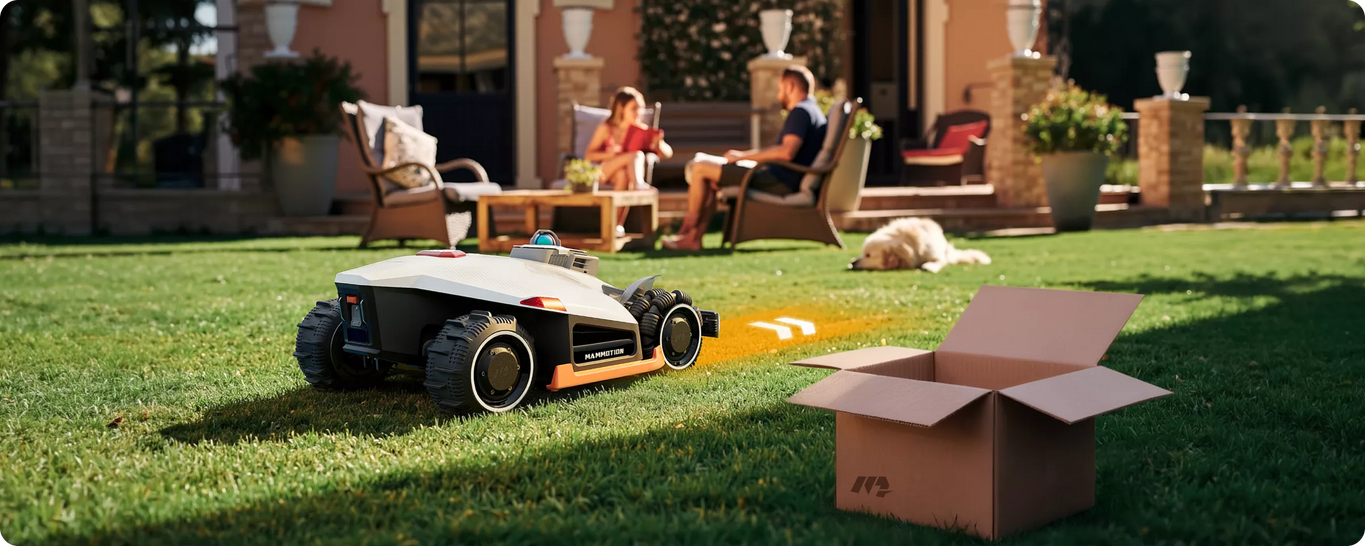
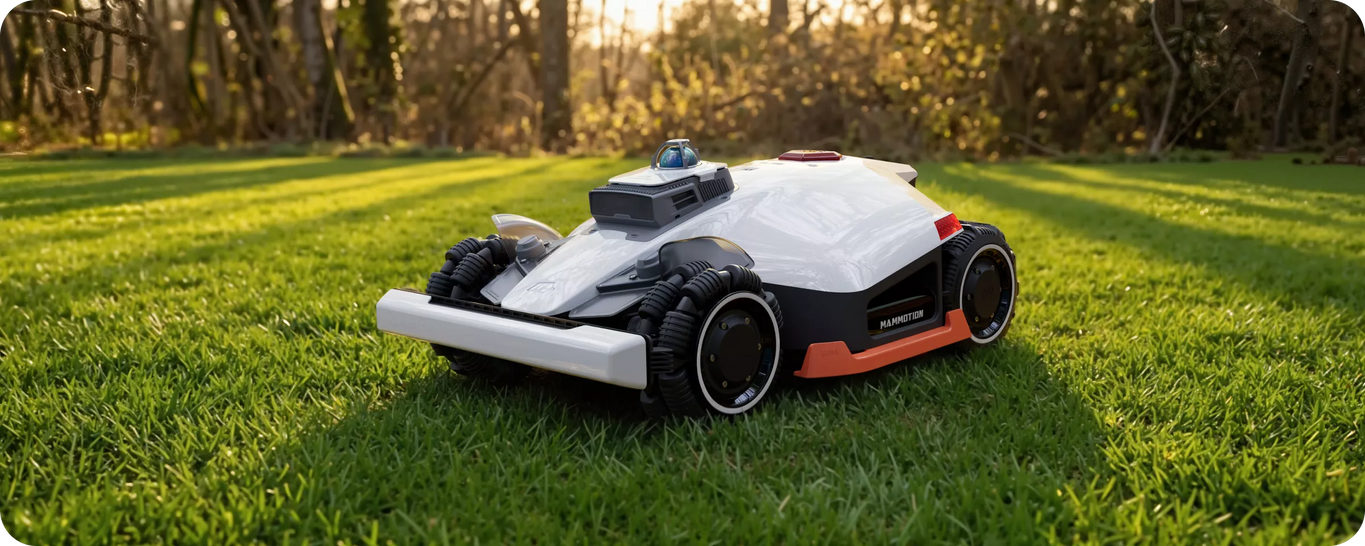
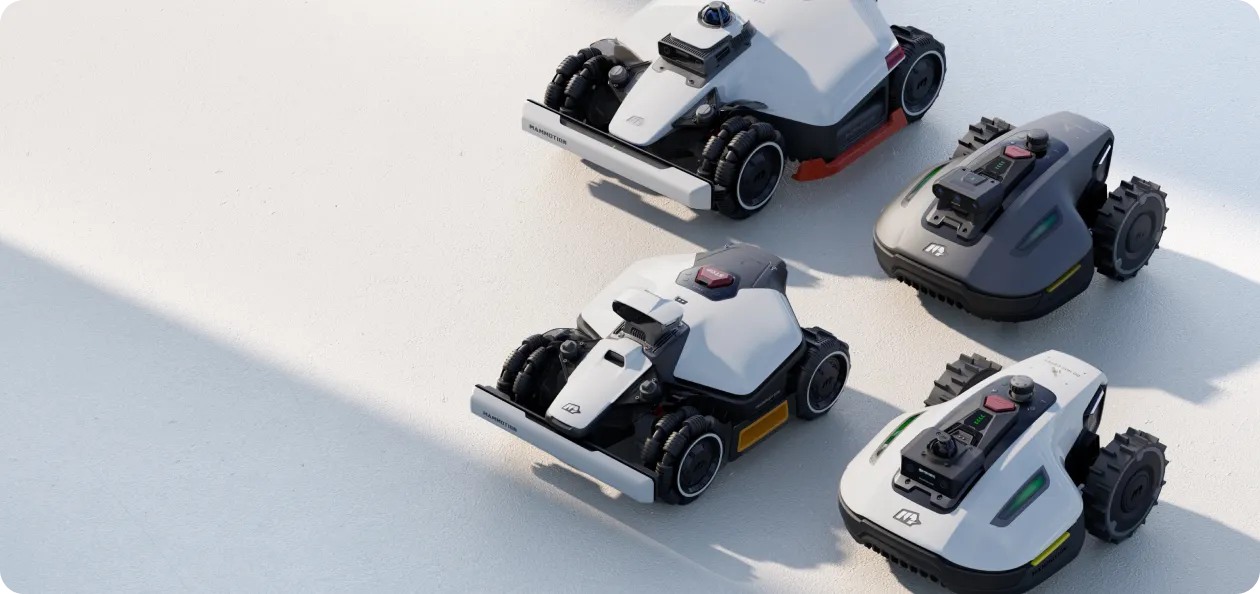
Best Robot Lawn Mower for Large Yard - Mammotion LUBA 3 AWD 5000

The Mammotion LUBA 3 AWD 5000 is a wire-free autonomous robot lawn mower designed for large, complex residential properties. It uses Mammotion’s Tri-Fusion navigation system, combining 360° LiDAR, NetRTK positioning, and dual-camera AI vision, which enables centimeter-level mapping accuracy and stable navigation across varied lawn conditions.
Unlike traditional robot mowers that rely on boundary wires or simpler RTK-only systems, the LUBA 3 AWD is built to handle multi-zone layouts, obstacle-heavy gardens, and uneven terrain without physical perimeter installation. It is positioned as a high-end solution for homeowners who want to significantly reduce manual mowing time rather than simply replace a push mower.
Its all-wheel-drive system (AWD) allows it to maintain traction on steep slopes and rough terrain, making it suitable for yards that would typically be challenging for standard robotic mowers.
Key Performance Breakdown
- Navigation system: Tri-Fusion (LiDAR + RTK + AI Vision) for high-precision mapping and obstacle awareness
- Slope handling: Up to ~80% incline capability depending on terrain conditions
- Cutting system: Dual-disc cutting system with adaptive power adjustment based on grass density
- Automation level: Fully autonomous mowing with scheduled multi-zone operation
- Obstacle handling: AI-based detection designed for complex residential environments
Best Use Case
- 1.25 Acres Large residential lawns (especially multi-zone properties)
- Yards with trees, narrow passages, and complex layouts
- Homeowners prioritizing automation over mowing speed
- Properties with slopes or uneven terrain where traditional mowers are less efficient
Limitations
- Requires initial setup, mapping, and zone configuration
- Slower “completion speed” compared to ride-on mowers (it maintains rather than finishes in one session)
- Higher upfront investment than conventional lawn mowers
- Performance depends on signal quality and environmental conditions (trees, fences, coverage)
Why It Fits Large Yards
The LUBA 3 AWD 5000 is not designed to replace high-speed mowing equipment like zero turn or stand-on mowers. Instead, it changes the mowing model entirely: from periodic manual cutting to continuous automated lawn maintenance.
This makes it particularly effective for homeowners who value long-term convenience and consistent lawn appearance over single-session mowing speed.
Quick Comparison of the Best Lawn Mowers for Large Yards (2026)
|
Product |
Toro TimeCutter 42" |
John Deere X330 48" |
Ferris SRS Z3X |
|
|
Category |
Zero Turn Mower |
Lawn Tractor |
Stand-On Mower |
Robot Lawn Mower |
|
Best For |
Fast residential mowing |
Hills + utility + towing |
High-efficiency large mowing |
Automated lawn maintenance |
|
Yard Size |
1–3 acres |
1–3+ acres |
3+ acres |
0.1–5+ acres |
|
Speed |
⭐⭐⭐⭐ |
⭐⭐⭐ |
⭐⭐⭐⭐ |
⭐⭐⭐ |
|
Terrain Handling |
⭐⭐⭐ |
⭐⭐⭐⭐ |
⭐⭐⭐⭐ |
⭐⭐⭐⭐AWD |
|
Maneuverability |
⭐⭐⭐⭐⭐ |
⭐⭐ |
⭐⭐⭐⭐ |
⭐⭐⭐⭐ navigation-based |
|
Cost Manual Time |
⭐⭐⭐⭐ |
⭐⭐⭐⭐⭐ |
⭐⭐⭐⭐ |
⭐ |
|
Maintenance |
⭐⭐⭐⭐ |
⭐⭐⭐ |
⭐⭐⭐⭐⭐ |
⭐ |
|
Learning Curve |
⭐⭐⭐ |
⭐⭐ |
⭐⭐⭐ |
⭐⭐ |
|
Key Strength |
Cutting speed |
Stability + versatility |
Productivity + durability |
Automation + no mowing effort |
|
Main Limitation |
Poor on slopes |
Slower mowing speed |
Cost + overkill for homeowners |
Setup + slower completion |
Mistakes to Avoid When Buying a Lawn Mower for Large Yards
Choosing the best lawn mower for a large yard is not only about picking the right type—it is also about avoiding common buying mistakes that can lead to poor performance, higher costs, or long-term frustration.
❌ Buying a Mower With Too Small Deck Size
One of the most common mistakes is underestimating how much cutting width matters for large properties.
A smaller deck size means more passes, longer mowing time, and unnecessary wear on both the machine and the operator. For large yards (typically 1+ acres), insufficient deck size becomes a long-term efficiency problem rather than just a minor inconvenience.
❌ Choosing a Zero Turn Mower for Steep Hills
Zero-turn mowers are often selected for their speed, but they are not always the best choice for sloped terrain.
On steep or uneven hills, traction and stability become more important than turning speed. In these cases, lawn tractors or AWD-equipped machines generally provide safer and more consistent performance.
❌ Overpaying for Commercial-Grade Equipment
Commercial mowers like stand-on models are built for durability and productivity under heavy workloads, but they are not always necessary for residential users.
For most homeowners with 1–3 acre lawns, residential or mid-tier equipment provides sufficient performance without the added cost, weight, and maintenance requirements of commercial machines.
❌ Ignoring Long-Term Maintenance Costs
Many buyers focus only on the upfront price and overlook ongoing maintenance requirements.
Gas-powered zero-turn mowers and tractors require regular servicing such as oil changes, belt replacements, and blade maintenance. Robot lawn mowers reduce many of these tasks but may require a higher initial investment and occasional software or system maintenance.
Understanding total cost of ownership is essential when selecting the best lawn mower for a large yard.
Final Thoughts
Choosing the best lawn mower for a large yard ultimately comes down to matching the machine to your specific property conditions and how you want to manage your lawn over time.
If your priority is sheer speed on flat, open terrain, a zero-turn mower will usually deliver the most efficient results. For sloped or mixed-terrain yards where traction and operator safety are critical, a stand-on mower provides superior hill stability and weight distribution. If you have a flat yard but need a budget-friendly machine that doubles as a utility vehicle to haul dirt or plow snow, a lawn tractor offers the best versatility. Finally, for homeowners who want to minimize manual mowing altogether, modern robot lawn mowers offer a more automated long-term solution.
There is no single “best” option for every yard. The right choice is the one that balances performance, terrain handling, maintenance requirements, and your personal time commitment.