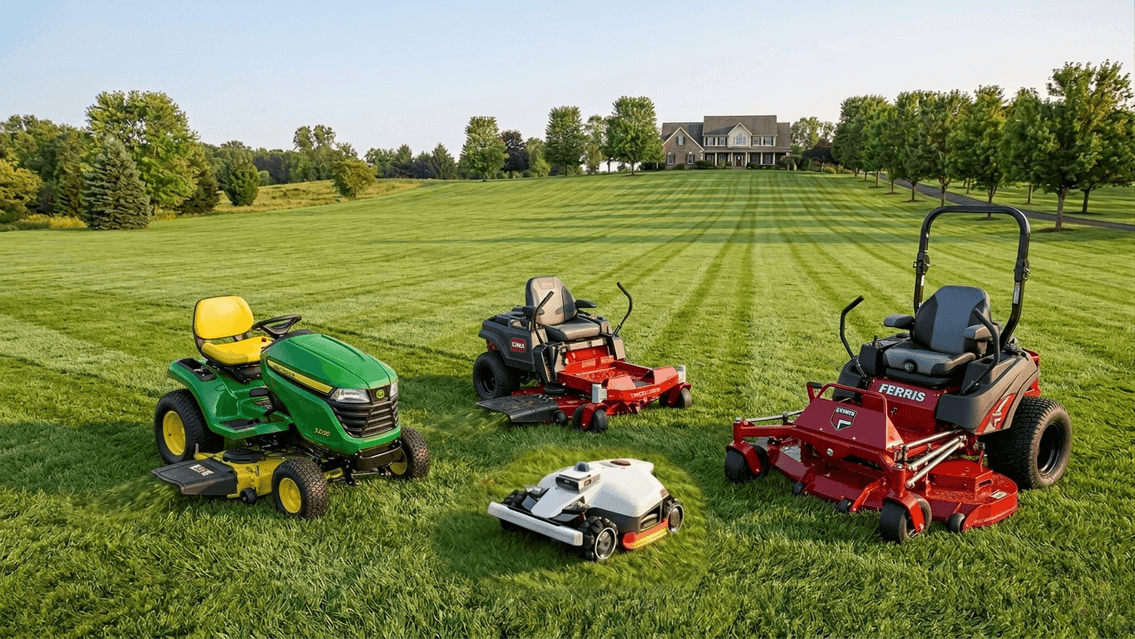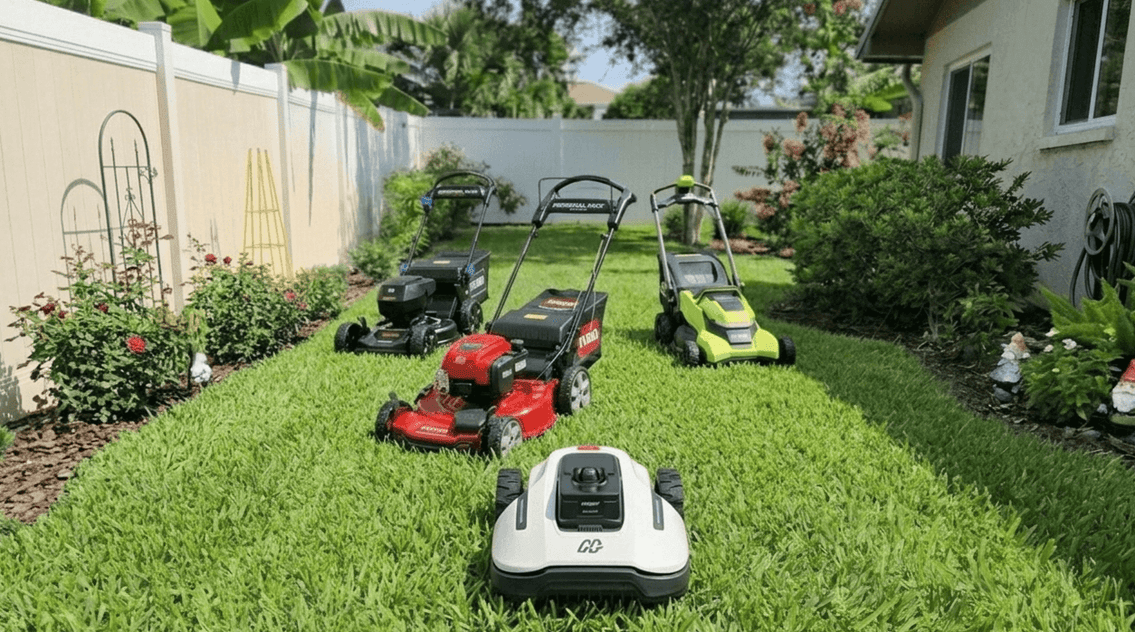







A 1 acre lawn is large enough that mower type can significantly impact mowing time, effort, and overall maintenance. While smaller yards may be manageable with a standard walk-behind mower, maintaining an acre of grass often requires a more efficient solution.
This guide compares four common mower categories used on 1 acre properties—riding tractors, zero-turn mowers, electric self-propelled mowers, and robot lawn mowers. Rather than focusing on specifications alone, the comparison examines how each type performs in real-world residential lawn conditions.
- Best Riding Lawn Mower for 1 Acre Lawns: John Deere S100 42-in
- Best Zero-Turn Mower for 1 Acre Lawns: Toro TimeCutter 42-inch
- Best Electric Self-Propelled Mower for 1 Acre Lawns: EGO POWER+ 22”
- Best Robot Lawn Mower for 1 Acre Lawns: Mammotion LUBA 3 AWD 5000
What to Expect When Maintaining a 1 Acre Lawn
Maintaining a 1 acre lawn involves more time, effort, and equipment capability than smaller residential yards. At this scale, mowing is no longer a quick household task but a recurring maintenance activity that can vary significantly depending on lawn conditions and mower type.
1. Mowing Time Becomes a Meaningful Factor
At the 1 acre level, mowing time can range from under an hour to well over that depending on the equipment being used. Riding and zero-turn mowers typically reduce mowing duration compared to walk-behind options, while robotic mowers shift the process into continuous maintenance rather than single-session cutting.
Because of this, time efficiency becomes one of the first practical considerations for most homeowners when selecting a mower.
2. Lawn Conditions Have a Strong Impact on Difficulty
Not all 1 acre lawns require the same level of effort. Open, flat lawns are generally easier to maintain, while properties with slopes, trees, garden beds, or narrow access areas can significantly increase mowing complexity.
In many cases, the physical layout of the lawn can have as much influence on mower performance as the mower itself.
3. Equipment Choice Directly Affects Overall Effort
The physical effort required to maintain a 1 acre lawn varies widely depending on mower type. Riding and zero-turn mowers reduce manual labor by allowing seated operation, while self-propelled electric mowers still require walking and steering throughout the mowing process.
Robot mowers remove most physical effort after initial setup, but shift the workload toward configuration and ongoing system management.
Best Lawn Mower Types for 1 Acre Compared
This section compares the four most common mower categories used for maintaining approximately 1 acre of lawn. Instead of focusing on individual models alone, the comparison highlights how each mower type performs in real-world residential conditions, including mowing efficiency, ease of use, and operational limitations.
Because a 1 acre lawn can vary significantly in layout and terrain, the effectiveness of each mower type depends not only on cutting power but also on maneuverability, runtime, and maintenance requirements.
Best Lawn Mower Types for 1 Acre: Full Comparison Overview
Before evaluating each mower category in detail, it is useful to understand how they compare across key performance factors.
|
Mower Type |
Best Overall Use Case |
Time Efficiency |
Ease of Use |
Maintenance Level |
Key Limitation |
|
Riding Lawn Mower |
Balanced residential mowing |
Medium |
High |
Medium |
Slower compared to a zero-turn |
|
Zero-Turn Mower |
Large open lawns |
High |
Medium |
Medium–High |
Learning curve and terrain sensitivity |
|
Electric Self-Propelled Mower |
Light to moderate maintenance lawns |
Medium |
High |
Medium |
Battery runtime limitations |
|
Robot Lawn Mower |
Automated lawn maintenance |
Continuous |
Very High |
Low–Medium |
Setup and mapping complexity |
This comparison reflects general real-world usage patterns rather than manufacturer specifications, as actual performance can vary based on terrain, grass density, and mowing frequency.
Best Riding Lawn Mower for 1 Acre Lawns (John Deere S100 42-in)
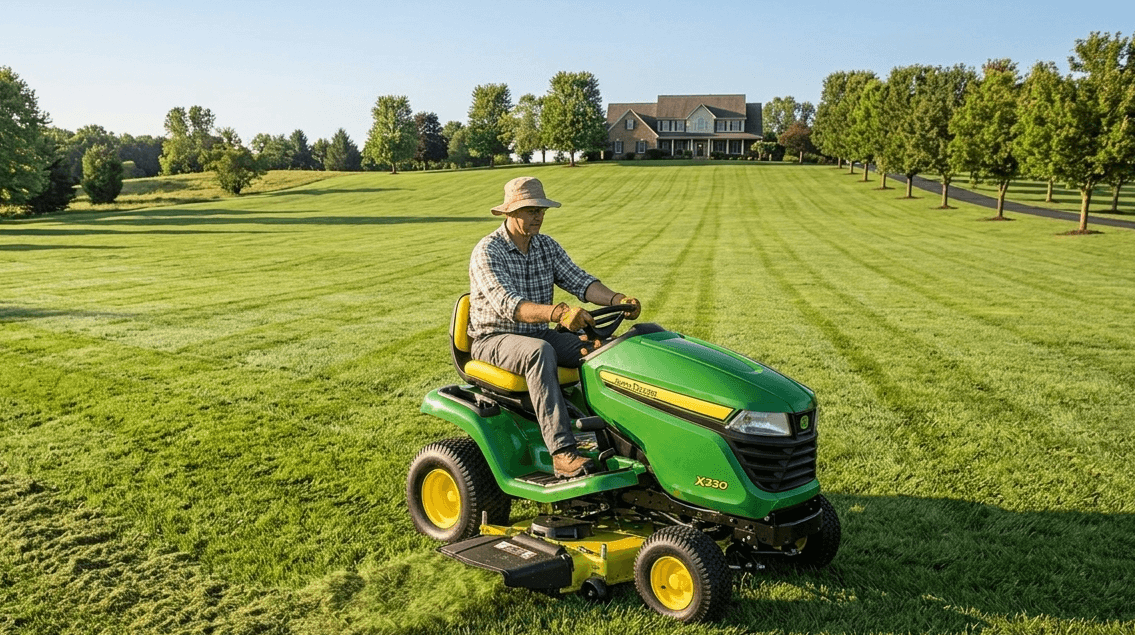
Riding tractor mowers are one of the most commonly used categories for maintaining 1 acre residential lawns. They are typically designed to balance ease of operation, stability, and affordability, making them a common starting point for homeowners upgrading from walk-behind mowers.
The John Deere S100 is an entry-level riding tractor that represents this category well, particularly for standard suburban 1 acre properties with mixed terrain and moderate mowing frequency.
John Deere S100 42-in Riding Mower Overview

The John Deere S100 is positioned as a residential riding lawn tractor designed for general-purpose lawn maintenance. It features a 42-inch cutting deck and is commonly used on small to mid-sized residential properties, including lawns around the 1 acre range.
Its design prioritizes ease of use and stability rather than maximum mowing speed. As a result, it is often considered a practical option for users who prefer a straightforward mowing experience without a steep learning curve.
Real-World Performance for 1 Acre Lawns
In real-world use, the S100 performs reliably on 1 acre lawns, particularly in yards with uneven terrain or mild slopes. The riding tractor format provides stable control and reduces physical strain compared to walk-behind mowers.
However, mowing efficiency is moderate rather than fast. Compared to zero-turn mowers, the S100 typically requires more time to complete the same area due to its wider turning radius and lower maneuverability in tight sections.
It is generally better suited for users who prioritize control and consistency over mowing speed.
Best Zero-Turn Mower for 1 Acre Lawns (Toro TimeCutter 42-inch)
Zero-turn mowers are designed for efficiency and maneuverability, and they are typically used in residential and light commercial lawn maintenance where reducing mowing time is a priority. Compared to riding tractors, they use a dual-lever steering system that allows tighter turning radiuses and more efficient coverage around open lawn areas.
The Toro TimeCutter 42-inch model represents a residential zero-turn mower designed for homeowners who want faster mowing performance on relatively open properties, including lawns around the 1 acre range. Its 42-inch cutting deck is sized for balancing coverage efficiency with maneuverability in typical suburban environments.
Toro TimeCutter 42” Zero Turn Mower Overview

The Toro TimeCutter 42-inch zero-turn mower is a residential-grade machine designed for efficiency-focused lawn maintenance. It uses a lap-bar steering system that enables independent wheel control, allowing the mower to pivot in place rather than requiring wide turning arcs like a riding tractor.
With a 42-inch cutting deck, it is optimized for medium to large residential lawns, where open space allows the machine to fully utilize its speed advantage. This makes it particularly effective in flat or relatively unobstructed 1 acre properties.
The design emphasizes mowing efficiency and reduced cutting time, rather than slow, controlled operation over complex terrain.
Real-World Performance for 1 Acre Lawns
In real-world conditions, the Toro TimeCutter generally reduces mowing time compared to riding tractors on 1 acre lawns, especially in open layouts with fewer obstacles. The tighter turning capability reduces overlap between passes, which improves overall efficiency.
However, performance benefits are most noticeable in flatter yards. On uneven terrain or in obstacle-heavy layouts, the efficiency advantage may be reduced, as more careful maneuvering is required to maintain control and avoid turf damage.
While the TimeCutter significantly improves mowing speed, it typically requires some adjustment period for users who are new to zero-turn steering systems.
Best Electric Self-Propelled Mower for 1 Acre Lawns (EGO POWER+ 22”)
Electric self-propelled mowers represent a different approach to lawn maintenance compared to riding or zero-turn mowers. Instead of prioritizing cutting capacity through larger decks and higher speeds, they focus on battery-powered operation, lower maintenance requirements, and reduced noise levels.
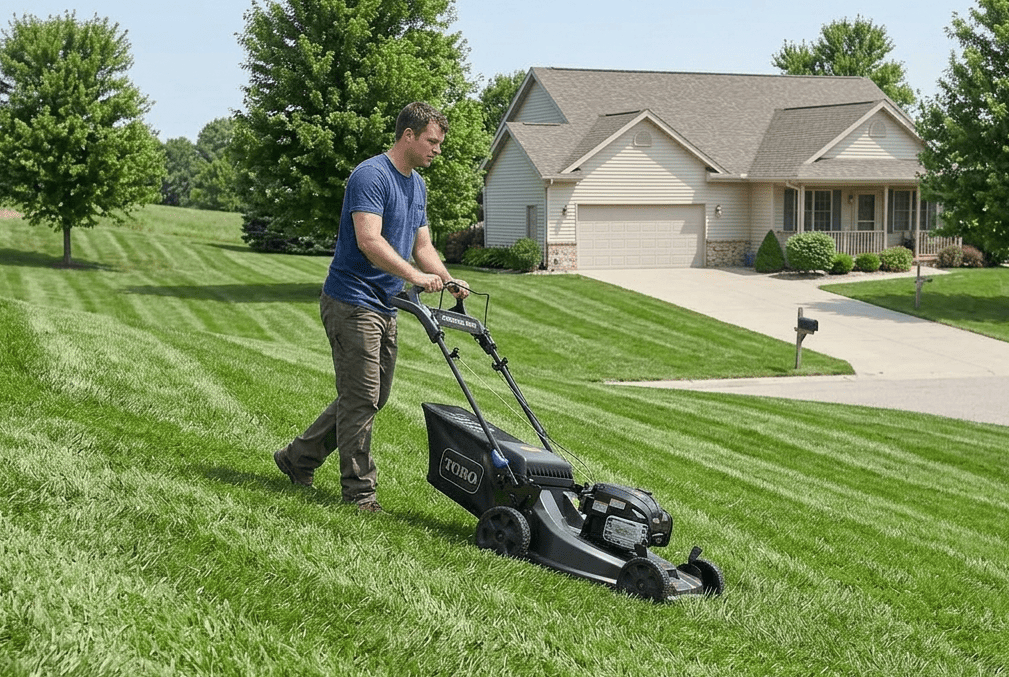
The EGO POWER+ 22-inch self-propelled mower (LM2236SP) is a widely used example in this category. It is designed for homeowners who prefer electric operation without the effort of pushing the mower manually, using a motor-driven propulsion system to assist movement during mowing.
EGO POWER+ 22” Self-Propelled Mower Overview
The EGO LM2236SP is a battery-powered self-propelled mower featuring a 22-inch cutting deck and a dual-battery system designed to extend runtime compared to single-battery electric mowers. It uses a brushless motor system that drives both blade rotation and wheel propulsion.
In residential use, it is commonly positioned as a low-maintenance alternative to gas-powered walk-behind mowers, particularly for users who prioritize ease of storage, quieter operation, and reduced mechanical servicing.
However, due to its walk-behind format and limited cutting width, it is structurally different from riding or zero-turn mowers in terms of scale and efficiency.
Real-World Performance for 1 Acre Lawns
In real-world conditions, the EGO self-propelled mower can handle 1 acre lawns, but performance is highly dependent on grass conditions, terrain, and mowing frequency.
For a full 1 acre cut in a single session, runtime becomes a key constraint. In many cases, users may need to manage mowing in segments or rely on additional battery sets depending on grass density and environmental conditions.
Because of its 22-inch cutting deck, coverage efficiency is significantly lower than riding or zero-turn mowers. This means total mowing time is substantially longer, especially in thicker or taller grass conditions.
As a result, this category is often more practical for maintenance mowing rather than full-acre cutting in a single continuous session.
Best Robot Lawn Mower for 1 Acre Lawns (Mammotion LUBA 3 AWD 5000)
Robot lawn mowers represent a fundamentally different approach to lawn care compared to riding, zero-turn, or walk-behind mowers. Instead of completing mowing in a single session, they are designed to maintain grass continuously through frequent, automated cutting cycles.
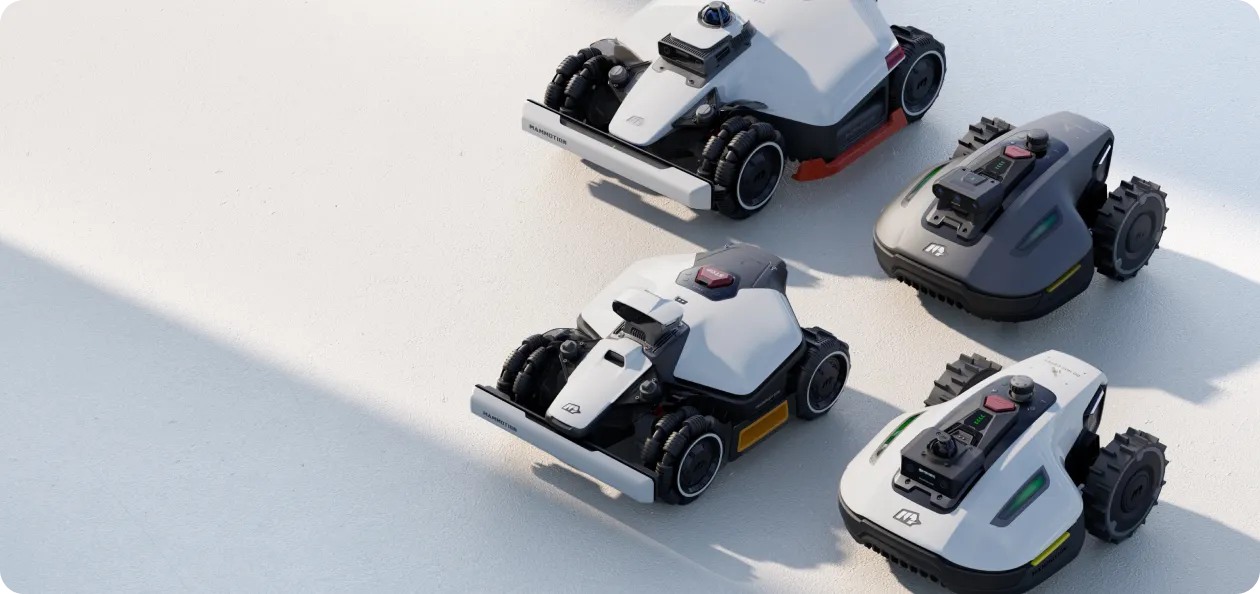
The Mammotion LUBA 3 AWD 5000 is an example of a modern all-wheel-drive robotic mower designed for residential properties up to and beyond 1 acre. It uses Tri-fusion navigation (NetRTK+LiDAR+AI Vision) to operate without a traditional perimeter wire, allowing it to map and maintain defined mowing zones autonomously.
Mammotion LUBA 3 AWD 5000 Robot Mower Overview

The LUBA 3 AWD 5000 is a fully autonomous robotic mower designed for complex residential lawns. It uses Tri-fusion positioning to navigate combined with AI and maintain precise mowing paths without requiring physical boundary wiring in most setups.
Its all-wheel-drive system allows it to handle slopes and uneven terrain more effectively than many earlier-generation robotic mowers. The mower operates within defined digital boundaries that are configured during initial setup through a mapping process.
Unlike traditional mowers, its cutting system is designed for frequent, light trimming rather than periodic heavy cutting, which changes how lawn maintenance is approached at the system level.

Real-World Performance for 1 Acre Lawns
In real-world use, robotic mowers like the LUBA 3 AWD handle 1 acre lawns through continuous or scheduled mowing cycles rather than completing the entire area in a single session.
This means the lawn is maintained incrementally over time, resulting in a consistently trimmed appearance rather than periodic “full cuts.” Performance depends heavily on initial setup quality, mapping accuracy, and environmental factors such as satellite signal strength and terrain complexity.
For properties with multiple zones or irregular layouts, robotic mowers can reduce manual labor significantly once properly configured. However, the initial setup phase requires more effort compared to traditional mower types, and performance is closely tied to boundary definition and navigation reliability.
Comparative Analysis of Lawn Mower Types for 1 Acre Lawns
Understanding how different mower types perform across key real-world factors is essential when evaluating options for a 1 acre lawn. Rather than focusing on individual models, this section compares the four mower categories based on time efficiency, physical effort, and operational complexity.
Mowing Time Comparison for 1 Acre Lawns
|
Mower Type |
Typical Time Pattern |
Real-World Interpretation |
|
Riding Tractor |
Moderate (about 60–90 minutes) |
Balanced speed with stable operation |
|
Zero-Turn Mower |
Fast (about 30–60 minutes) |
Most efficient for open lawn layouts |
|
Electric Self-Propelled Mower |
Slow to moderate (90+ minutes) |
Depends heavily on battery and mowing conditions |
|
Robot Lawn Mower |
Continuous cycles |
Lawn maintained over time rather than in one session |
In practice, zero-turn mowers generally offer the fastest single-session completion, while robotic mowers shift the concept of mowing toward continuous maintenance rather than periodic cutting.
Physical Effort Comparison
|
Mower Type |
Effort Level |
Description |
|
Robot Lawn Mower |
Very Low |
Fully automated operation after setup |
|
Electric Self-Propelled Mower |
Low |
Assisted movement reduces pushing effort |
|
Riding Tractor |
Medium |
Seated operation with manual steering |
|
Zero-Turn Mower |
Medium |
Requires active control and coordination |
Physical effort does not always correlate with mowing speed. For example, zero-turn mowers are fast but still require active operator input, while robotic mowers require almost no physical involvement after setup.
Maintenance and Operational Complexity
|
Mower Type |
Maintenance Level |
Key Considerations |
|
Electric Self-Propelled Mower |
Low |
Battery care and blade maintenance |
|
Robot Lawn Mower |
Low to Medium |
Software updates, mapping, sensors |
|
Riding Tractor |
Medium |
Fuel, oil, mechanical servicing |
|
Zero-Turn Mower |
Medium to High |
More complex mechanical systems and upkeep |
Maintenance requirements vary significantly depending on mechanical complexity and power source. Electric and robotic systems reduce mechanical servicing needs but introduce dependency on batteries and software systems.
How Different Lawn Conditions Affect Mower Suitability
Lawn conditions play a major role in determining which mower type performs best on a 1 acre property. While mower categories differ in speed, effort, and functionality, real-world performance is often influenced more by terrain and layout than by the machine itself.
Understanding how specific lawn conditions affect mower behavior can help explain why different homeowners may prefer different mower types, even when their properties are similar in size.
Open and Flat Lawns Favor Higher Efficiency Mowers
Open and flat lawns provide the most favorable conditions for efficient mowing. With fewer obstacles and minimal terrain variation, mowers can operate at or near their maximum cutting efficiency.
In these environments, wide cutting decks and high-speed turning capabilities become more effective, allowing riding tractors and zero-turn mowers to complete mowing tasks in less time compared to other categories.
Sloped or Uneven Terrain Requires Stability and Control
Lawns with slopes or uneven ground introduce additional challenges related to traction, balance, and operator control. In these conditions, stability becomes more important than raw mowing speed.
Riding tractors are often used in such environments due to their steady handling characteristics, while some zero-turn mowers may require more cautious operation depending on slope severity.
Obstacle-Dense Lawns Prioritize Maneuverability
Properties with many trees, garden beds, pathways, or landscaping features require frequent directional changes and precise maneuvering. In these environments, turning radius and navigation flexibility become more important than mowing speed.
Zero-turn mowers generally perform well due to their tight turning capability, while robotic mowers can also adapt effectively once properly mapped.
Multi-Zone Lawns Introduce Operational Complexity
Some 1 acre properties are divided into multiple disconnected mowing areas, such as front yards, side yards, and backyards. These layouts introduce additional complexity, particularly when moving equipment between zones is required.
In such cases, ease of transport, setup time, and automation capability become important considerations. Robotic mowers may offer advantages in continuous maintenance across multiple zones, while traditional mowers require manual relocation between areas.
Final Thought
Each mower category approaches 1 acre lawn maintenance from a different operational philosophy. Some prioritize speed and coverage, others reduce physical effort, while robotic systems focus on automation and consistency over time.
There is no universal best option, as suitability depends more on lawn layout and usage preference than on raw performance metrics.
Did you like this article? Add us as a preferred source to find us more easily on Google.