


The best pool vacuum for an inground pool depends on the pool’s size, surface, shape, debris, and required cleaning coverage. Robotic cleaners are a strong choice for automated floor, wall, and waterline cleaning, while suction-side and pressure-side cleaners can make sense when you want to use existing pool equipment.
This guide compares the main types of inground pool vacuums first, then evaluates the specifications that matter most before comparing specific models. The goal is to help you match a cleaner to your pool rather than choosing based only on price or brand.
Best Pool Vacuums for Inground Pools in 2026 at a Glance:
- Dolphin Nautilus CC Plus — Best Established Corded Option
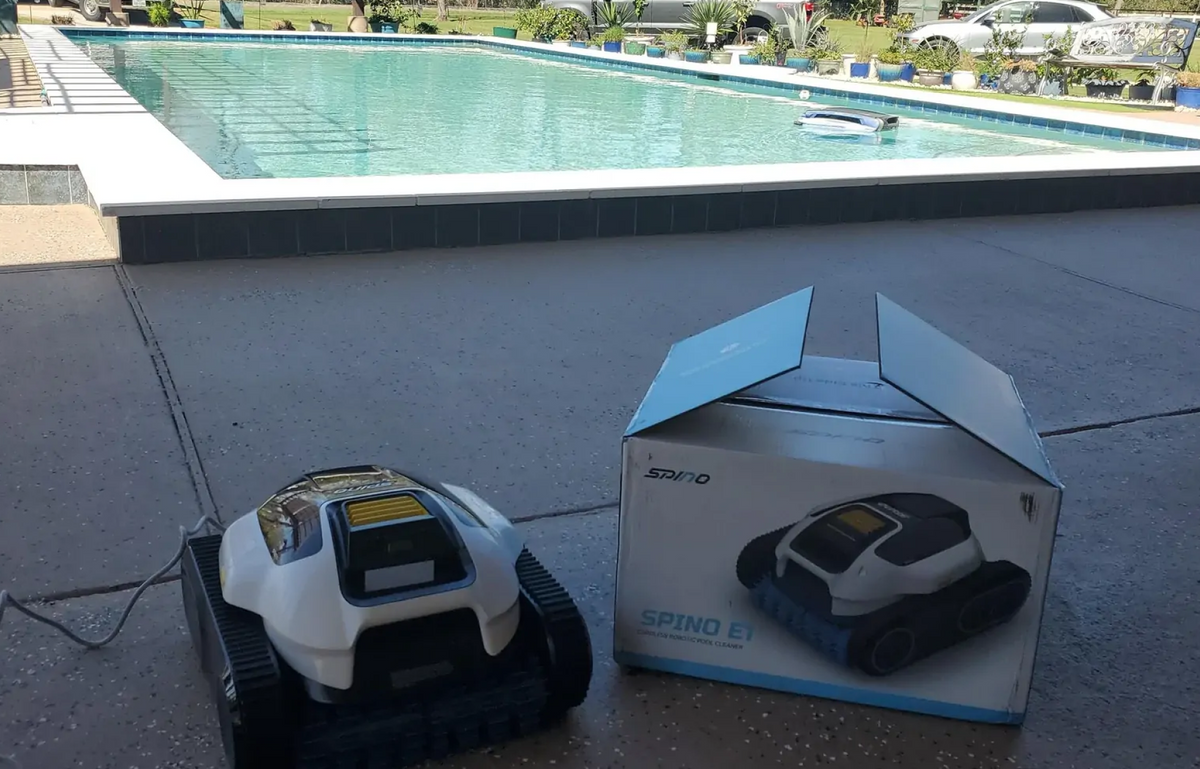
- Mammotion SPINO E1 — Best Overvalue Cordless Option
- Aiper Scuba S1 — Best Around $500
- Dolphin Premier — Best for Heavy Debris
- Polaris Freedom — Premium Cordless Alternative
- Beatbot AquaSense 2 Ultra — Best Premium Feature Set
- Aiper Scuba S1 Pro — Advanced Cordless Alternative
Inground Pool Vacuum Types: Which Pool Cleaner Should You Choose?
Inground pool owners typically choose between robotic, suction-side, pressure-side, and manual cleaners, with the best option depending on automation needs, existing pool equipment, debris, and required cleaning coverage.
Pool Vacuum Types Comparison Table
| Cleaner Type | Best For | Main Requirement | Main Trade-off |
|---|---|---|---|
| Robotic | Automated pool cleaning | Electrical power or battery | Higher upfront cost |
| Suction-side | Pools with compatible circulation systems | Suction connection | Uses the pool pump and filtration system |
| Pressure-side | Pools with compatible return-side equipment | Return/booster setup | May require additional equipment |
| Manual / handheld | Spot cleaning and small cleanup jobs | Manual labor | Least automation |
What You Need to Consider Before Buying
- For robotic pool cleaners, compare cleaning area, runtime, filtration, navigation, wall-climbing capability, charging time, and replacement parts.
- For suction-side pool cleaners, the key consideration is compatibility with your pool’s existing plumbing and equipment rather than the cleaner’s purchase price alone.
- For pressure-side pool cleaners, verify whether the cleaner requires a booster pump, dedicated return line, or other installation equipment before buying.
- Manual and handheld pool vacuums are most appropriate for occasional spot cleaning rather than fully automated routine maintenance.
Inground Pool Size and Shape: How Should You Match a Pool Vacuum?
Match an inground pool vacuum to your pool’s cleaning area, depth, shape, wall geometry, and obstacles rather than choosing a model based on pool volume or price alone.
How Does Pool Size Affect Pool Vacuum Selection?
A larger in-ground pool generally requires greater rated cleaning coverage and sufficient runtime to complete the required cleaning cycle without exceeding the cleaner’s specifications.
Check these measurements before buying:
- Pool cleaning area: Compare your pool’s approximate surface area with the manufacturer’s stated cleaning area.
- Runtime: Check how long the cleaner can operate in the cleaning mode you intend to use.
- Cleaning cycle: Some models specify a particular cycle length rather than continuous operation.
- Pool depth: Verify that your pool falls within the manufacturer’s stated operating depth.
Do not assume that a cleaner rated for a certain square footage will clean every pool below that number equally well. Pool geometry, obstacles, and cleaning mode can affect actual coverage.
Why Does Pool Shape Matter for an Inground Pool Vacuum?
Pool shape matters because corners, curves, transitions, steps, and irregular walls can make navigation and coverage more demanding than in a simple rectangular pool.
| Pool Characteristic | What to Check |
|---|---|
| Rectangular pool | Basic navigation and coverage |
| Freeform pool | Navigation capability |
| Curved walls | Wall-climbing compatibility |
| Multiple corners | Navigation and coverage pattern |
| Steps | Specific step-cleaning capability |
| Tanning ledges | Supported geometry |
| Sloped walls | Maximum stated wall angle |
A cleaner that performs well in a simple rectangular pool should not automatically be assumed to handle every freeform or multi-level pool.
Does Pool Depth Affect Robotic Pool Cleaner Compatibility?
Pool depth affects compatibility when the manufacturer specifies a minimum or maximum operating depth, so compare your actual water depth with the model’s published range before purchase.
Depth becomes particularly relevant for:
- Deep inground pools
- Pools with significant depth changes
- Models with specified minimum water depth
- Cordless cleaners with defined operating conditions
For example, Mammotion specifies a 23.62–118.11-inch water-depth range for the SPINO E1. That is a model-specific specification, not a universal range for robotic pool cleaners.
Reference Guide: How to Choose a Robotic Pool Cleaner: A Practical Buying Guide
Inground Pool Surfaces and Debris: What Should a Pool Vacuum Handle?
The right inground pool vacuum should match both the pool surface and the debris it needs to collect, because leaves, sand, pollen, and fine particles place different demands on filtration, brushes, traction, and debris capacity.
Common in-ground pool surfaces include: Vinyl, Fiberglass, Concrete, Tile, Pebble, or other textured finishes.
Surface compatibility matters most when you need wall climbing. A cleaner may be suitable for floor cleaning on a particular surface without necessarily being suitable for climbing every wall or transition on that surface.
What Is the Best Pool Vacuum for Leaves?
For pools with heavy leaf fall, prioritize debris capacity and intake design because a cleaner that collects large debris efficiently can require less frequent filter or basket emptying.
Check:
- Debris basket capacity
- Intake opening
- Filter design
- Ease of basket removal
- Manufacturer guidance for large debris
- Whether leaves can obstruct brushes or tracks
A pool surrounded by trees may generate substantially more debris than a pool in an open yard, so debris type and volume can matter more than headline suction specifications.
What Is the Best Pool Vacuum for Fine Dirt and Sand?
For fine dirt, sand, pollen, and other small particles, filtration becomes a primary selection factor, so compare the cleaner’s filter design and stated micron rating rather than relying only on suction or motor specifications.
| Debris Type | Specification to Prioritize |
|---|---|
| Large leaves | Debris basket capacity |
| Small leaves | Basket + intake design |
| Sand | Fine-debris filtration |
| Pollen | Filter design |
| Mixed debris | Filtration + debris capacity |
A lower published micron number can indicate finer filtration capability, but micron rating alone does not establish overall cleaning performance. Filter area, basket capacity, water flow, and the cleaner’s overall design also matter.
For any specific model, use the manufacturer’s stated filtration specifications and recommended maintenance procedures as the reference point.
Inground Pool Vacuum Coverage: Do You Need Floor, Wall, and Waterline Cleaning?
Floor cleaning handles the basic pool surface, while wall and waterline cleaning require specific capabilities, so buyers should verify each coverage type separately instead of assuming a cleaner labeled “full pool” reaches every area.
Can a Robotic Pool Cleaner Clean Pool Walls?
A robotic pool cleaner can clean pool walls only when the specific model is designed and rated for wall climbing, so check its stated wall capability, surface compatibility, and maximum supported wall angle.
Wall cleaning depends on:
- Traction
- Track or wheel design
- Wall angle
- Pool surface
- Waterline transition
- Debris accumulation
For example, Mammotion specifies that the SPINO E1 supports wall slopes of up to 110° and uses a 1.57-inch widened caterpillar tread. These are manufacturer-stated specifications for that model and should not be generalized to other robotic cleaners.
Can a Robotic Pool Cleaner Clean the Waterline?
A robotic pool cleaner can clean the waterline when the manufacturer explicitly lists waterline cleaning as a supported function; floor and wall coverage alone should not be interpreted as waterline coverage.
This distinction matters because the waterline is where:
- Oils can accumulate
- Sunscreen residue can collect
- Organic debris can settle
- Mineral deposits may develop
When comparing products, look specifically for “waterline cleaning” rather than relying on phrases such as “full pool cleaning.”
Inground Pool Vacuum Runtime and Filtration: Which Specifications Matter?
Runtime, filtration, and maintenance should be evaluated together because a longer battery rating matters only if the cleaner can cover your pool, while filter capacity and replacement parts affect its long-term practicality.
How Much Runtime Does an Inground Pool Vacuum Need?
The required runtime depends on your pool’s cleaning area, cleaning mode, navigation, and debris load, so compare the manufacturer-rated runtime with the coverage your pool actually requires.
For cordless robotic cleaners, check:
- Floor runtime
- Wall runtime
- Cleaning cycle length
- Charging time
- Rated cleaning area
- Battery capacity
For example, Mammotion rates the SPINO E1 for up to 210 minutes in Floor Mode and up to 180 minutes in Wall Mode, with approximately 3 hours of charging time.
Does a Higher Micron Rating Mean Better Filtration?
A micron rating describes the size of particles a filter is designed to capture, but it should not be used alone to determine overall cleaning performance because filter design, capacity, water flow, and debris load also affect results.
When comparing filtration, consider:
| Specification | Why It Matters |
|---|---|
| Micron rating | Indicates filtration particle size |
| Filter area | Affects filtration capacity |
| Basket capacity | Determines how much debris can be collected |
| Filter accessibility | Affects maintenance effort |
| Debris type | Determines the filtration requirement |
For example, Mammotion specifies a 180 μm filter basket for the SPINO E1. That number should be treated as the product’s stated filtration specification rather than an industry-wide ideal.
Best Pool Vacuums for Inground Pools in 2026: 7 Models Compared
The best inground pool vacuum depends on the pool conditions it needs to handle, so the comparison below prioritizes cleaner type, coverage, pool compatibility, runtime, filtration, and price rather than ranking every model by one performance claim.
| Specification | Mammotion SPINO E1 | Aiper Scuba S1 | Aiper Scuba S1 Pro | Dolphin Nautilus CC Plus | Dolphin Premier | Beatbot AquaSense 2 Ultra | Polaris Freedom |
|---|---|---|---|---|---|---|---|
| Cleaner Type | Cordless robotic | Cordless robotic | Cordless robotic | Corded robotic | Corded robotic | Cordless robotic | Cordless robotic |
| Price Position | Promotional price: $499 | $499.99 MSRP | $1,199.99 MSRP | $749 MSRP | $2,499 MSRP | $2,299 MSRP | $1,399 MSRP |
| Rated Pool Size | Up to 1,600 sq. ft. | Up to 1,600 sq. ft. | Up to 2,150 sq. ft. | Up to 40 ft. | Up to 50 ft. | Up to 3,875 sq. ft. | Verify current model |
| Floor Cleaning | ✓ | ✓ | ✓ | ✓ | ✓ | ✓ | ✓ |
| Wall Cleaning | ✓ | ✓ | ✓ | ✓ | ✓ | ✓ | ✓ |
| Waterline Cleaning | ✓ | ✓ | ✓ | — | ✓ | ✓ | ✓ |
| Maximum Runtime | 210 min floor | 180 min | 180 min | 2-hour cycle | 3-hour cycle | Up to 5 hr floor* | 150 min |
| Suction Power | 5800GPH | 3600GPH | 6000GPH | 4500GPH | 4500GPH | 5500 GPH | 5640GPH |
| Filter / Filtration | 180 μm | 180 μm + 3 μm MicroMesh | 180 μm + 3 μm | Ultra-Fine filter | Multi-layer filtration | 150 μm + 250 μm | Verify current model |
| Debris Basket | 3.5 L | 3.5 L | 5 L | Not specified | Not specified | 4L/3.7 L | 4L |
| Best Match | Value cordless | $500-class cordless | Larger/fine-debris pools | Established corded option | Multi-debris cleaning | Large premium pools | Premium cordless alternative |
Important: Specifications, prices, and included features can change by model year, retailer, and promotion. Product-page specifications should be verified immediately before publication.
Related Guide: Best Robotic Pool Cleaner 2026 (Top 5 Under $800 Tested & Reviewed)
How to Use This Comparison Table
The most important columns are rated pool size, cleaning coverage, runtime, filtration, and price because these specifications determine whether a cleaner actually fits your pool rather than simply making one model look more advanced.
For example:
- A 1,600 sq. ft. pool does not automatically require a $2,000+ cleaner.
- A pool with substantial wall and waterline cleaning needs should be matched to a model that explicitly supports those areas.
- A pool surrounded by trees may benefit more from debris capacity and filtration than from maximum suction alone.
- A cordless cleaner should be evaluated using runtime + charging time, not battery capacity alone.
- A premium cleaner is easier to justify when its additional capabilities solve a specific pool-maintenance requirement.
Do not rank these cleaners by suction GPH alone. A higher GPH number does not automatically establish better overall pool cleaning because navigation, brushes, filtration, debris capacity, wall traction, cleaning coverage, and runtime all affect suitability.
For example, the Aiper Scuba S1 Pro lists 6,000 GPH, while the Dolphin Premier lists 4,500 GPH; those figures are useful specifications, but they are not by themselves a valid “winner” test.
Inground Pool Vacuum Buying Guide: Which Cleaner Is Best for Your Pool?
The best inground pool vacuum is the lowest-cost model that meets your pool’s actual requirements for coverage, surface, debris, runtime, and maintenance, rather than simply choosing the model with the highest suction rating or most expensive feature set.
Choose by Pool Condition, Not by Brand
Use your pool’s physical conditions as the first filter, then compare products that meet those requirements.
| Your Pool Situation | What to Prioritize | Models to Consider |
|---|---|---|
| Small or simple inground pool | Floor coverage, value, simple maintenance | Dolphin Nautilus CC Plus, Aiper Scuba S1 |
| Up to ~1,600 sq. ft. | Rated coverage + runtime | SPINO E1, Aiper Scuba S1 |
| Large pool | Cleaning area + runtime | Aiper Scuba S1 Pro, Beatbot AquaSense series |
| Heavy leaves | Debris capacity + accessible filter | Aiper Scuba S1 Pro, Dolphin Premier |
| Fine dirt or pollen | Fine filtration + filter capacity | Dolphin Premier, Aiper Scuba S1 Pro |
| Wall buildup | Wall-climbing capability + traction | SPINO E1, Dolphin models with wall cleaning |
| Waterline buildup | Explicit waterline-cleaning specification | SPINO E1, Dolphin Premier, supported premium models |
| Freeform pool | Navigation + coverage | Advanced robotic models |
| Want no cable | Battery runtime + charging time | SPINO E1, Aiper, Beatbot, Polaris |
| Want established corded equipment | Proven corded platform + pool compatibility | Dolphin |
Current 2026 comparison coverage shows that the market is increasingly segmented by pool size, cleaning coverage, filtration, cordless operation, and automation, rather than by one universal “best” model.
Use This Final Buying Checklist
Before purchasing an in-ground pool vacuum, confirm these 7 specifications:
The best pool vacuum is therefore not necessarily the most expensive or the most powerful model. It is the model whose documented capabilities cover your pool with the fewest compromises in runtime, maintenance, and cleaning coverage.
FAQ: Best Pool Vacuums for Inground Pools
For most inground pools, robotic pool cleaners are a strong choice when you want independent automated cleaning, but the best model depends on pool size, debris, required coverage, and budget. Current 2026 comparison results frequently position robotic cleaners as the leading option for general inground-pool cleaning.
Robotic pool cleaners are generally better suited to owners who want independent operation and broader automated coverage, while suction-side and pressure-side cleaners remain useful when existing pool equipment or heavy debris makes those systems more appropriate.
Most residential pools can start with about 2–3 cleaning cycles per week, increasing toward daily cleaning during heavy pollen, leaf-drop, or high-use periods. There is no universal schedule because debris load, pool use, weather, and season all affect the required frequency.
A standalone robotic pool cleaner generally does not require the main pool pump to operate because the robot has its own motor, pump, and filtration system. This is one of the main differences between robotic cleaners and suction-side or pressure-side systems.
Some robotic pool cleaners can clean walls and the waterline, but these capabilities are model-specific and should be confirmed separately before purchase. A robot that cleans the floor and walls should not automatically be assumed to provide waterline cleaning.
Large inground pools generally benefit from a cleaner with a sufficiently high manufacturer-rated cleaning area, long runtime, or unlimited corded operation. Current 2026 comparisons also recommend considering corded robots when pool size makes cordless runtime a potential limitation.
Many robotic pool cleaners are designed for residential saltwater pools, but saltwater compatibility should be confirmed for the specific model before purchase. Salt exposure can also make routine rinsing and proper storage more important for long-term equipment care.
It is generally better to remove a robotic pool cleaner after its cleaning cycle, rinse the filter and cleaner as recommended, and store it according to the manufacturer's instructions rather than treating the robot as permanent pool equipment. Manufacturer guidance should take priority because storage recommendations vary by model.
A robotic pool cleaner can be worthwhile when it reduces recurring manual cleaning and provides coverage that matches your pool, but the value depends on purchase price, maintenance, replacement parts, cleaning frequency, and how much of the pool it can actually clean. Current comparison guides consistently treat cost and pool-specific requirements as major decision factors.
Did you like this article? Add us as a preferred source to find us more easily on Google.